
Book Review: "Reliable Essays" by Clive James (Part 2)
2.5/5 - Some bad opinions about Nabokov, sarcasm in Rome and to end, some classic misogyny directed at Marilyn Monroe

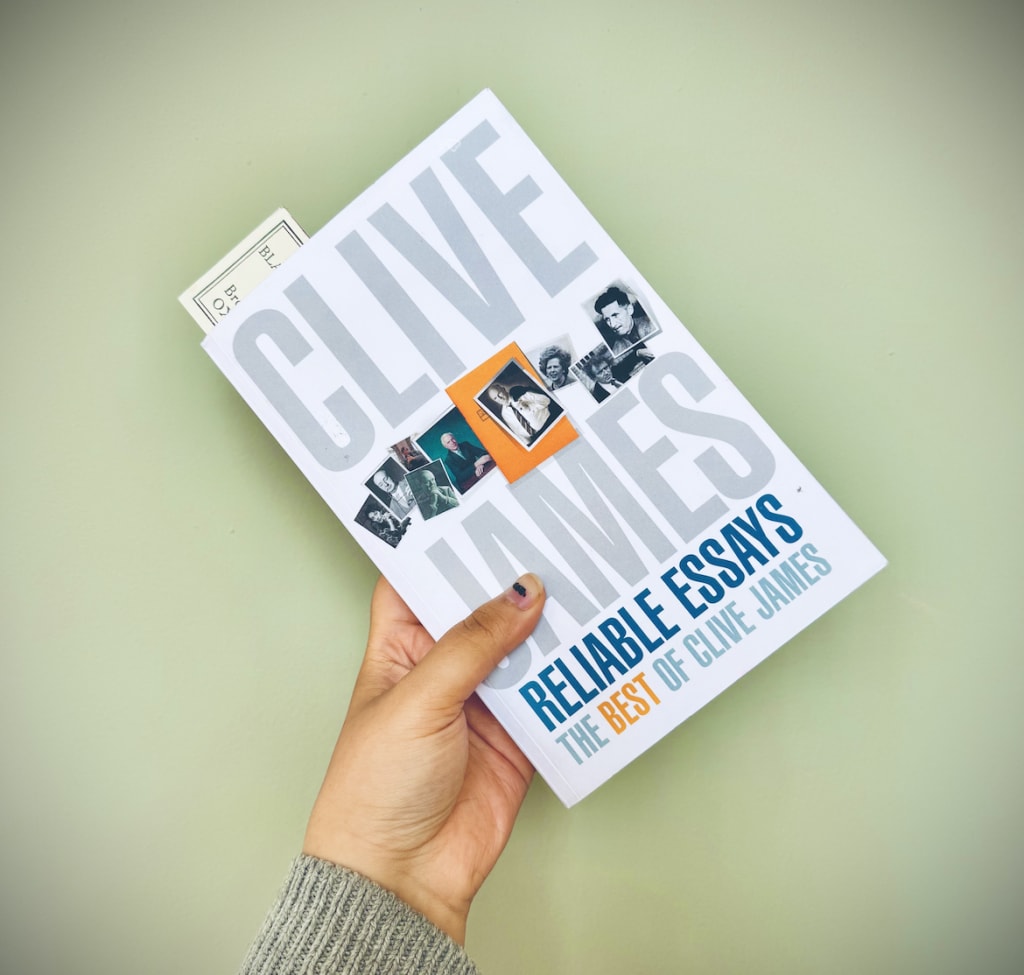
Welcome to Part 2 of the series on "Reliable Essays" by Clive James. Again, we are not going to cover every single essay but the ones I believe are the most important to talk about will be featured here. It was split into parts because it simply ended up being too long. Here, we will see covered the articles on Vladimir Nabokov, Travelling to Rome and Norman Mailer's book on Marilyn Monroe. There will be a Part 3 in which we will see Primo Levi and Adolf Hitler.
Book Review: "Reliable Essays" by Clive James
(Part 2)
Nabokov's Grand Folly

"Nabokov was incapable of being anyone's servant"
It's clear that many of the things that Clive James says about Vladimir Nabokov are not, strictly speaking, very nice. The whole article is about how Nabokov translated Puskin in a weird and, according to James, terrible way. Again James states that Nobokov's biggest crime in the translation is making Pushkin sound like Nabokov rather than like Pushkin. Having read this translation in question, I can say that James might be half-right about this.
"Nabokov's theory of translation was based on 'humble fidelity' to the original, yet try as he might to give us nothing more pretentious than a word-for-word equivalent, he still managed to make Pushkin sound like Nabokov."
It is weirdly worded, I know. But to call Nabokov pretentious I think is a mistake. Unlike the previous section reviews in which Clive James shows his talents for analysing Orwell and Waugh, I think he regularly misses the point when it comes to Nabokov and perhaps dislikes the sentimentality in his writing enough to write this article in a more mean-spirited manner. The tone is by far, more sarcastic and less appreciative and understanding than his article about Evelyn Waugh. However, I think we can all agree that though Waugh's novels were great, the man was in fact a horrid human being by most accounts. For example: portraying Nabokov as making Pushkin "sound like a Scrabble buff" doesn't really mean anything when you actually read the translation of Eugene Onegin and just gives off the tone of being rather mean.
He tears through Nabokov's language use, stating things such as "Nabokov keeps saying 'mollitude' where either 'bliss' or 'languor' would have done" and shows he doesn't really understand Nabokov's performance as a writer. Nabokov is, in fact, that writer who will use the word that may not be exact, but does have the quality of being hand-selected by Vladimir Nabokov himself. I mean, just read the book Nabokov's Favourite Word Is Mauve and it will explain the idea to you in a more playful way. Though, being released only a couple of years before Clive James died - I doubt he read it. Be that as it may, he is still quite mean about Nabokov's ability to write even though this is an article about translation - they are two very different skills.
"The sad thing about Nabokov's translation is that he is not really capable of echoing such a quality."
Even though we've established that this is an article about translation, Clive James makes regular jabs at Nabokov's writing talent. He also makes it clear that Nabokov's ability to write is tied in with this individual translation when it is known that Nabokov translated quite a bit of work including a Russian translation of Alice's Adventures in Wonderland - and you don't translate that mind-bending children's novel without knowing a thing or two about what you're doing.
"The idea behind using 'mollitude' is evidently to convey something of the Russian word's Frenchified feeling. But 'mollitude' does nothing to make the English reader think of French influence. It just makes him think about the weight of the OED."
So he has basically admitted that this word perhaps, was not used for the English reader to fully grasp but rather the multilingual one, like Nabokov himself? It is not known what message Clive James is trying to convey as he kind of tells on himself like this throughout the course of the article. It's also hard to agree with him, but at the moment it is still like a healthy disagreement - a conversation of ideas. Yes, we have seen some quotations that are a bit mean-spirited, but when we get on to Norman Mailer's Marilyn being reviewed, we will see Clive James really get nasty about things. Especially when it comes to his implied opinions about women, which are not very nice at all.
I find it rich that Clive James has managed to say some quite horrid things about Vladimir Nabokov whilst also berating Nabokov for having some adverse opinions about Fyodor Dostoevsky. I do not agree with Nabokov's opinions about Dostoevsky, but after this near-rant by Clive James, it should be permissable. Apparently, only Clive James is allowed an opinion about writing.
"Calling Dostoevsky a 'much-overrated sentimental and gothic novelist' is dull if it is meant to be funny and funny if it is meant to be serious. We are told that Balzac and Saint-Beuve are 'popular but essentially mediocre writers'...I am reasonably familiar with Saint-Beuve and if he is a mediocre writer then I am a monkey's uncle."
I mean, I get it - he's getting defensive about his opinions. But if he's going to write his own then other people are allowed theirs. However, they are both wrong and Dostoevsky is great and I love some of Nabokov's works. Balzac is also pretty good - sometimes.
The article ends with quite a snarky remark about Nabokov's translation of Pushkin and where that puts Nabokov himself as a writer of the same tradition - which we have to remember, Nabokov was not.
"A doomed attempt and a superfluous one, since by pointing to the source of its literary tradition Nabokov has helped remind us of the Russia that really is undying, and in which his place is now secure."
This is clearly not meant to be a compliment.
Postcard from Rome

Thankfully, Clive James' work on his trip to Rome which didn't go quite as planned seems to be a much better read even though it has the same biting nature trapped within the tone. It isn't misdirected at someone though and it seems to also be balanced around the idea that he himself was quite bitter about the experience.
It starts with James going to the airport and analysing the idea of the British transport industry. It is quite funny and has that edge that made his analysis of Waugh quite readable though also sarcastic:
"In England, British Rail loudspeakers had been smugly announcing prolonged delays due to locomotives coming into contact with inexplicable meteorological phenomena, such as heaps of water lying around in frozen form. Airport officials were equally flabbergasted to discover more of the same stuff falling out of the sky."
I think every British person can relate to this. Traveling during winter is absolutely terrible to experience because everything is cancelled. Clive James uses his witty tone hinted with the same sort of mean-spirit to direct our gaze towards the very idea of what it means to be British in the winter. It is probably much better than his article on Nabokov's translations.
He does the same when it comes to his experience of Rome. He takes us through where he lives and the way in which there was a spiral staircase. It is both picturesque but also kind of ridicolous. I imagine a sort of Roman Gosford Park styled situation here. He proves he can actually be funny when he really wants to be, without having the mean spirit underline it.
"You had to apply in writing to take a bath. Lunch was half a plate of pasta on the other side of the Tiber. Dinner was the other half."
He does get away with being particularly mean about his experience because of the fact it is not directed anywhere or at anyone in particular. But apart from this, he also echoes the tone he portrayed in The All of Orwell in which he set up something that was quite serious and profound. He desperately wanted the reader to think about what they were reading and we can say that he does the very same in parts of Postcard from Rome through the more sensitive topics he takes on.
"In the Catacombs of Domitilla, for example, more than 100'000 people were buried but only seventy of them came down to modern times with any identity beyond that conferred to the heap of powder their bones turned into when touched by air."
He describes going to a number of different places in the country, looking at how Italy's history (even as modern as the fascist government) are reflected in the various pieces of the city of Rome and further. When he walks around Rome, he admits something that many of us seem to think about it as well whether or not we have actually been there ourselves.
"Everything and everywhere in and around Rome is saturated with time. If you look too long, you will be hypnotised."
Apart from the weird side narrative about Sophia Loren's movie that flopped, there are some snarkier remarks throughout the piece as well. These are usually done in good humour but in some readings, could sound classist. But let's investigate what you think about it. In my opinion there are these two ways of viewing it, however there is probably a deeper propensity to view this in the other way because of who Clive James was. The tone is a bit off as well, so it doesn't help him to just be snarky and get away with it.
"The audience in the stalls consisted mainly of the Roman bourgeoisie. They behaved like pigs. A man near me recited the whole plot to his deaf wife while she ate chocolate which apparently been wrapped in dead leaves. The stalls were empty before the curtain calls were half over. But the gallery went crazy with gratitude."
Yes I know what you're going to say: how is that classist? Well, the idea that this entire crowd was known to be bourgeoisie is one thing (perhaps they were rich, but they don't have to all be bourgeoisie. The implication of that is really a reverse calling that is more on the culture of the Romans) but the other thing is comparing a whole culture to being a set of pigs even if you are referring to a bourgeoisie set is weird. It reeks of the entitlement which usually plagues the British when they go abroad. It is on par with when a native waiter of another country does not understand the British person making a food order and so the British person speaks in a way that is almost arrogantly slow - acting as if they have been hindered on their holiday by this person who cannot understand English properly.
He is, however, good at making these profound observations about Rome which happen to be like lifting up a curtain put over the city by the travel industry.
"Rome produces little. For a long time it has been a consumers' town. Even the Renaissance was produced in Florence and consumed in Rome. Bringing Michelangelo to Rome was like bringing Tolstoy to Hollywood."
He goes on to talk about the empire, perhaps inspired by the history that was around him. He looks at crowds and atmosphere, describing things within, often admitting that the "Roman Empire died of success." Observations on Livy litter the page and more than often do nothing but show us how well read Clive James actually is - as if he is constantly trying to remind us or else he fears he will come off as just a bitter guy about it all.
He gets carried away a little with the artisitic and literary references. We were halfway there with the Tolstoy/Michelangelo comparison, three-quarters of the way there with Livy and now, there's Bernini.
"In the Piazza Navona I found the Bernini fountains plump with ice, like overfilled tubs of lemon gelato."
It's a bit weird to imagine the colour that might be. However, I find the comparison of frozen ice to lemon gelato to be even weirder. Read here: a comparison of frozen water to... more frozen water. I get it, it just isn't as clever as we think it is upon first reading. It sounds nice, but it means nothing.
He tosses in the fact that "[Raphael] of Urbino was once here" which we all kind of knew anyway but it helps to make yourself look intelligent especially when you've just slated another culture's theatre sector in order to get some sway, persuading people you know what you're talking about more than the other 'pigs' in the stalls. He finishes of course, with the one whose name was writ in water - John Keats.
"The Spanish Steps were a cataract. Climbing them like an exhausted salmon, I passed the window of the room in which Keats coughed up the last hours of his short life with nothing to look at except a cemetery of time."
By the time he leaves Rome, the reader is exhausted with him.
Mailer's Marilyn

I have some gripes with this article because it is suggestively misogynistic towards actresses of the 1950s and 60s, but then again, it is also giving Norman Mailer a hard time. However, Clive James does admit he did Mailer dirty in the article - he does not take back what he says about Marilyn Monroe which is mostly his own opinion. I will accept his opinion, but in no way to I agree with it and I will explain why.
Clive James makes his first stement not about Mailer's book but about the character of Marilyn Monroe. He is absolute in his stance that she was not a talented actress but rather just a pretty face. This implies a lot of the remarks that Clive James will make about Doris Day and other classic actresses later on - some which are rather anti-woman. I am not saying the man is a woman hater, but I think he really discounts the talents of these women to get people in their seats for the cinema experience which was still a climbing situation during the decade of which Marilyn Monroe belongs to.
He admits that the "camera was desperately in love with her" but then goes on to say the following, which to any cinema fan is simply wrong:
"As far as talent goes, Marilyn Monroe was so minimally gifted as to be almost unemployable, and anyone who holds the opinion that she was a great natural comic identifies himself immediately as a dunce."
So, what we are being led to believe that is Clive James is allowed to have an opinion about someone who is very clever better than him, but Norman Mailer is not allowed to have a different opinion? Well, that is what he is suggesting, not me. He is someone who later on the same page will call Norman Mailer's book a "embarrassing...rush job", which if you have read the book is simply not true at all. I would in fact, call it a tribute and a fitting one to a woman who basically was Hollywood.
However, we can forgive him for the sort of weird comparison he makes from Mailer to Marilyn as being something like Dante and Beatrice, or even Patrarch and Laura. Which is incorrect even though it sounds nice. I do not think that there was an entire cultural following of Dante's Beatrice until long after the publication of the Paradiso and then even more so after the works of Dante Rossetti, solidifying her as a pastel-faced red-head. I think he (even though he is one himself) forgot that he was painting an Italian.
I think my main gripe, as you know is with the way that Clive James has this weird hatred for Marilyn Monroe which takes over from the fact that this is supposed to be a book review of Mailer's book about her. James refers to Marilyn Monroe as a "dumb tomato" and I don't exactly know what kind of insult that is, but it seems to be the very fact that Marilyn often leant into the media's image of portraying her as a 'dumb blonde' in order to swindle money out of the same people - and also because it is objectively funny to do so. If anything, it was a very clever career move.
He simply does not understand her acting talent or her career trajectory and shows this clearly in his analysis of her films:
"He is quite right to talk of Some Like it Hot as her best film, but drastically overestimates her strength in it."
Putting this down to not getting on with her co-stars is an oversimplification because there are many great actors who are stated not to get on with their co-stars in a movie that turns out to be very good due to their methods. Sir Daniel Day-Lewis on the set of the phenomenal My Left Foot comes to mind - most of the other actors loathed his method. But it went on to become one of the greatest films of the 20th century. False dichotomies aren't a good look for someone who is supposed to be an articulate man of letters and reading.
He will later refer to the women of Hollywood as "cosmeticised androids" which were "crawling" all over the screens of the 1950s and 1960s, taking down some insult towards Doris Day's face and how Audrey Hepburn was 'supposed to be class'. He takes down Carole Lombard and a woman known as one of the greatest actors to ever live: Katharine Hepburn. At this point, it is clear that Clive James has absolutely no idea what he is talking about and therefore, as they say on social media: his opinion is invalid.
But see hear, when Mailer delivers some harsh words for Laurence Olivier, Clive James is the first to defend Olivier against this judgement because apparently, leading men of this Hollywood era he hates so much can perhaps, do no wrong. But I think that Marilyn Monroe and Laurence Olivier were both equally pretty bad in The Prince and the Showgirl - I think it might have been the writing.
There's something that reeks of misogyny in the whole article. It is less about Mailer's book and more Clive James' rant about successful women who were able to capitalise off their looks and their talent at the same time.
I would hate to hear his opinions (if he has read any) of literary women.
Conclusion
As you can tell, I wasn't that keen on most of this and so, it has earned itself lower marks. I hope you stick around for the final part - part 3.
About the Creator
Annie Kapur
I am:
🙋🏽♀️ Annie
📚 Avid Reader
📝 Reviewer and Commentator
🎓 Post-Grad Millennial (M.A)
***
I have:
📖 280K+ reads on Vocal
🫶🏼 Love for reading & research
🦋/X @AnnieWithBooks
***
🏡 UK
Keep reading
More stories from Annie Kapur and writers in Geeks and other communities.
Book Review: "Reliable Essays" by Clive James (Part 1)
Disclaimer: This is Part 1 of a series of reviews of "Reliable Essays" by Clive James. Here, I feature the author's note, the introduction, George Orwell and Evelyn Waugh. In the next part of the series, you will find: Nabokov, Travel Writing of Rome and Norman Mailer on Marilyn Monroe.
By Annie Kapur9 months ago in Geeks
The Rachels - 2025
Much to my surprise, I have kept a list of the films I‘ve seen this year. I daresay it isn’t complete. There will be films that snuck in on a late night in front of the TV that I would’ve forgotten to note. Or others, that I went to watch at the cinema, but then had a red wine and promptly forgotten about. But it’s not a bad approximation of the films I’ve seen this year. In total, there are 53 films listed, so an average of one a week and one for good luck.
By Rachel Robbins20 days ago in Geeks
Karl Ove Knausgaard, Niall Williams, Daniyal Mueenuddin, and More: 21 New Books Out Today
Book lovers, rejoice! Today marks the release of an impressive lineup of new titles from some of the world’s most celebrated authors. From literary fiction to compelling memoirs, these 21 new releases promise to entertain, provoke thought, and transport readers across time and continents. Whether you are a long-time fan of Karl Ove Knausgaard’s deeply introspective prose, intrigued by Niall Williams’ evocative storytelling, or captivated by Daniyal Mueenuddin’s vivid portrayals of Pakistan, there’s something in this batch for every type of reader.
By Fiazahmedbrohi 2 days ago in Geeks


Comments
There are no comments for this story
Be the first to respond and start the conversation.