
Book Review: "Quiet Days in Clichy" by Henry Miller
4/5 - Paris: a love letter, a critique and an observation...

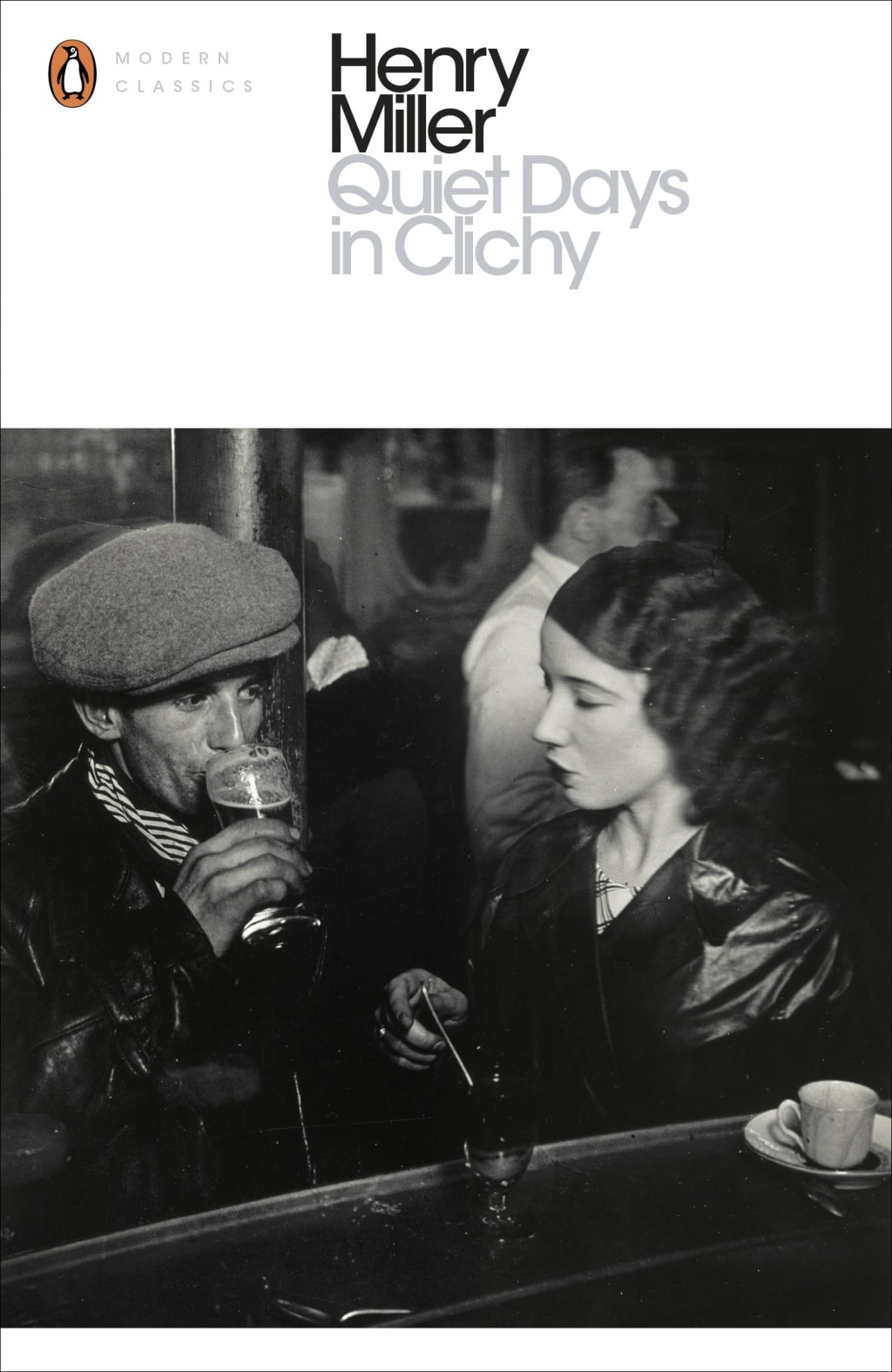
“Quiet Days in Clichy” I have to admit, is not one of Henry Miller’s best works but it is still something to be admired amongst the general realm of literature in which love letters are written to and about cities and places. In this text by Henry Miller, there is a general sense of awe pervading Paris and yet, something about it always seems a bit overly-romanticised. As if Henry Miller is really trying to make up for what the city lacks in substance, he builds up in stylistic writing and romantic images that require pastel-coloured backgrounds and berets sitting in a cafe somewhere in order to be full appreciated. I’m not saying that this is not a good idea, but what I am saying is to take this picture of Paris for what it is - a piece of art. It is not a representation of a city which is now basically in ruin and has been for a very long time. The contrast from New York to Paris is never really made definite upon the personalities within both with New York obviously having the more progressive types of people. Be that as it may, we cannot take away from the fact that the city of light has become of central importance to Henry Miller over the course of many texts of his and that it has served him well. One thing I have to say as well is that he makes this city, that is no longer in its prime, out to be something far greater than it is - and that is a skill, not a fault.
Let us take a look at some quotations that I thought were especially telling in this book. Obviously, we will start with the opening quotation for the sake of hanging on to reason for writing in Miller’s own mind:
“As I write, night is falling and people are going to dinner. It’s been a gray day, such as one often sees in Paris. Walking around the block to air my thoughts I couldn’t help but think of the tremendous contrast between the two cities. It is the same hour, the same sort of day and yet even the word gray, which brought about the association, has little in common with that gris which to the ears of Frenchmen, is capable of evoking a world of thought and feeling. Long ago, walking the streets of Paris, studying the watercolours on exhibit in the shop windows, I was aware of the singular absence of what is known as Payne’s gray. I mention in because Paris, as everyone knows, is pre-eminently, a gray city. I use this made-to-order gray excessively and obsessively. In France, the range of grays is seemingly infinite; he the very effect of gray is lost.”
Even the gray of Paris is romanticised as being a different and almost philosophical type of gray. It is almost as if Miller is trying to make us believe that there is something beautiful and deep about the gray of Paris compared to the gray of everywhere else.
“On the gray days, when it was chilly everywhere except in the big cafes, I look forward with pleasure to spending an hour or two at the Cafe Wepler before going to dinner. The rosy glow which suffused the place emanated from the cluster of whores who usually congregated near the entrance. As they gradually distributed themselves among the clientele, the place became not only warm and rosy but fragrant. They fluttered about in the dimming light like perfumed fireflies. Those who had not been fortunate enough to find a consumer would saunter slowly out to the street, usually to return in a little while and resume their old places. Others swaggered in, looking fresh and ready for the evening’s work. In the corner, where they usually congregated it was like an exchange, the sex market, which has its ups and downs like other exchanges. A randy day was usually a good day, it seemed to me. There are only two things you can do on a rainy day as the saying goes, and the whores never wasted time playing cards.”
There is something brutal and raw about his writing here that you rarely see in other quotations. When he talks about the whores he really does make this juxtaposing image of Paris as a romance city and Paris as every other city come alive in these few minutes of analysis. For a book that is written with average zeal for Henry Miller, this quotation solidifies its marks in my books.
About the Creator
Annie Kapur
I am:
🙋🏽♀️ Annie
📚 Avid Reader
📝 Reviewer and Commentator
🎓 Post-Grad Millennial (M.A)
***
I have:
📖 280K+ reads on Vocal
🫶🏼 Love for reading & research
🦋/X @AnnieWithBooks
***
🏡 UK
Keep reading
More stories from Annie Kapur and writers in Geeks and other communities.
A Filmmaker's Guide to: Trailers
In this chapter of ‘the filmmaker’s guide’ we’re actually going to be learning about literature and film together. I understand that many of you are sitting in university during difficult times and finding it increasingly hard to study and I understand that many of you who are not at university or not planning on it are possibly stuck of what to do, need a break or even need to catch up on learning film before you get to the next level. This guide will be brief but will also contain: new vocabulary, concepts and theories, films to watch and we will be exploring something taboo until now in the ‘filmmaker’s guide’ - academia (abyss opens). Each article will explore a different concept of film, philosophy, literature or bibliography/filmography etc. in order to give you something new to learn each time we see each other. You can use some of the words amongst family and friends to sound clever or you can get back to me (email in bio) and tell me how you’re doing. So, strap in and prepare for the filmmaker’s guide to film studies because it is going to be one wild ride.
By Annie Kapur5 years ago in Geeks
Silver Screen Magic with Mae West
American actress and singer Mae West became a popular film actress during the Great Depression. She started entertaining in vaudeville, then performed on Broadway, and finally went to Hollywood. She signed up with Paramount Pictures and made her debut in the 1932 film “Night After Night.” She also starred in musicals, comedies, and crime dramas. The American Film Institute named her one of the best classic Hollywood actresses.
By Rasma Raisters4 days ago in Geeks
Emma Watson, Sir Lenny Henry and Sir Elton John lead British Diversity Awards
The prizes will be handed out at a glittering ceremony in London on March 25 2026 and Harry Potter actress/activist Watson will compete with Henry and John for the top gong of Media Personality of the Year with the musician competing alongside his husband David Furnish.
By Dena Falken Esq2 days ago in Geeks



Comments
There are no comments for this story
Be the first to respond and start the conversation.