
Book Review: "Pseudoscience: A Very Short Introduction" by Michael D. Gordin
4/5 - an interesting little book in which the author does not pass nasty judgements...

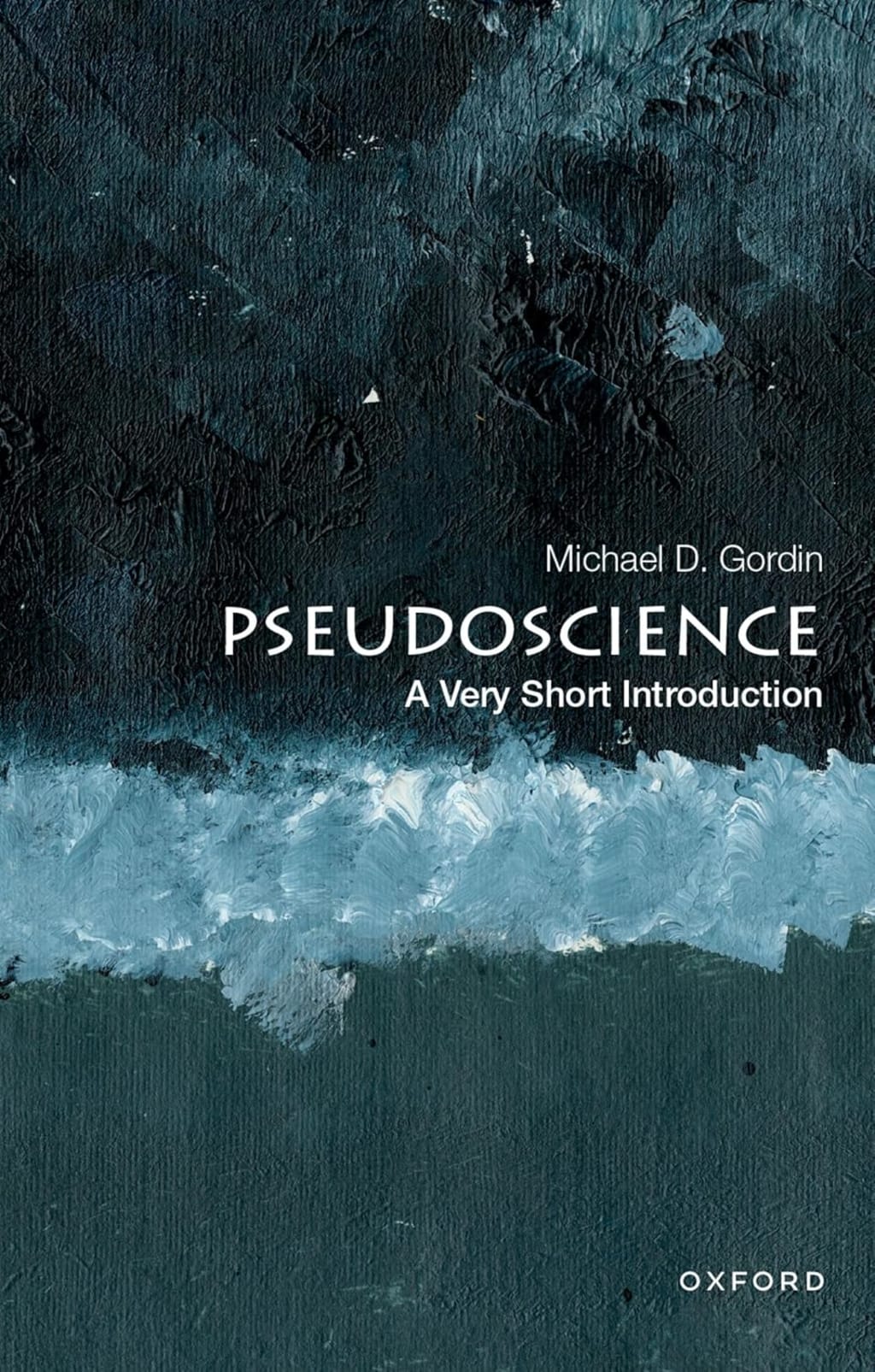
If I've said it once, I've said it a thousand times: I love free books. I also love dipping my toes into the Very Short Introduction series, especially when I'm between bigger books. I've read those on Biblical History, I've read some on philosophy and now this one, is on pseudoscience. From UFOs to Anti-Vaxxers, from eugenics to how the Russians basically made up their own science during the height of communism, from the planets to the human body - pseudoscience is everywhere. But what is it, where did it come from, and what are the different forms it can arise in? Well, the truth is that pseudoscience is just as old as science itself...
One great point he starts off by making is that there is really no such thing as pseudoscience, instead there are just fringe scientific theories that, if there was no experimenting, wouldn't exist. The only issue is that only a few of these fringe theories have made it into the public consciousness and only a few of them are also now part of mainstream and respected science. The author states that the main issue is that loud and very fringe voices tend to get the most attention whereas, more robust and clinical scientific research doesn't get noticed that much.
This leads to a community of scientists who are basically trying to do the equivalent of 'go viral' in the science world. They want the fame, they want to be reported on, they want the attention and so, they end up fudging or even entirely making up experiments and results. This is definitely something we have seen in the book May Contain Lies by Alex Edmans. Even in recent years, we have found that many science papers which claimed to have run experiments did not, in fact, run any experiments. This is why, the author states, the science cannot be replicated in some cases.

Another point the author makes is that the belief in pseudoscience is contextual. It depends on place, time, ideology, people etc. For example: the West no longer believes in astrology that much, but once upon a time it was a very prominent way of testing whether something was going to work out or whether the whole thing would sink. However, the East in some cases, still to this day, relies on astrology to plan wedding dates and business ideas, looking to the stars to determine what may happen to someone.
We go through the way in which UFOs were first studied and then, the debunking process. We get insight as to how, after the secrecy of what was going on in Vietnam, the trust in the American Government to tell its people the truth decreased dramatically. This gave rise to the conspiracy theories that came out of the UFO movement spearheaded by the fact that back when the Roswell Incident took place in the 40s (several years before the rise of the UFO movement), the government was proposing multitudes of reasons for what had happened.
On the other hand, the author shows us that initially theories that were proposed by Einstein and the rest of our great scientists from history were initially fringe theories, they seemed very out-there. But, with perseverance and time, they are now accepted as scientific fact. It is great to learn about the weirdos who once supported eugenics yes, but it is also important to remember that not everything that is fringe is completely stupid, some of the fringe beliefs can run into becoming science over time. This is something that the author wants to make clear because, if we are to tighten restrictions on scientific publication - we could lose the good fringe theories, which obviously means science progresses slower and sometimes, people die in the process.
To conclude, I have to say that this book was actually quite enjoyable as the author didn't try to make anyone out to be a nutcase, instead he explained where these ideas come from and how they germinate and spread - even the ones in which people do look like nutcases. I was quite surprised at how nice he was being about it, but I understand that when there are fringe theories, there is going to have to be a lot done to prove that they are worthy enough for mainstream science to accept it.
About the Creator
Annie Kapur
I am:
🙋🏽♀️ Annie
📚 Avid Reader
📝 Reviewer and Commentator
🎓 Post-Grad Millennial (M.A)
***
I have:
📖 280K+ reads on Vocal
🫶🏼 Love for reading & research
🦋/X @AnnieWithBooks
***
🏡 UK
Keep reading
More stories from Annie Kapur and writers in Geeks and other communities.
Book Review: "Time After Time" by Chris Atkins
I'm quite interested in the prison systems across the world and how they work. Back when I read Let the Lord Sort Them a few months ago, I was surprised at how horrifying the American death row system actually was and how often it got things wrong and that doesn't just mean that they executed the wrong person - it means that the system is definitely rigged against some. Chris Atkins though, writes about the British prison system, where the death penalty thankfully doesn't exist (I don't trust the government to make the correct decisions on whether prisoners live or not). But there are so many damn things wrong that if you're not angry, then you're not paying attention. The British Government, no matter who is in charge, is the biggest joke in the country.
By Annie Kapura day ago in Geeks
Silver Screen Magic with Mae West
American actress and singer Mae West became a popular film actress during the Great Depression. She started entertaining in vaudeville, then performed on Broadway, and finally went to Hollywood. She signed up with Paramount Pictures and made her debut in the 1932 film “Night After Night.” She also starred in musicals, comedies, and crime dramas. The American Film Institute named her one of the best classic Hollywood actresses.
By Rasma Raisters8 days ago in Geeks


Comments
There are no comments for this story
Be the first to respond and start the conversation.