
Book Review: "Paris was Yesterday: 1925-1939" by Janet Flanner
5/5 - an immersive and beautiful book of vignettes concerning the most and the best of her generation...


This is one of the books where I sat there reading the provided sample online and when I got to the end, I quickly went to look it up on Amazon so I could carry on reading it. Unfortunately, it was a little out of my current price range and so, I started to scroll around until I found the "used" button. For only about £1 or so, I could get the book on free delivery as well. Doing the little cartoon Grinch grin to myself, I hit the buy button but told myself I would still have to wait for a while before I actually received the book. Upon receiving it though, I went right back to the beginning, starting all over. And reader, I breathed it in...
The book opens with Flanner’s reflections on Paris in the 1920s, a city recovering from the devastation of World War I but still brimming with energy and optimism. The streets of Paris, as Flanner describes them, pulse with life, from the cafés of Montparnasse to the bohemian enclaves of the Left Bank. Flanner captures the intoxicating mix of tradition and modernity, as the city, while steeped in its historical grandeur, embraces new artistic and cultural movements. She presents Paris not simply as a backdrop but as an active participant in the era’s transformative changes, a microcosm of broader societal shifts. One of the things I loved about the introduction is how infatuated she is with books like A Moveable Feast, referring to Hemingway's death as his "mortal liberation", and then talking endlessly about Ulysses and the classic little bookstore where Gertrude Stein once worked.

A significant portion of the book is dedicated to the expatriate American writers and artists who made Paris their home during the so-called “Lost Generation” era. Flanner’s portrayal of figures like our friend Ernest Hemingway, the Jazz Age's F. Scott Fitzgerald, and the fantastic Josephine Baker is both affectionate and unflinching. She delves into their creative endeavours, their personal struggles, and their complex relationships with one another and the city itself. For instance, she observes Hemingway’s ascetic approach to his craft and Fitzgerald’s descent into despair as his personal life and career unravel. Baker, by contrast, is depicted as a commanding, almost mythical figure, whose talent became a symbol of resistance and perfection - an ideal that is always there and never boring.
Beyond the expatriates, Flanner explores the Parisian art scene, documenting the careers and influence of towering figures like Pablo Picasso and Henri Matisse. She discusses the emergence of surrealism, led by André Breton, and the avant-garde movements that challenged conventional aesthetics. Her commentary is richly informed, offering readers not only a glimpse into the works of these artists but also an understanding of their cultural and historical significance. Flanner’s insights reveal the tensions between tradition and innovation that characterised the Parisian art world during this period. At the start of the chapter entitled 1927, there is a vignette on Claude Monet which I found especially brilliant. Why? Unlike some of the other artists, the chapter on Monet focuses on his death, his work and his coffin.
Flanner’s attention to detail extends to the realm of fashion, where she chronicles the revolutionary contributions of designers like Coco Chanel and Elsa Schiaparelli. Through her observations, fashion becomes more than mere clothing; it is a barometer of societal change, reflecting shifting attitudes towards gender, class, and modernity. Chanel’s streamlined designs and Schiaparelli’s surrealist influences, Flanner argues, symbolise the liberation and creativity of the interwar years. These powerful women help to also shape what we understand about this time in France - there is a liberating feeling in which everyone is mixed together and celebrated for their offerings to the cafe society culture.
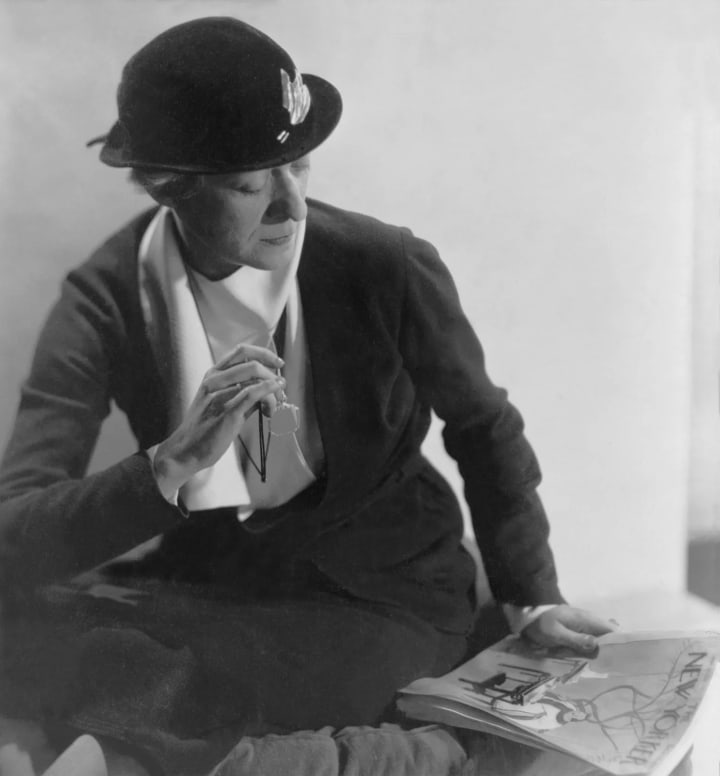
As the narrative moves into the 1930s, the tone of the book becomes more sombre, reflecting the rise of political extremism and the growing threat of another global conflict. Flanner provides a ground-level view of the political upheavals of the era, from the rise of fascism in Europe to the tumultuous French political scene. She writes with urgency about the Spanish Civil War, the ascent of Adolf Hitler, and the looming spectre of anti-Semitism, all of which cast a shadow over Paris’s cultural vibrancy. Her commentary is deeply informed, blending personal observation with a broader understanding of the historical context. She doesn't shy away from these darker aspects either: the strikes, the labour uprisings and the political turmoil cannot be ignored as the differences between the working and the middle classes also cannot.
Flanner’s prose is a blend of journalistic precision and literary flair. Her descriptions of major events—such as the opening of the 1937 Paris Exposition or the death of cultural icons like Anatole France—are infused with a sense of occasion and historical gravity. Yet, she also excels at capturing the small, everyday details that bring the city to life, from the peculiar habits of Parisian street vendors to the intricate choreography of café society. This ability to balance the monumental with the mundane is one of the book’s defining features. The closer we get to World War 2, the darker the book gets and we see the differentiation she makes between the two decades upon which she writes. It is a fantastic landscape completely with life, experience and death in hugely different ways. As the balance of the mundane becomes more difficult to do as political upheaval cannot be ignored, Flanner offers us philosophies where we can think about who is to be remembered and who is not to.
All in all, within Paris Was Yesterday: 1925 to 1939, Janet Flanner offers more than just a chronicle of events; she provides a deeply personal and richly textured portrait of a city in flux. Her writing captures the essence of Paris—its beauty, its contradictions, and its eternal spirit. Whether celebrating the achievements of its artists and writers or lamenting the political turmoil that threatened its stability, Flanner’s work remains a powerful testament to the enduring allure of the City of Light.
About the Creator
Annie Kapur
I am:
🙋🏽♀️ Annie
📚 Avid Reader
📝 Reviewer and Commentator
🎓 Post-Grad Millennial (M.A)
***
I have:
📖 280K+ reads on Vocal
🫶🏼 Love for reading & research
🦋/X @AnnieWithBooks
***
🏡 UK
Keep reading
More stories from Annie Kapur and writers in Geeks and other communities.
Book Review: "Stolen Focus" by Johann Hari
“We live in a culture that is constantly amping us up with stress and stimulation.” - "Stolen Focus" by Johann Hari Yes I'm reading more by this controversial journalist. I believe that perhaps Johann Hari is trying to make a point and I am aware that he often cherry-picks facts thank you very much Alex Edmans. However, I think we should also be aware that he probably makes some good points even though they are a little bit obvious from time to time. The enjoyability of reading a Johann Hari book is basically that if you have more than half a brain to think about these things - you can basically say to yourself, "yes, I was right all along!" But let's not get ahead of ourselves. Let's take a good look at what he's really talking about here. From the ultra-processed food revolution that plagued the childhoods of millennials like myself to the sinister intentions of 'surveillance capitalism' that is now making its way into our homes, maybe "Don't Be Evil" is not really the tagline big-tech companies want to be taking since they have become a huge slice of the problem.
By Annie Kapur12 months ago in Geeks
Marvel Zombie
The last entry into our 2025 superhero projects catalogue is Marvel Zombies. This was a show that was anticipated by absolutely no one and it disappeared from the public consciousness as quickly as it was released. There was nothing special about the project that made it a must see, or a must remember. In fact if anything it's a must forget.
By Alexandrea Callaghan26 days ago in Geeks
Sentimental Value
Sentimental Value has shown up well during awards season, and it has a stellar cast. It has been one of my most anticipated watches this year and now that the Oscars are breathing down my neck I have finally made time to actually see it. After meeting the main cast members I got even more excited to see it.
By Alexandrea Callaghan6 days ago in Geeks
Smart phones, Humans and Aliens.
WARNING. I will be tapping into one of your favorite creative tensions: The absurdity of humans worshipping their glowing rectangles as if they were tiny oracles. There’s something deliciously poetic about that contradiction, and it lends itself beautifully to an instructive proviso.
By Novel Allen5 days ago in Poets


Comments
There are no comments for this story
Be the first to respond and start the conversation.