
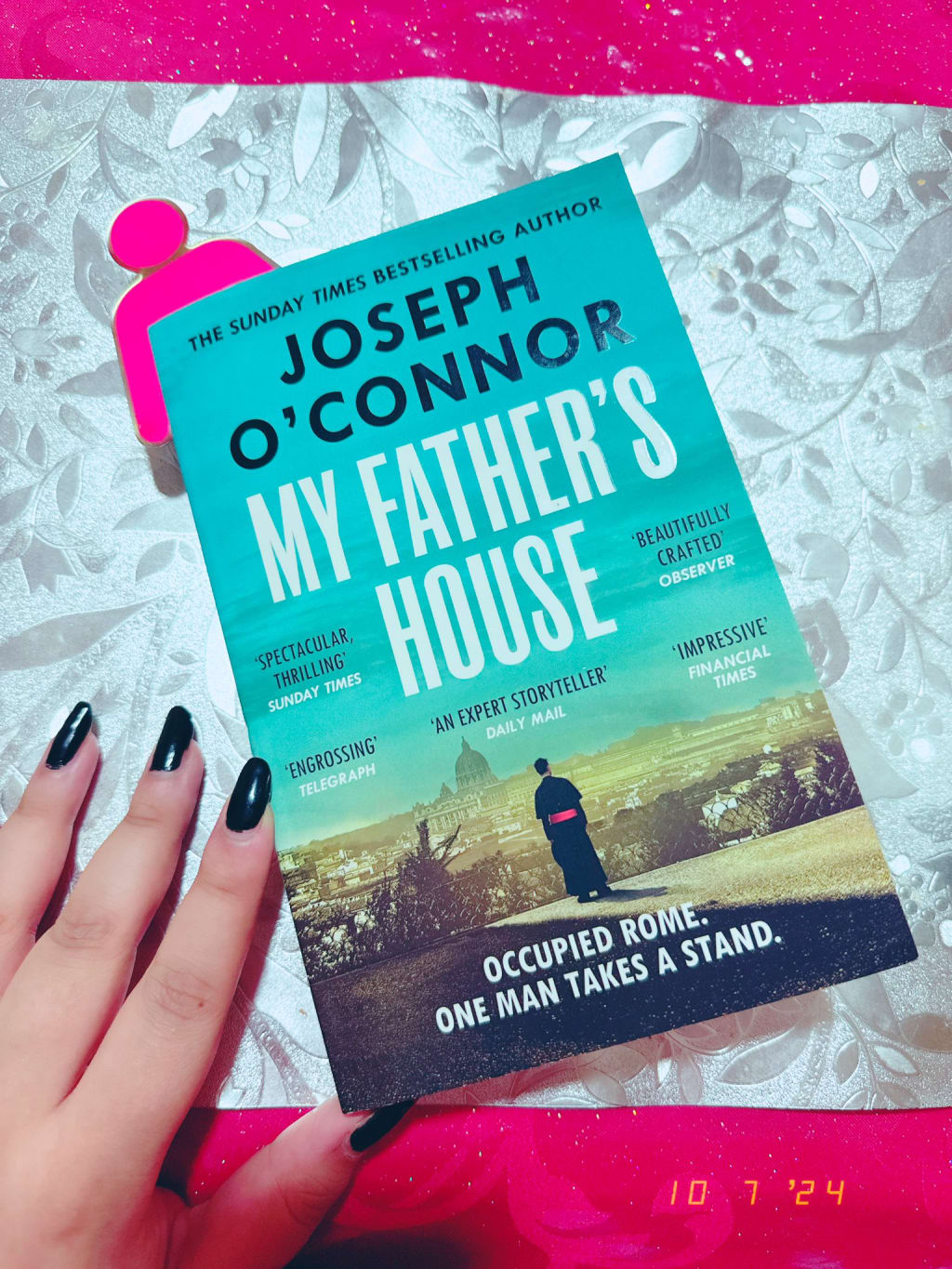
Book Review: "My Father's House" by Joseph O'Connor
5/5 - the astounding survival of the human spirit...

“His version of the piece will not be the same as anyone else’s on this Earth, though both orchestras are playing from identical sheet music. For that reason, his knowledge of the score must be total, more even than the composer’s. Is there any more difficult calling?”
- My Father's House by Joseph O'Connor
Now, if I told you how long I have had this book sitting on my shelf without being read I'm sure you'd be disappointed in me. Honestly though, I bought this book a while ago and then for some reason, I got lost amongst the 'Dexter' series I was reading and thus, it was not found for some time. (If you are wondering why there are no reviews for the 'Dexter' series then I will reveal that I do not actually review every single book I read and if this comes as a shock then I'm sorry). 'My Father's House' is a book I was initially unsure about but became something quite special.
Monsignor O’Flaherty, stationed in the Vatican, is meticulously planning his significant mission, Rendimento, set to unfold on Christmas Eve 1943. This mission aims to smuggle Jews and escaped Allied prisoners out of Italy to safety, all under the vigilant watch of the Nazis, particularly Obersturmbannführer Paul Hauptmann. Hauptmann harbors deep resentment towards the Irish priest, especially after O’Flaherty was appointed as an official Vatican visitor to an Italian concentration camp for British prisoners of war. The prisoners, previously subjected to starvation diets, began receiving small treats from O’Flaherty, an act that did not go unnoticed by Hauptmann. As a result, the visits were halted, and O’Flaherty became Hauptmann’s nemesis, with the Nazi suspecting him of being sympathetic to, or even involved with, the Escape Line.
The priest initiated his plotting under the cover of his 'Choir'—a group of like-minded citizens determined to outsmart the Nazis, despite the risks to their own lives.

The Gestapo's meticulous surveillance of the priest and his visitors created almost unbearable tension. The narrative, beautifully written, reflects the pain, misery, and hardship of conflict, highlighting the extraordinary fortitude and perseverance needed not just to survive the cruelty and oppression but to overcome persistent fear and take action against injustice, regardless of the personal danger involved.
The story of the Roman Escape Line unfolds through dual timelines: the days leading up to Rendimento on December 23, 1943, and twenty years later in 1963, as recounted by members of the Choir. The details of the mission were pieced together from the choristers' recollections into a cohesive tale of fear, intrigue, and bravery. The characters, including Monsignor O'Flaherty and Paul Hauptmann, were well-developed. Information was conveyed through whispers and scribbled notes on toilet paper, all while Hauptmann's Gestapo planted microphones and informants to catch O'Flaherty in the act.

I found this approach not only effective but exceptionally so, maintaining a smooth and uninterrupted narrative flow. The fluency of the work is beautiful, and its narrative style is a testament to the difficulty of achieving such cohesion. The fractured narratives, pieced together through dual timelines and various perspectives, create a choir of voices that highlight the determination and will behind O'Flaherty's plan. The story is layered with such depth that you'll find yourself revisiting certain pages to re-experience the emotions they evoke.
This novel transcends the typical thriller; it's a profound survival story that emphasizes personal responsibility. Monsignor O'Flaherty, despite having no direct connection to the Nazis, couldn't stand idly by as he witnessed people across Europe being rounded up and sent to Nazi death camps, knowing they would likely never return. The sense of moral duty he felt compelled him to take action, even at the risk of his own life.

What makes this story so powerful is its demonstration of human courage and compassion in the face of overwhelming evil. It highlights the remarkable individuals who refused to be passive bystanders. Instead, they chose to confront the atrocities head-on, using their ingenuity and bravery to save lives. O'Flaherty's mission is a testament to the impact of personal responsibility and the profound difference that determined individuals can make.
All in all, this narrative teaches us about the resilience and moral fortitude required to stand against tyranny. It's a reminder that in the darkest times, there are always those who will rise up, risking everything to protect others. Their actions are a beacon of hope, showing that even in the face of immense danger, humanity's spirit of compassion and justice endures.
About the Creator
Annie Kapur
I am:
🙋🏽♀️ Annie
📚 Avid Reader
📝 Reviewer and Commentator
🎓 Post-Grad Millennial (M.A)
***
I have:
📖 280K+ reads on Vocal
🫶🏼 Love for reading & research
🦋/X @AnnieWithBooks
***
🏡 UK
Keep reading
More stories from Annie Kapur and writers in Geeks and other communities.
Book Review: "Lilith" by Nikki Marmery
You guys know me and how much I love reading Greek Mythology Retellings. How about reading Biblical Mythology Retellings? I never knew they were a real thing until about now. 'Lilith' is a book about that very character and though I didn't read the preview, I was excited about what to expect when it came to the writing style, the characters included and the way in which emotion, truth and religious perspective were introduced and carried through the book. I am left however, with a few mixed feelings. Some of the ideas in the book I was left evaluating became less positive when I reflected back on the book. This was mainly because of the overall experience - these were things that when I was within the reading of the book, I didn't notice all too much until the very end.
By Annie Kapur2 years ago in Geeks
Silver Screen Magic with Mae West
American actress and singer Mae West became a popular film actress during the Great Depression. She started entertaining in vaudeville, then performed on Broadway, and finally went to Hollywood. She signed up with Paramount Pictures and made her debut in the 1932 film “Night After Night.” She also starred in musicals, comedies, and crime dramas. The American Film Institute named her one of the best classic Hollywood actresses.
By Rasma Raisters8 days ago in Geeks
Kangana Ranaut Hints At Hrithik Roshan's ‘Controversial Legal Notice’ From 2016: Life Became A Living Hell
Summary of this article Kangana Ranaut has joined the ‘2026 Is The New 2016’ trend and recalled the 'miserable' phase of her life. Without naming Hrithik Roshan directly, Ranaut referred to receiving a controversial legal notice from a "colleague". She also called 2016 the best phase of her career.
By Dena Falken Esq4 days ago in Geeks
How to Succeed at the Benson Directory®
Congratulations and welcome to the Benson Directory® employee #22391! As our newest call handler, you will have the privilege of speaking with dozens of unique and interesting people on a daily basis as well as the opportunity to earn bonuses for high performance. Contained within this handbook you will find a set of ease to follow instructions designed to help you settle in to your new role and begin paving the way to success.
By S. A. Crawford5 days ago in Fiction



Comments
There are no comments for this story
Be the first to respond and start the conversation.