
Book Review: "Monumenta" by Lara Haworth
5/5 - a fantastic short read that puts rigidity and change into perspective...

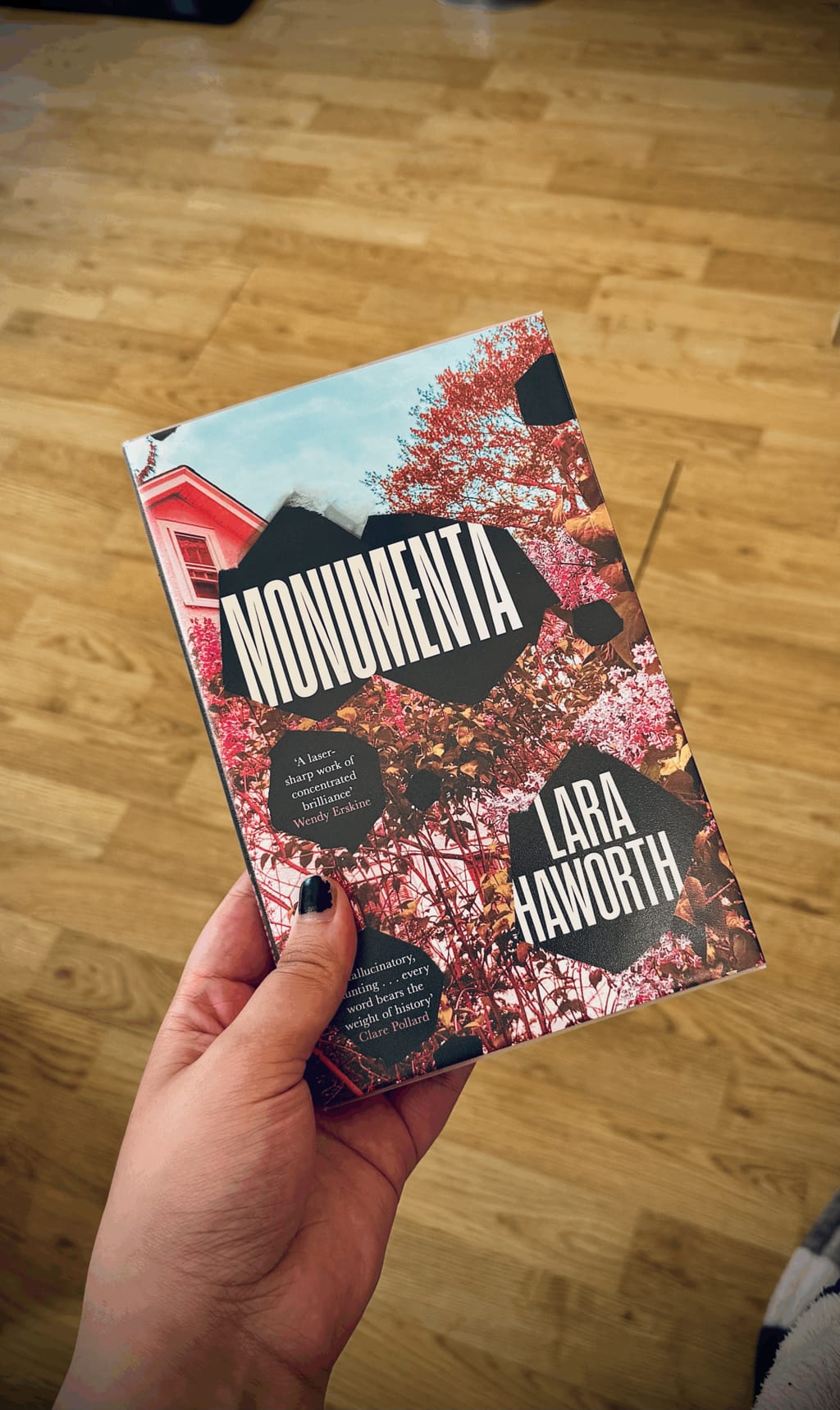
I'm still using the library in Nottingham and as of now it is March 2025 (as of writing). This means that my mental health is a bit here and there. I don't want to sound sorry for myself but I do find I have started to enjoy the library here more than usual. Since I've been visiting: I have been to some exhibitions, spent time reading in the coffee shop there and even looked into reserving books using the online catalogue which helped me find things I like a bit faster. So I guess, when life isn't going your way there is always something to enjoy - even if it's only a little thing like a trip to the library. Let's have a look at one of the books I reserved called "Monumenta" by Lara Haworth.
Olga Pavić, an elderly woman residing in Belgrade, receives notice that her long-time family home is to be demolished. The authorities plan to replace it with a grand monument meant to commemorate a historical massacre. However, the specific event being memorialised remains vague and disputed, reflecting the shifting and contested nature of national memory. Olga, deeply attached to her home, resolves to resist the destruction, determined to remain until she can reunite with her children one last time. Honestly, this is a heartbreaking way to start the story and even though the book is short - it is really emotive.
As part of the city’s initiative, three architects submit competing proposals for the monument, each embodying different interpretations of historical tragedy. Their designs reveal starkly contrasting philosophies: one focused on abstract symbolism, another striving for brutal realism, and a third seeking a compromise between the two. These differing perspectives underscore the challenges of memorialisation, as each architect wrestles with how to represent trauma in a meaningful yet politically acceptable way. This really made me think about how these three people don't reflect on what this will mean for people who are in the area already. It reflects on our society in which empathy is low, but narcissism is high.
Olga’s children, Hilde and Danilo, return to Belgrade, drawn back by their mother’s insistence on one final family gathering before the house is destroyed. Hilde, pragmatic and career-driven, has distanced herself from the city and its troubled past, while Danilo, more introspective and secretive, harbours personal conflicts he has long kept hidden. Their arrival forces them to confront not only their childhood home’s impending loss but also the unresolved tensions within their fractured family dynamic. I love looking at this because it is a direct contrast to the argument the three architects are having. But, the reader is much more emotionally invested in this one.
As the siblings navigate Belgrade’s shifting landscape, they are reminded of how the city has continuously rewritten its own history. Streets have been renamed, buildings repurposed, and past atrocities selectively remembered, or deliberately forgotten. This theme of erasure versus remembrance plays a crucial role in the novel, as the characters grapple with their personal connections to a place that has been altered beyond recognition. This is wonderfully done by the writer in the book because it really does make that emotional connection between people and places. It is as though Belgrade is a character in the book - one that is unstable and suffering from a crisis of identity through lies by omission.
Despite the inevitability of the demolition, Olga stubbornly refuses to leave her home, staging an act of resistance. She continues her daily routines as if nothing is changing, even as workmen begin preparations outside. Her defiance is not loud or confrontational but rather an attempt to preserve the significance of her past, even as the world around her insists on moving forward without it. As we see the stubbornness of the architects, we also see how all characters have a rigidity about them. It may not be aggressive, but it is definitely a sense of conviction. Olga's preservation of her past is directly contrasted with Belgrade's constantly changing atmosphere. The amount of juxtaposition in this book was amazing and the writer has done really well to fit it into such a short book without making it look obvious or badly developed.
This is just the beginning of what other contrasts of rigidity and change are placed in contrast in the book. It starts to go deep into societal structures including everything from migration to the lack of acceptance of the LGBTQA+ community. It is something that the writer has done so well that when you notice it is happening, it becomes really the beating heart of the story. You notice that some things have to change and others are best kept the same. It opens a huge conversation about societal structures that I think we all need to have.
About the Creator
Annie Kapur
I am:
🙋🏽♀️ Annie
📚 Avid Reader
📝 Reviewer and Commentator
🎓 Post-Grad Millennial (M.A)
***
I have:
📖 280K+ reads on Vocal
🫶🏼 Love for reading & research
🦋/X @AnnieWithBooks
***
🏡 UK
Keep reading
More stories from Annie Kapur and writers in Geeks and other communities.
Book Review: "Clean" by Alia Trabucco Zerán
Yes, I was perusing the cheapest possible books on the Kindle store again and yes, I was looking for things that were toeing the lines of psychological horror. It's currently late March of 2025 and I have enjoyed rediscovering one of my favourite subgenres: psychological horror. After folk horror, it has to be up there somewhere and I'm not going to lie when I tell you that there is a lot of great modern stuff out there. From the 'haunted house with a strange twist' novel to the 'good for her' narratives, from the 'dark past' characters to the 'Norman Rockwell painting' horrors, this subgenre has only grown with the 21st century. I am totally here for it. Clean is a book about a house maid driven to her limits in a life which feels strangely disconnected...
By Annie Kapur9 months ago in Geeks
Silver Screen Magic with Mae West
American actress and singer Mae West became a popular film actress during the Great Depression. She started entertaining in vaudeville, then performed on Broadway, and finally went to Hollywood. She signed up with Paramount Pictures and made her debut in the 1932 film “Night After Night.” She also starred in musicals, comedies, and crime dramas. The American Film Institute named her one of the best classic Hollywood actresses.
By Rasma Raisters7 days ago in Geeks
The Devil's Cut
“Comrade, finally you’re awake.” The voice was smooth, sensual. A flickering incandescent bar was all that lit the white, sterile room. All Vladimir remembered was everything going black. He tried to move his arms and found them strapped to the gurney.
By Matthew J. Fromm6 days ago in Fiction



Comments (1)
Good luck