
Book Review: "Love, Poverty and War" by Christopher Hitchens
5/5 - an anthology of thought-provoking journalism...

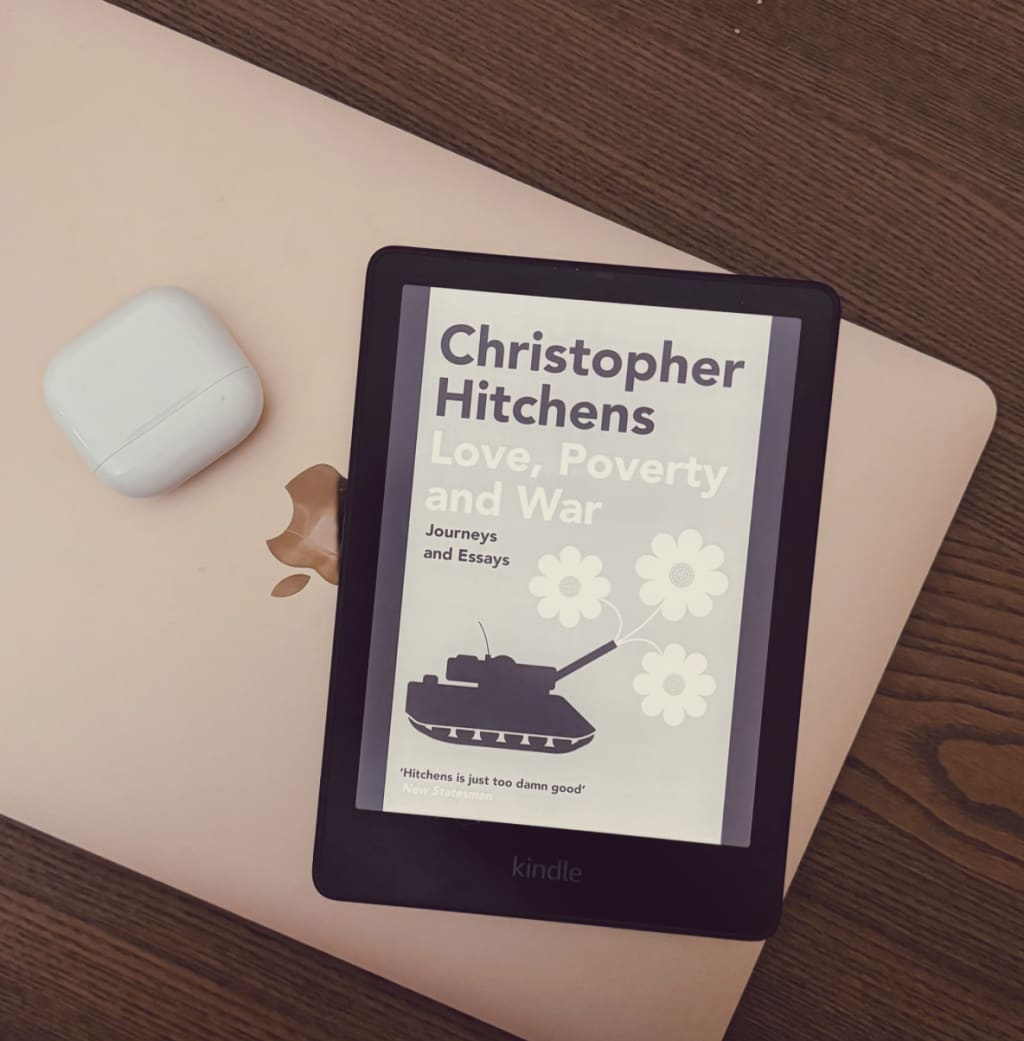
I used to read quite a bit of Christopher Hitchens, back when he had cancer and was dying. Honestly, I was still in my teen years at that time and I would have to read God is Not Great again to see his point. As a precocious teen with a certain amount of respect for religion, I liked to read other people's arguments as long as they were readable in book format and the author was a good writer (thanks for nothing, Richard Dawkins). This is perhaps the first time I'm reading such a large anthology of Hitchens' journalism and so, I took my time to process it. Here are my thoughts.
In the first section, Hitchens examines the works of notable authors and cultural figures, showcasing his deep appreciation for literature and the arts. His essays on George Orwell are particularly captivating, as Hitchens identifies Orwell as a lodestar for principled dissent and intellectual clarity. Hitchens’ analysis highlights Orwell’s unwavering commitment to truth and his resistance to totalitarianism, qualities that Hitchens himself aspired to embody.
Hitchens writes with equal reverence about the enduring relevance of James Joyce, the daring of Vladimir Nabokov, and the emotional depth of Philip Larkin’s poetry. His literary critiques are not mere acts of veneration; he is unafraid to challenge widely held opinions, often arguing that certain works or authors are overestimated or misunderstood. For example, his piece on Rudyard Kipling provides a nuanced reassessment of the poet’s imperialist undertones while also acknowledging his literary brilliance.
In his explorations of art and cinema, Hitchens underscores the power of storytelling to shape societal values and individual identity. His reflections on cultural icons such as W.H. Auden and Charlie Chaplin demonstrate his belief in the universal appeal of art, even as he situates their work within the political and historical contexts that shaped them. I think he has found a similar thing to what I have found: people often misunderstand or misinterpret Orwell. I think that the two political sides are having a little tug of war for Orwell's narrative and neither of them quite understood what he was actually trying to say.
The second section of the book shifts to Hitchens' incisive commentary on politics, offering a scathing critique of ideological dogma and political hypocrisy. With his signature contrarianism, Hitchens takes aim at both the Left and the Right, exposing the failures and moral compromises of each. He is particularly critical of the complacency of Western democracies in the face of growing authoritarianism and religious extremism. Hitchens addresses the war in Iraq with characteristic polemicism, justifying his controversial support for the intervention by arguing that it was a moral imperative to confront tyranny. While this stance alienated some of his peers, Hitchens defends his position with a moral clarity rooted in his deep opposition to totalitarian regimes.
The essays also explore Hitchens’ disdain for organised religion, a theme that would later dominate his writings in God Is Not Great. He critiques the way faith is used to justify violence and oppression. His unwavering commitment to secularism is evident as he advocates for reason, science, and the separation of church and state. I think that it is important to know that Christopher Hitchens, though he states certain controversial things, is not trying to change anyone's mind about anything but rather he is trying to present an argument that we ourselves can ponder on.
The theme of war looms large throughout the collection, as Hitchens delves into the human cost of violence and the moral complexities of conflict. His essays on the Balkan wars and the Rwandan genocide are particularly harrowing, as he bears witness to the atrocities committed and the failure of the international community to intervene effectively.
Hitchens’ reporting from war zones is both gripping and deeply personal, revealing his empathy for the victims of violence and his anger at the indifference of global powers. His reflections on September 11th and its aftermath capture the seismic shift in global politics and the rise of the so-called “clash of civilisations.” He warns against the dangers of both terrorism and the overreach of Western militarism, advocating for a balanced approach grounded in justice and human rights. I have to say I quite enjoyed the sections on war because I found it interesting that he would report on it since many male members of his family served in the army. This is something we learn early on in the book.
All in all, the collection encapsulates the breadth of his interests and the depth of his intellect, offering readers a rich tapestry of ideas and experiences. Whether reflecting on literature, dissecting political ideologies, or recounting his travels, Hitchens consistently challenges readers to confront uncomfortable truths and consider alternative perspectives. His unwavering commitment to intellectual honesty and his passion for the written word make this anthology a compelling and enduring contribution to the world of letters. I thought it was a fantastic and thought-provoking read.
About the Creator
Annie Kapur
I am:
🙋🏽♀️ Annie
📚 Avid Reader
📝 Reviewer and Commentator
🎓 Post-Grad Millennial (M.A)
***
I have:
📖 280K+ reads on Vocal
🫶🏼 Love for reading & research
🦋/X @AnnieWithBooks
***
🏡 UK
Keep reading
More stories from Annie Kapur and writers in Geeks and other communities.
Book Review: "The Picador Book of 40" ed. by Charlotte Greig
If you had told me that there was a Picador Anthology of stories last year then I would have read it, why didn't anyone tell me? Most anthologies are published at a milestone like fifty years or one hundred years, but forty just made me even more interested to read it. I was fascinated to see how many writers could write something compelling about the number, the publishing house or something to do with writing itself - especially one of my favourite writers, John Banville - who managed to write about turning forty and what it means. There are many things to celebrate in this anthology and I'm glad Picador didn't take the usual milestones to write about. Here's what I thought...
By Annie Kapur11 months ago in Geeks
Silver Screen Magic with Mae West
American actress and singer Mae West became a popular film actress during the Great Depression. She started entertaining in vaudeville, then performed on Broadway, and finally went to Hollywood. She signed up with Paramount Pictures and made her debut in the 1932 film “Night After Night.” She also starred in musicals, comedies, and crime dramas. The American Film Institute named her one of the best classic Hollywood actresses.
By Rasma Raisters8 days ago in Geeks
How to Succeed at the Benson Directory®
Congratulations and welcome to the Benson Directory® employee #22391! As our newest call handler, you will have the privilege of speaking with dozens of unique and interesting people on a daily basis as well as the opportunity to earn bonuses for high performance. Contained within this handbook you will find a set of ease to follow instructions designed to help you settle in to your new role and begin paving the way to success.
By S. A. Crawford4 days ago in Fiction



Comments (2)
Ah, the Hitch! I'm glad you looked into this one. His reviews and - let's call them what they are - takedowns are spot-on!
Your reflections on Christopher Hitchens' work provide a thoughtful and thorough analysis. Thank you for sharing your insights about this thought-provoking read.