
Book Review: "Lost Connections" by Johann Hari
3.5/5 - weird science but ultimately entertaining...

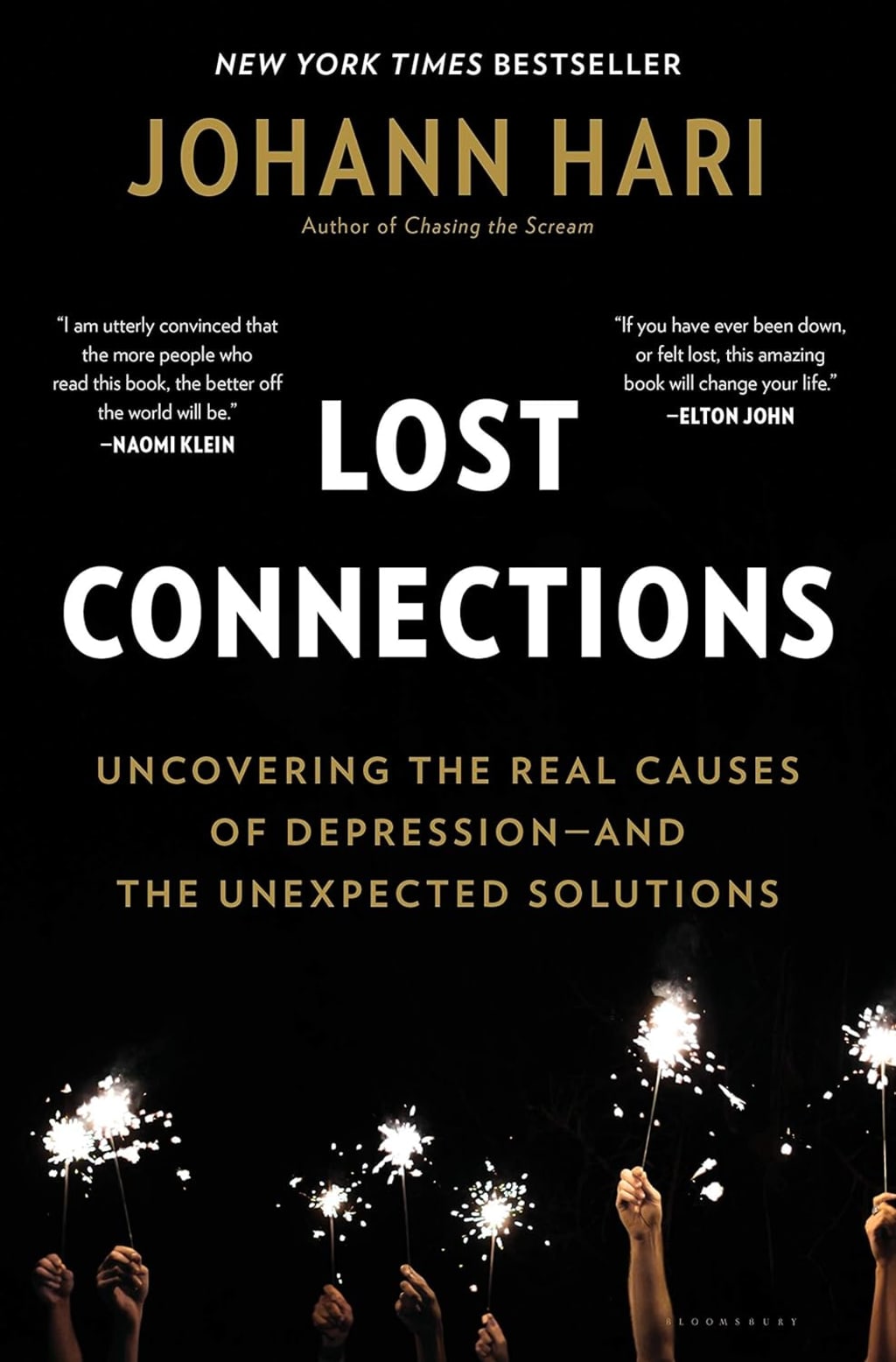
Oh please, I have heard about Johann Hari and his sketchy research, I know about his strange secondary sources and his weird bibliographies that often contain pop-science books more than scientific research but I do have to say that this book was very interesting to read even though I don't take it too seriously. First of all, before we go into the review I'd like to thank May Contain Lies by Alex Edmans and whoever wrote How to Lie With Statistics for their contributions to my warped perspective upon everything that is nonfiction I read nowadays. Now, on with the review in which I liked the book, though I do have to check out its data problem. Here we go again...
Hari begins by recounting his own struggles with depression, which led him to rely on antidepressants from a young age. Like many, he was told that his condition was due to a serotonin imbalance in his brain—a narrative that became widely accepted in modern psychiatry. However, despite years of medication, he continued to feel disconnected and unfulfilled, prompting him to investigate alternative explanations for his condition. Even though this provides the heart of the book, I'm going to say one thing: it is too much. It goes on forever. I don't care about the sufferings of Johann Hari that much to read an entire chapter in which he does nothing but 'first world problems'. I cried for a week over a Kafka novel, he cried in Kafka's house. I didn't write a chapter of a nonfiction book about it. There's a difference.
The first part of Lost Connections focuses on the causes of depression and anxiety, which Hari argues are deeply rooted in societal and personal disconnections. These causes include disconnection from meaningful work, other people, meaningful values, childhood trauma, status and respect, the natural world, and a secure future. Hari also addresses the biological and genetic components of depression but stresses that these factors are often overemphasised at the expense of understanding broader social and environmental influences. This is where I direct you to a book called The Inner Level which is perhaps better than this book at explaining this whole situation than Hari is but, has some of the same talking points. The difference is: if you like simplistic language which is straightforward and littered with anecdotes (nothing wrong with that) then read Hari. However, if you enjoy the science and psychology more, then The Inner Level is for you. Enjoy both of them if you can.
Disconnection from meaningful work is a central theme in the book. Hari explains how many people feel trapped in jobs that lack purpose or autonomy, leading to feelings of dissatisfaction and despair. He cites research showing that workplaces where employees feel valued and engaged have significantly lower rates of depression. The industrialised, profit-driven nature of modern employment, he argues, often strips workers of a sense of agency and pride, leaving them vulnerable to mental health issues. Johann Hari has his Dr Peterson moment here. For those of you who are fans of Dr Jordan Peterson like I am, I have to say - job satisfaction theory is starting to grow on me even though I still believe that passion and work should be kept as separate as possible in order to live well. My theory, if you care, is that we need to keep them separate so that we don't have overlords exploiting our passions by giving us more work for less, which seems to be part of the job satisfaction theory that nobody has accounted for.
Hari also examines disconnection from meaningful values, arguing that consumerism and materialism have distorted our sense of purpose. Many people chase wealth, status, and possessions, believing these will bring happiness, only to find themselves unfulfilled. Hari connects this to what psychologists call "extrinsic goals" and contrasts them with "intrinsic goals" like building relationships and contributing to the community, which provide a more enduring sense of satisfaction. I have to say though this sounds good on paper, in reality it doesn't actually work since everything costs money in society. Even if you want to sit in your home and 'be present' (whatever that means), it still costs money since you are using light (and possibly heat) in order to live. So, the theory that we shouldn't be consumerist is alright, but the extrinsic/intrinsic argument is a bit shoddy since everything he mentions still has some sort of monetary value.
Disconnection from the natural world is a lesser-discussed but significant contributor to depression, according to Hari. He argues that modern lifestyles have separated us from nature, depriving us of the calming and restorative effects of outdoor spaces. Research cited in the book demonstrates the mental health benefits of spending time in green environments, including reduced stress and improved mood. Now, I'm not saying that I don't believe this is true - but I do think that the research around it is sketchy at best. We have been made to believe through hundreds of years that if we make our houses homes then we should feel safe and secure. Then, why should we be told all of a sudden that leafy green areas will fix any issues we have? It's like in fifty years they'll say: "hey, are leafy areas your thing but they're bringing you down? Go home and try spending time there." It's a bit here and there for me.
In the second part of the book, Hari shifts focus to potential solutions, advocating for a more holistic approach to mental health. He emphasises the importance of reconnection—to work, relationships, values, and the natural world—as a means of addressing the underlying causes of depression and anxiety. His proposed solutions are grounded in both scientific evidence and real-world examples, many of which are inspiring and thought-provoking. Yes, they are inspiring and thought-provoking but the main issue here is that they have been said over the last decade or so and yet have not been implemented in any degree.
Hari also advocates for systemic changes in the workplace, such as giving employees more control over their tasks and fostering a sense of purpose. He shares examples of companies that have implemented these practices, resulting in happier and more productive employees. Similarly, he calls for a shift away from consumerism and towards values that prioritise relationships, creativity, and personal growth. As a teacher, I have absolutely no control over what I get to teach and to be honest, I find this alright since now I have no responsibility over what's being learnt to any degree. I know it sounds 'lazy' and 'disconnected' but there are people getting paid way more than me, doing way less work who's prime job is to think about this stuff. Why should I be doing it? This is the danger. This sort of thinking leads to 'thankless work' to people who would want to exploit it (those at the top). Forget 'seizing the means of production' and all that communist nonsense. We should seek to allocating work by pay. If you are paid more, you should do more work - it doesn't matter whether you're happy or not.
I'll spare you the rest but I still think you should read it. Lost Connections though not entirely scientific, is a nice place to start when it comes to reading books about mental health, consumerism and how work culture has ruined our lives. However, more scientific books such as The Spirit Level (referenced in this book) and The Inner Level are absolutely brilliant scientifically.
About the Creator
Annie Kapur
I am:
🙋🏽♀️ Annie
📚 Avid Reader
📝 Reviewer and Commentator
🎓 Post-Grad Millennial (M.A)
***
I have:
📖 280K+ reads on Vocal
🫶🏼 Love for reading & research
🦋/X @AnnieWithBooks
***
🏡 UK
Keep reading
More stories from Annie Kapur and writers in Geeks and other communities.
My Reading Songs
It's true that a lot of people feel like they can't focus when there's music on and they're trying to read. However, I feel like I focus much better when there is a light hum of songs I have heard a thousand times over in the background, especially if I am reading out and about such as: in a coffee shop or on public transport. With this, I am also able to noise cancel out the sounds of the world including the more annoying noises such as: people talking loudly on the phone, inconsiderate people who don't wear headphones when playing videos or music and finally, the person in the café sitting near me who sips their drink too loud.
By Annie Kapur12 months ago in Geeks
Silver Screen Magic with Mae West
American actress and singer Mae West became a popular film actress during the Great Depression. She started entertaining in vaudeville, then performed on Broadway, and finally went to Hollywood. She signed up with Paramount Pictures and made her debut in the 1932 film “Night After Night.” She also starred in musicals, comedies, and crime dramas. The American Film Institute named her one of the best classic Hollywood actresses.
By Rasma Raisters8 days ago in Geeks
Freezing Rain and Ice Disrupt Travel Across Central and Eastern Europe
Dangerous winter weather brings chaos to roads, rails, and airports as authorities urge caution A powerful wave of freezing rain and ice storms has swept across large parts of central and eastern Europe, bringing daily life to a near standstill and creating hazardous travel conditions for millions. From Germany and Austria to Poland, the Czech Republic, and parts of the Balkans, ice-coated roads, grounded flights, and disrupted rail services have turned routine journeys into dangerous ordeals. Meteorologists warn that freezing rain — one of the most treacherous winter weather phenomena — poses a greater risk than snowfall because it creates an invisible glaze of ice that is nearly impossible to detect until it is too late. What Is Freezing Rain and Why Is It So Dangerous? Freezing rain occurs when rain falls through a layer of warm air and then passes into sub-zero temperatures near the ground. Instead of freezing mid-air like snow, the rain remains liquid until it hits a cold surface, where it instantly turns to ice. The result is black ice — a thin, transparent layer that covers roads, sidewalks, power lines, aircraft wings, and railway tracks. Unlike snow, it offers no traction and is extremely difficult to remove. Experts describe freezing rain as one of winter’s most dangerous hazards, capable of crippling transport networks within hours. Travel Chaos Across the Region Across central and eastern Europe, the effects have been swift and severe. Major highways have reported multi-vehicle accidents, while local roads have become impassable in rural and mountainous areas. In several countries, authorities temporarily closed sections of motorways after trucks jackknifed on ice-slick surfaces. Rail networks were also hit hard. Ice accumulation on overhead lines caused power failures and signal disruptions, forcing trains to run at reduced speeds or be canceled altogether. Thousands of passengers were stranded at stations as operators struggled to keep services running safely. Air travel faced similar challenges. Airports in Germany, Poland, and the Czech Republic reported delays and cancellations as aircraft required repeated de-icing. Even a thin layer of ice can dramatically affect an aircraft’s lift, making safety checks essential but time-consuming. Emergency Services Under Pressure Emergency responders across the region were stretched thin as calls surged. Ambulances struggled to reach patients on icy streets, while fire brigades responded to accidents, fallen trees, and damaged power lines. Hospitals also reported a rise in slip-and-fall injuries, particularly among older residents. Broken bones, head injuries, and hypothermia cases increased as people attempted to navigate frozen sidewalks. Authorities urged residents to avoid non-essential travel and to remain indoors whenever possible. Power Outages and Infrastructure Damage Beyond transport, the ice storm also affected energy infrastructure. Ice-laden power lines sagged and snapped under the weight, leading to localized power outages in several regions. In rural areas, repair crews faced dangerous conditions as they worked to restore electricity. Icy roads slowed response times, leaving some communities without power for extended periods during freezing temperatures. Telecommunications networks also experienced disruptions, further complicating emergency response efforts. Economic Impact and Business Disruptions The freezing rain has had an immediate economic impact. Delivery services were delayed, factories reduced shifts due to staff shortages, and retailers reported lower foot traffic as customers stayed home. Logistics companies warned that prolonged icy conditions could disrupt supply chains, particularly for food and medical supplies that rely on just-in-time delivery systems. Tourism was also affected, with winter destinations reporting canceled bookings and delayed arrivals, even as ski resorts benefited from colder temperatures at higher elevations. Climate Change and Extreme Winter Weather Scientists point out that climate change may be contributing to more frequent freezing rain events. As winters become warmer overall, temperatures often hover around the freezing point — the exact conditions needed for freezing rain. This creates a paradox where regions experience fewer snowstorms but more ice storms, which can be far more destructive. Climatologists warn that infrastructure across Europe was largely designed for snow, not prolonged ice events, leaving cities vulnerable as weather patterns evolve. Authorities Urge Vigilance Governments and meteorological agencies issued repeated warnings, advising drivers to reduce speed, increase braking distance, and equip vehicles with winter tires and emergency kits. Pedestrians were encouraged to wear non-slip footwear and use handrails whenever possible. Schools in several areas shifted to remote learning to reduce travel risks. Officials emphasized that patience and caution save lives, reminding citizens that even experienced drivers cannot control a vehicle on black ice. Looking Ahead Forecasts suggest that temperatures may gradually rise in some areas, easing icy conditions, while others could face additional freezing rain before the system moves on. Cleanup and repairs are expected to continue for days, even after the weather improves. The freezing rain sweeping across central and eastern Europe serves as a stark reminder that winter’s most dangerous storms are not always the most visible. As climate patterns continue to change, authorities and citizens alike may need to rethink how they prepare for — and respond to — ice, not just snow.
By Fiaz Ahmed Brohi8 days ago in Geeks


Comments (2)
This impressed me. Hari and Peterson are dubious intellectuals to me, but occasionally they get it right. And I like what you said here about teaching. I have to choose the material this term, but I feel like I'm being pushed by bad decisions from other less-than-talented people. I will check this out.
Awesome work