
Book Review: "Jane Austen at Home" by Lucy Worsley (Pt.1)
5/5 - a fantastic beginning to the story of a literary giant...

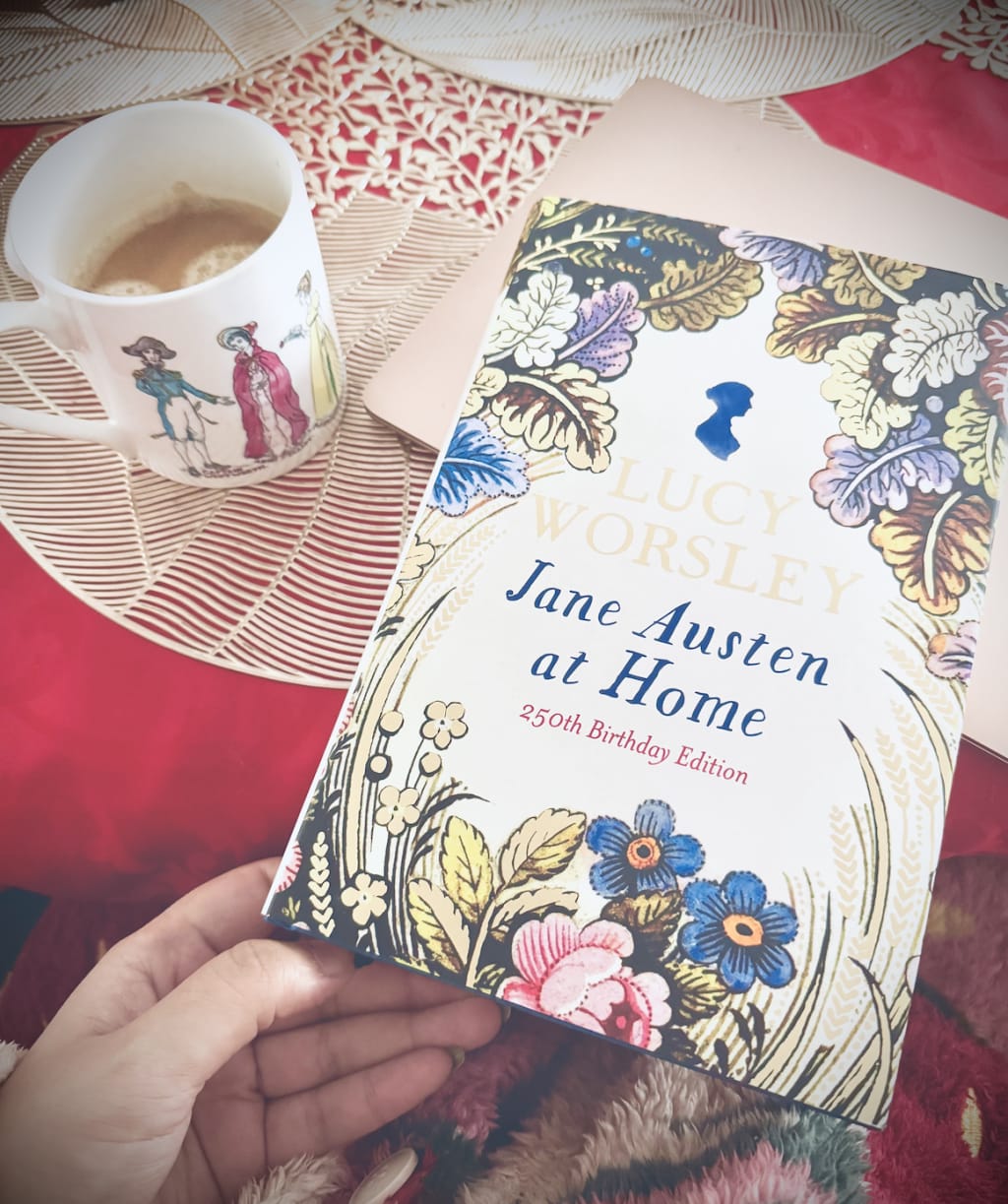
The reason I have split the review up is because I have realised that many people don't tend to read my longer reviews. I hope therefore, that this is more manageable.
Annie.
***
This piece reviews the 'Introduction' through to 'Chapter 9' entitled 'Youth and Beauty'.
Lucy Worsley is one of the treasures of the literary and historical academic world and this book basically solidifies that fact. Her writing on Jane Austen's life is clear, analytical and yet, is also greatly entertaining. I bought this book whilst out to the Jane Austen House in Chawton and, if you're my friend on Facebook - you probably would've seen that 'photodrop' I did of the day. Once I started reading it, I was completely immersed in the life and times of one of literature's most beloved figures, which strangely starts off with the author acknowledging the fact that she meets people who don't like Jane Austen.
In her introduction, Worsley takes us through the reason why so many women connect to the literature of Austen, looking through the dynamics of her stories, the search for a home, the want for stability and yes - also the vision of wit that would become central to the experience of reading Jane Austen as a woman. I've always thought that as a woman, my experience of reading Jane Austen was important in some way - now I realise it is a way of connecting with other women who read, connecting with women who are witty, wanting and intelligent. Lucy Worsley gives us the perfect 'story-before-the-story' - an answer to the question of how Jane Austen, a woman from a parsonage in the south, has remained so universal to women who read everywhere. It is because, in many ways, she communicates to all women, all at once.
She starts her story before Jane is even a thought. Her parents and grandparents are covered first, with Worsley introducing where the name 'Austen' actually came from. We have a family tree laid out for us and witness the calm and cool gentleness with which Mr Austen (Jane's father) would raise his children and the emotional distance to which her mother would give to them as well. In fact, it is said that Jane's mother would often go away and the children, no matter how young, would barely notice her absence. This is not normal for young children. When Jane comes along in 1775, the world is opening up. The American Revolution is underway, the French Revolution is on the way and the Age of Reason seems to be doing just fine. But this means nothing to the child that is Jane. She lives in a parsonage, grows up with some older siblings and attends a boarding school where she is often seen as a troublesome child. Worsley writes Jane's story as if we might know her personally ourselves. And I think that is the essence of Jane Austen to women - she is much like a friend.
Did Jane not really enjoy the French influence that pervaded over the culture as she grew up? Lucy Worsley observes that characters of French manners, or characters who drop French phrases into their lexicon are often viewed as unlikeable, pretentious and often croaky figures who are distant, droopy and make for bad conversation. She would live through the upsets in France leading to its revolution and of course, we have to assume that she at least would have known about it in some respects. Whether the French-ness of the characters in some of her novels is intrinsically linked to the French Revolution and her alleged dislike for the people is rather an interesting speculaiton. Everything was highly charged and political in that time, can we only assume that Jane was as well? Or do we take the stance that a parsonage woman would not be interested in such things? If there is one thing I know about English Literature, it's this: it is never a good idea to underestimate Jane Austen.
By the time Cassandra's (Jane's sister) husband dies, there is a gloom that sort of falls over life a tad bit. However, this does not stop Jane from pursuing a career dedicated to telling some of the world's most recogniseable stories in English literary history. As Jane's story progresses, we see her world change yet again. England was changing and Jane changed with it. In her 40-odd years, she had a lot to do and even though life in the parsonage may have been tedious - her output was far from it.
In Chapter 10, we start with the 'Novels' and work our way forwards.
Lucy Worsley, you are a national treasure.
About the Creator
Annie Kapur
I am:
🙋🏽♀️ Annie
📚 Avid Reader
📝 Reviewer and Commentator
🎓 Post-Grad Millennial (M.A)
***
I have:
📖 280K+ reads on Vocal
🫶🏼 Love for reading & research
🦋/X @AnnieWithBooks
***
🏡 UK
Keep reading
More stories from Annie Kapur and writers in Geeks and other communities.
Book Review: "The Defence" by Steve Cavanagh
This book was recommended to me by Twitter and I’m seriously reconsidering taking recommendations from that hellscape. The first novel in a series is supposed to be the one that hooks you in, makes you fall in love with characters and themes and establish real in-depth parts of the backstory to you. This book does none of those things and yet, is so confident about itself that it completely fails to give the reader a coherent story that they can get lost in. I would say the audience of this book is basically people who don’t like to read - why? There’s no atmosphere, there are no in-depth concepts, there is no real story and the characters are hollow as hell. I was quite underwhelmed after reading this, it just felt so forgettable.
By Annie Kapur5 days ago in Geeks
Steve Burton announces he is leaving General Hospital
The Steve Burton rumor is finally real There are always rumors regarding soap stars, and usually, the information is not true. However, this time, what is being reported is accurate. Soap Opera Digest has revealed that Steve Burton is taking a hiatus from his role as Jason Morgan on General Hospital.
By Cheryl E Preston4 days ago in Geeks
Blessed 33
So I woke up on the morning of February 5, 2026 and guess what and you know what I realized? It’s my 33rd birthday. Do you know what that means? Yes, technically I’m getting old, but what I couldn’t have guessed was this would be one of the best days of my life.
By Joe Patterson6 days ago in Confessions


Comments (1)
Thanks for sharing this though not my scene, but Charlotte Brontë got a mention in my latest story