
Book Review: "Inherent Vice" by Thomas Pynchon
4/5 - much better than the movie...

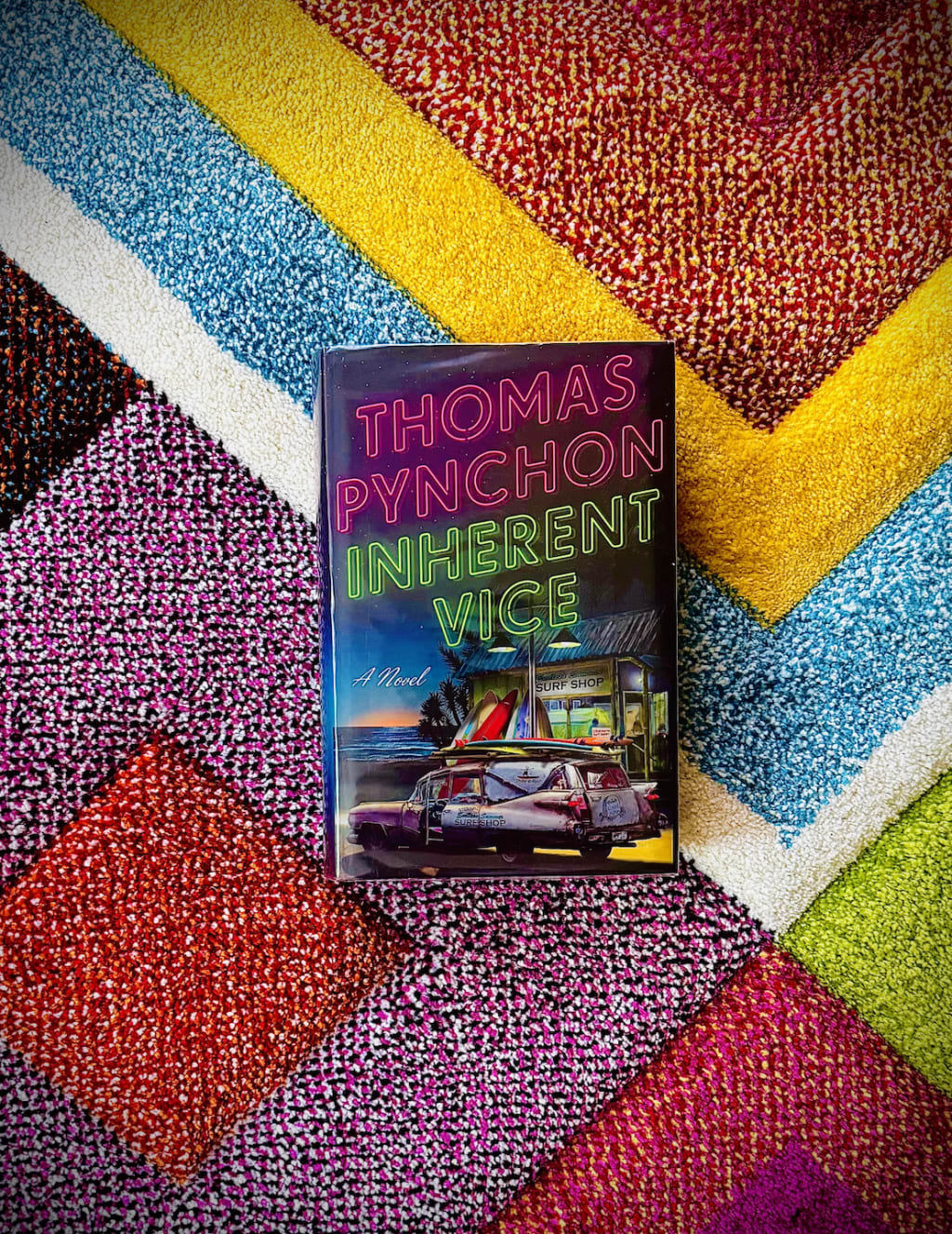
As you know, I have seen the film of this book a few times and I'm sorry when I say that it is probably the worst film of Paul Thomas Anderson's career. I sought out the book and I thought it was probably going to be a lot different to my experience of the movie. This is why I will always advocate for reading the book before you see the film. I was actually quite shocked to find that the book was more understandable and didn't feel as though it was wasting my time. I felt like the characters in the book were a lot different in my mind to the way the characters in the film were presented, especially the main character.
The protagonist, Larry “Doc” Sportello, is a private investigator and dedicated pothead who seems more at home in the counterculture of the 1960s than in the fast-approaching, more cynical 1970s. Doc’s character is a clear subversion of the classic hardboiled detective archetype: while figures like Sam Spade or Philip Marlowe are tough, sharp, and efficient, Doc is frequently distracted, hazy, and passive, often stumbling into clues rather than uncovering them through traditional detective work.
Despite his laid-back attitude, Doc has a good heart and a strong sense of loyalty, particularly when it comes to his ex-girlfriend Shasta Fay Hepworth, who brings him the case that sets the entire story in motion. His character is as much an observer of the world as he is a participant, and through his stoned but oddly perceptive perspective, Pynchon paints a portrait of a world where the ideals of the 1960s are fading, making way for something more sinister. This is something the film definitely lacked: a crime atmosphere. It was too laid back and focused on its counterculture rubbish than actually depicting the story. I found the book to be much darker and more serious.
Shasta Fay Hepworth reappears at the beginning of the novel with a request. She’s been having an affair with real estate mogul Mickey Wolfmann, and now she’s worried that Wolfmann’s wife and her lover are planning to have him committed to a mental institution. Shasta wants Doc to look into it, but before he can get very far, both she and Wolfmann mysteriously disappear. What starts as a straightforward missing persons' case quickly spirals into a sprawling conspiracy involving drug smugglers, corrupt cops, shady business dealings, and a mysterious organisation known as the Golden Fang. As Doc tries to follow the various leads, he finds himself drawn deeper into a maze of deception, paranoia, and ever-growing confusion. Here's another thing that was done much better in the book: the depiction of the actual crime that was taking place and the atmosphere of conspiracy. It definitely felt like there was more at risk and more tension in the book than there was in the film.
Pynchon’s Los Angeles is more than just a setting, it’s a character in its own right, reflecting the transition from the freewheeling 1960s to the more controlled, consumerist 1970s. The city is full of contradictions: it’s a place of sunshine and freedom, but also of darkness and corruption. Hippie communes coexist with ruthless real estate developments, and the old countercultural dream is being swallowed up by commercialism and law enforcement crackdowns. Throughout the novel, Doc navigates this shifting landscape, from neon-lit strip clubs to beachside bungalows, from police precincts to yacht parties filled with Hollywood elites. Each location serves to highlight the changing nature of America itself; a place where idealism is giving way to cynicism, and where the forces of power are tightening their grip. This is really well done in the book yes, but I could never help but question whether depicting Los Angeles like this is both a huge cliché and an act of hilarious irony. I can never see anything countercultural about Los Angeles - it is the most cliché and branded city in the world.
One of Doc’s key foils in the novel is Detective Christian “Bigfoot” Bjornsen, a straight-laced LAPD officer who despises hippies and sees Doc as little more than a joke. Despite their animosity, Bigfoot is strangely fascinated by Doc, and the two engage in a wary, antagonistic relationship throughout the novel. Bigfoot represents the encroaching authority that is gradually squeezing out the free-spirited anarchy of the 1960s. He’s a cop who wants to be a movie star, a lawman who resents the corruption of his own profession, and a figure who, in his own way, is just as trapped as Doc. Their interactions provide much of the novel’s dark humour, as Doc constantly manages to frustrate and evade Bigfoot’s attempts to rein him in. I think that the dark humour is definitely better in the book than in the film because it is far less on the nose.
All in all, there is something really interesting about the book that of course, I have not seen when watching the movie. The movie and the novel have two different atmospheres and the book really does feel like a crime novel more than anything else. I definitely recommend reading this if you a) haven't seen the film or b) didn't like the film.
About the Creator
Annie Kapur
I am:
🙋🏽♀️ Annie
📚 Avid Reader
📝 Reviewer and Commentator
🎓 Post-Grad Millennial (M.A)
***
I have:
📖 280K+ reads on Vocal
🫶🏼 Love for reading & research
🦋/X @AnnieWithBooks
***
🏡 UK
Keep reading
More stories from Annie Kapur and writers in Geeks and other communities.
Book Review: "The Age of Magic" by Ben Okri
It's late February 2025 and I'm working on a few different articles at the moment. I want to give you another investigation but I'm really not sure where to start and as of yet, I don't know whether I've got around to writing that article on my ten favourite podcasts. If I have, then hats off to future me, you did well and stuck to it instead of erasing it from the board because you thought 'nobody's going to care about this crap'. When it comes to reading though, I worked my way through Ben Okri's The Age of Magic after seeing it sticking out of the library shelves so much it was about to fall off. Let's dive into this brilliant novel...
By Annie Kapur9 months ago in Geeks
Silver Screen Magic with Mae West
American actress and singer Mae West became a popular film actress during the Great Depression. She started entertaining in vaudeville, then performed on Broadway, and finally went to Hollywood. She signed up with Paramount Pictures and made her debut in the 1932 film “Night After Night.” She also starred in musicals, comedies, and crime dramas. The American Film Institute named her one of the best classic Hollywood actresses.
By Rasma Raisters8 days ago in Geeks
Vitaly Zdorovetskiy
In the early days of YouTube, when viral content felt spontaneous and unfiltered, a handful of creators stood out by pushing boundaries most people wouldn’t dare to approach. One of the most recognizable names from that era is Vitaly Zdorovetskiy, widely known simply as Vitaly. His journey through internet fame reflects both the power of digital platforms and the consequences that can follow when attention becomes the ultimate currency. From Immigrant Roots to Internet Recognition Vitaly Zdorovetskiy was born in Russia and later immigrated to the United States, where he spent his formative years adjusting to a new culture and environment. Like many young people navigating identity and ambition, he gravitated toward entertainment and performance. However, instead of following traditional routes, Vitaly found his stage online. YouTube, still evolving in the early 2010s, offered creators freedom with few rules and limitless reach. Vitaly saw an opportunity not just to entertain, but to shock, surprise, and provoke reactions. This approach quickly distinguished him from creators focused on skits or commentary. The Prank Era and Viral Explosion Vitaly rose to prominence through public prank videos that leaned heavily on shock value. These weren’t simple jokes meant to amuse passersby; they were elaborate stunts designed to elicit strong emotional responses. His videos spread rapidly across social media, earning millions of views and placing his channel among the fastest-growing at the time. For many viewers, Vitaly represented a fearless, rule-breaking personality who lived without hesitation. For others, his content crossed ethical and legal lines. That tension—between admiration and criticism—became a defining feature of his public image. Despite the controversy, there was no denying the influence Vitaly Zdorovetskiy had on online content culture. His success helped popularize extreme prank videos and inspired countless creators to chase virality at any cost. Fame, Pressure, and Public Scrutiny As Vitaly’s audience grew, so did scrutiny. Viral fame often magnifies both success and mistakes, and Vitaly experienced that amplification firsthand. Several of his stunts attracted attention from law enforcement, leading to arrests and legal consequences that were widely reported. These moments marked a shift in how audiences viewed him. What once felt like rebellious fun began to raise questions about responsibility, influence, and accountability. The same platforms that fueled his rise now served as public records of his missteps. The story of Vitaly highlights a critical reality of digital fame: visibility comes with permanence. Every action, especially those captured on camera, becomes part of a lasting narrative that audiences revisit and reassess over time. Attempts at Reinvention Like many creators who achieve rapid fame, Vitaly eventually faced the challenge of evolution. The internet moves quickly, and audiences mature. Content that once felt exciting can grow repetitive or uncomfortable as social norms shift. Vitaly Zdorovetskiy explored different formats over time, including lifestyle content and motivational themes. These changes suggested an awareness that long-term relevance requires more than shock value. However, transitioning away from a persona built on extremes is never simple. Audience expectations can become a trap, forcing creators to choose between growth and consistency. Vitaly’s attempts to reshape his image reflect a broader struggle faced by many early internet personalities trying to redefine themselves in a more regulated and socially conscious digital space. The Cultural Impact of Vitaly Whether viewed positively or critically, Vitaly’s influence on online entertainment is undeniable. He helped define an era where virality often outweighed caution, and where creators tested the limits of what platforms would allow. His career sparked conversations about ethics in content creation, the responsibilities of influencers, and the psychological toll of constant attention. In many ways, Vitaly Zdorovetskiy became a case study for both aspiring creators and platform regulators. Today’s content guidelines, stricter moderation, and evolving audience standards owe something to the lessons learned during the early viral years—lessons shaped in part by figures like Vitaly. Lessons from a Viral Career The story of Vitaly is not just about pranks or controversy. It is about ambition, risk, and the complex relationship between creators and their audiences. His rise demonstrates how authenticity and boldness can capture attention, while his challenges reveal the costs of sustaining fame without boundaries. For emerging creators, Vitaly’s journey offers important insights: virality is powerful, but longevity requires adaptability, self-awareness, and respect for the impact content can have on others. Where Vitaly Stands Today As the internet continues to evolve, so does the perception of figures like Vitaly. He remains a recognizable name, particularly among audiences who witnessed the early YouTube boom. While his presence may not dominate the platform as it once did, his legacy remains part of internet history. Vitaly Zdorovetskiy’s story serves as a reminder that online fame is rarely linear. It is shaped by timing, choices, and the unpredictable reactions of millions of viewers. In that sense, Vitaly’s journey mirrors the internet itself—fast, chaotic, influential, and always changing. Final Thoughts The rise of Vitaly underscores both the opportunities and responsibilities that come with digital platforms. His career invites reflection on how far creators should go for attention and what sustainable creativity truly looks like. In an era where viral moments can define a lifetime, Vitaly’s story remains relevant—not as a blueprint to follow, but as an experience to learn from.
By Saboor Brohi 5 days ago in Geeks
The Devil's Cut
“Comrade, finally you’re awake.” The voice was smooth, sensual. A flickering incandescent bar was all that lit the white, sterile room. All Vladimir remembered was everything going black. He tried to move his arms and found them strapped to the gurney.
By Matthew J. Fromm7 days ago in Fiction




Comments (2)
Oh, I've seen the film. And you know how I feel about Pynchon.
I never saw anyone talk about this book! It's one of my favourites