
Book Review: "Hotel World" by Ali Smith
5/5 - a book about the important questions when it comes to how we understand other people...

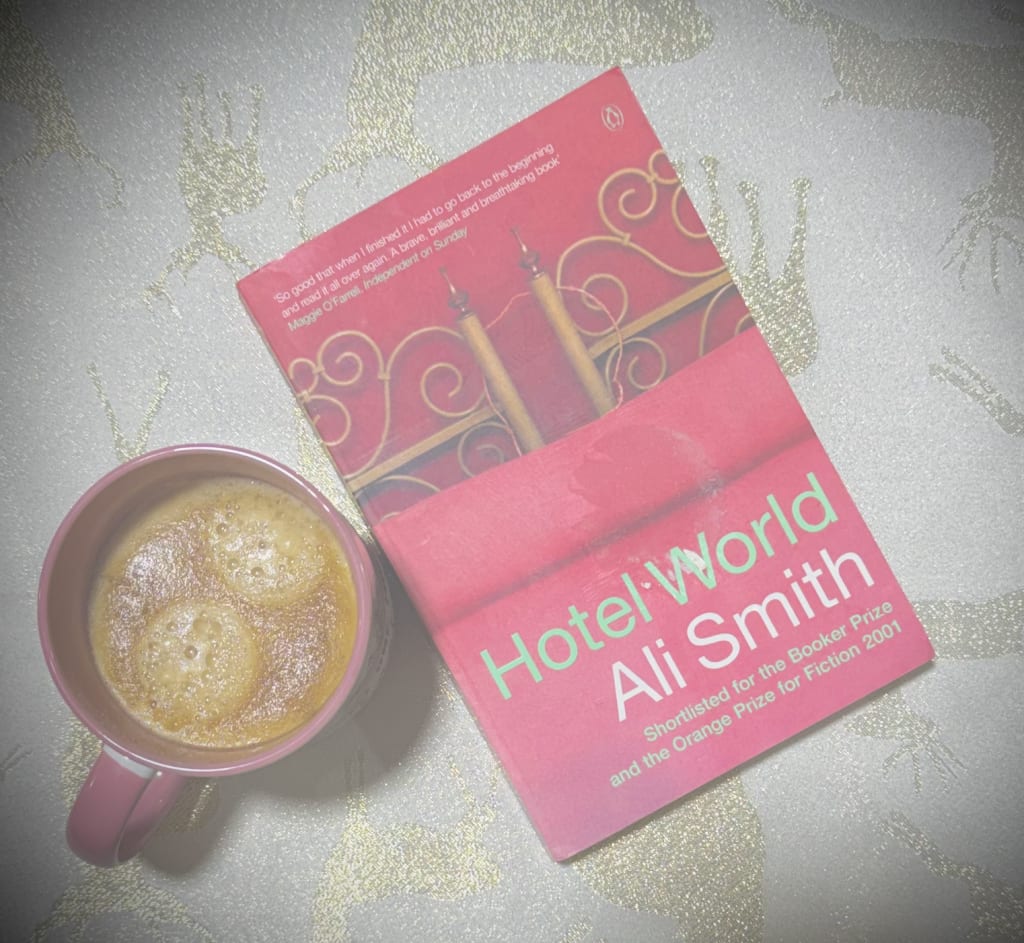
I don't read Ali Smith often but this was on sale. I featured her book Autumn in my '5 Books for Autumn' article some years' ago. Hotel World though is a completely different book to everything I've heard by this author. There's something deeply existential about this book and it features some of the most interesting quotation I have read on the subject of death this year. I mean just take a look at this quotation from the first chapter entitled 'Past'. I think it's such a hard-hitting one (I even shared it on social media if you remember it popping up)...

Let's take a look at the book then...
The novel opens with a woman who has climbed into a dumbwaiter at the Global Hotel as a dare. She has died and has been turned into a ghost. As a ghost, Sara narrates in fragmented, dissolving language, struggling to remember her body, her past, and the sensation of time. The fragmentation definitely reflects a disorientated mental state and the stream-of-consciouness we typically associate with the new, more modernist state of fiction. Narrating the boundary between life and death really is quite something and I think Ali Smith is definitely brave for making this attempt. It works so very well and really draws the reader into what ideas might lie ahead to be explored in the novel.
Sara’s death becomes the gravitational centre around which the novel’s other narrators orbit, each connected to the Global Hotel in a different, sometimes indirect, way. In a very dark variation on perhaps something the more movie-cultured would associate with The Grand Budapest Hotel, this book shows us the different people who can come and go into each other's lives and how different they truly are. The hotel itself is a metaphor for anonymity and well, six interacting sections which move through the realms of its hallways is simply a fantastic way at presenting transience. Ali Smith proves to be a great talent at fragmented literature.

Else, a homeless woman who sleeps near the Global Hotel, narrates a long, exhausted monologue shaped by poverty, hunger, and physical vulnerability. Lise, a hotel receptionist, undergoes a spiritual and emotional collapse after accidentally witnessing Sara’s fatal fall. Penny, a privileged hotel guest, offers a sharply contrasting perspective, observing the Global Hotel’s world from above rather than within. And of course, Clare, Sara’s sister, narrates a moving journey of grief as she attempts to come to terms with Sara’s death. Ali Smith shows us how each character changes because of the hotel and the hotel changes with them. They are all impacted by something, the hotel draws them to its sense of identity without having an identity. They all project themselves into the main role of a story that isn't theirs. It's quite fantastic as a narrative.
This is shown by the fact that Sara’s body, fall, and final moments reappear across multiple perspectives, creating a mosaic of interpretations that resist a single “truth.” The truth really is whatever each person wants it to be and that is both the beauty of the existential question and the entire problem we have in our everyday lives.
There is no exact truth, there are just people who see what they want to see - they are in fact, blind to everything else. They are blind to the loves and sufferings of others until it is convenient for them to be aware of it. They don't care whether they destroy someone's lives in the process. Sara is at the centre of this and yet, we see her suffering co-opted by every character for their own 'plot-lines' in which they are the main characters. It definitely resonates with our own modern culture of using and abusing others for our own gain, something which has gone up in recent years - further than when this book was written. I found Ali Smith's ability to tell this story incredible, she definitely shows us the multiplicity of human experience, and the impossibility of fully understanding another person’s life or death. You could never really know at all - everything is speculation, even what you think is the truth.
I loved this book, it definitely tells us an important story about how we form narratives about others based only on the very small amount we know. Even if we feel like we know everything about them, we don't know anything really. Nothing at all.
About the Creator
Annie Kapur
I am:
🙋🏽♀️ Annie
📚 Avid Reader
📝 Reviewer and Commentator
🎓 Post-Grad Millennial (M.A)
***
I have:
📖 300K+ reads on Vocal
🫶🏼 Love for reading & research
🦋/X @AnnieWithBooks
***
🏡 UK
Keep reading
More stories from Annie Kapur and writers in Geeks and other communities.
Book Review: "Conversations with Friends" by Sally Rooney
Yes, I'm reading some more Sally Rooney because I really enjoyed Beautiful World, Where Are You? Even though I really didn't like Normal People - it doesn't matter, there's only one way and it's forward. Sally Rooney's universality is wild because she is definitely not, as a human being, someone who can comment on the common experience of everyone. Middle-class, white and privileged - it is actually a wonder how she can express these existential issues as common problems everyone has without having access to the common working-class person. I would say this is quite an achievement and, as we continue, we look at Conversations with Friends. Again, this book is painfully middle-class and white, but it does ask all the right questions.
By Annie Kapur3 months ago in Geeks
No Other Choice (2025)
It is only February, so other films may well surpass “No Other Choice”, but I think this is the best film I’ve seen so far this year. And that surprises me, because, it is a subtitled film and while I am pretentious enough to choose to watch foreign-language films, I was also very tired and that was an extra commitment from me. But more importantly, let me warn you, this film is gruesome and violent. There were times I had to turn away from the screen to avoid the worst of it (including some self-inflicted dentistry).
By Rachel Robbins28 days ago in Geeks
How to Install and Use MetaTrader 4 (MT4) on Mac in 2026
MetaTrader 4 (MT4) remains one of the most widely used trading platforms for Forex and CFD markets in 2026. Despite the release of newer platforms, MT4 continues to dominate retail trading because of its stability, flexibility, and strong ecosystem of indicators and automated strategies.
By Ethan Cole7 days ago in Geeks



Comments
There are no comments for this story
Be the first to respond and start the conversation.