
Book Review: "Empire of Things" by Frank Trentmann
5/5 - one of the most in-depth books you will ever read about consumerism and its origins...

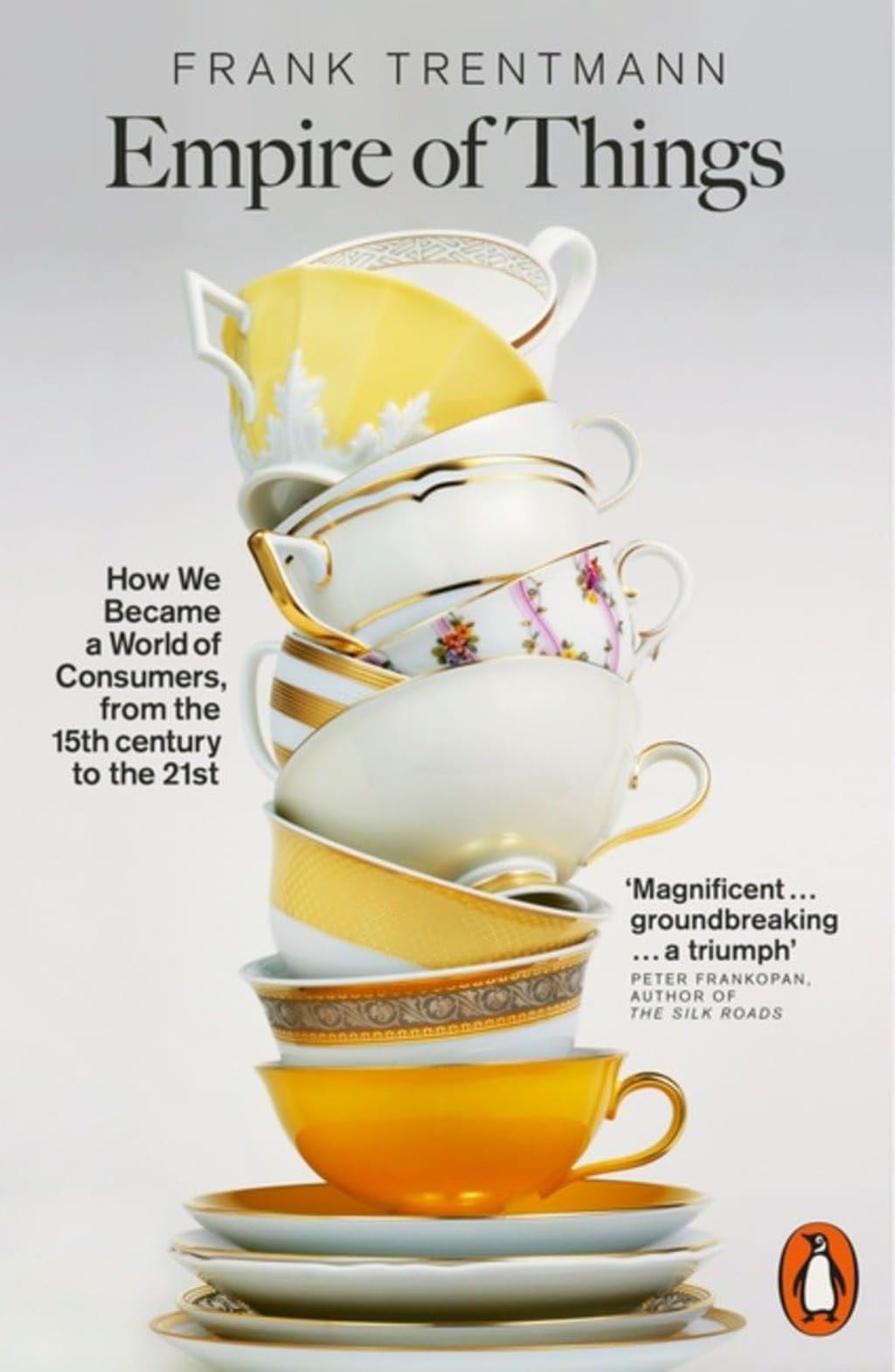
As you probably know, I'm still obsessed with reading stuff about consumerism and learning everything there is to know about the topic. I've made so many notes and I've read so much just from reading books that refer to other books. It really has been a great time but, I think I've hit the wall again for now. Empire of Things has been constantly recommended to me for a long while now and so, even though it stands at almost 900 pages, it is genuinely one of the most informative books I've ever read.
Trentmann begins by dismantling the notion that consumerism is a purely modern phenomenon. He traces the roots of consumption back to ancient civilisations, illustrating how material goods were used as symbols of status, power, and religious devotion. In medieval Europe, luxury items such as spices and textiles signified wealth and global connections. However, it was the rise of capitalism and the industrial revolution that truly transformed consumption into a mass phenomenon. By providing this historical context, Trentmann reveals that consumerism is deeply ingrained in human societies, predating modern advertising and globalisation. This was really interesting because from what I have read, consumerism has been so far a 20th and 21st century thing. This book talks about old China and 15th Century Italy and tons of other places and times. It was so compelling but also made a lot of sense since consumerism started with empires and want for status.
The book argues that consumption is not merely an economic activity but a cultural and social one. Material goods, Trentmann asserts, play a central role in shaping personal identities and social relationships. He examines how objects—from clothing and furniture to technological gadgets—have been used to signal class, gender, and cultural affiliation. For instance, in the Victorian era, household items like china and upholstery became markers of respectability and moral virtue. Trentmann highlights how consumption reflects and reinforces societal norms, evolving alongside shifts in values and aspirations. I was surprised to learn about the fact that these consumer goods were once used as life insurance policies where people would buy lots of silver cutlery and then, when they died they would pass it on as they already knew it would increase in value.
Trentmann explores how globalisation has both expanded and homogenised consumer choices. He delves into the early modern period when the global trade of goods such as sugar, coffee, and tobacco began to create interconnected markets. These goods were not only commodities but also cultural products that transformed diets, rituals, and economies. In the 20th century, the proliferation of global brands further blurred national boundaries, creating a shared consumer culture. However, Trentmann also notes the persistence of local practices and preferences, arguing that globalisation has not erased cultural diversity in consumption. I loved learning about all these interconnected markets in which consumerism absolutely changes who we are. Changing people's habits over a short time is not easy and so, I can understand why things like war and political shifts would be exploited by companies in order to sell more of their products and get their products associated with certain ideas and cultures. It is so easy when you think about it, but it requires someone to place the products there at the correct time and place.
The book examines how the 19th and 20th centuries gave rise to the consumer society we recognise today. Trentmann highlights key developments, such as the emergence of department stores, advertising, and credit systems, which made goods more accessible and desirable. He also discusses how mass production and technological innovation lowered costs, enabling middle and working-class consumers to participate in the market. Importantly, Trentmann links these changes to broader societal shifts, such as urbanisation and the growth of the middle class, which created new demands and aspirations. Learning about the department store and how it rose in prominence is one of the highlights of this book as we also get to know how businesses wanted more and more people to participate in the culture over larger and larger areas.
A significant portion of the book is devoted to the environmental consequences of modern consumption. Trentmann critiques the unsustainable nature of current consumer practices, highlighting issues such as resource depletion, waste, and climate change. He traces the historical roots of these problems, arguing that the industrial revolution marked a turning point in humanity’s relationship with nature. By prioritising growth and innovation, societies began to overlook the ecological costs of consumption. Trentmann calls for a more sustainable approach, emphasising the need to balance material desires with environmental stewardship. I think many of us by now have watched the Netflix Documentary entitled Buy Now: The Shopping Conspiracy and I think if you have watched and enjoyed that, then this book is definitely for you. Think of it as an expansion - it allows you to delve deeper into cultures and histories that opened the doors for the consumerist culture explored in the documentary. It is not as isolated as we like to believe.

Trentmann delves into the psychological dimensions of consumer behaviour, exploring why people desire certain goods and how they derive meaning from them. He discusses theories of status, aspiration, and self-expression, showing how consumption is driven by both practical needs and emotional motivations. For example, the acquisition of luxury items often satisfies a desire for recognition and distinction. Trentmann also examines how advertising and branding tap into these psychological factors, shaping tastes and preferences. For example: one of the points I really thought was interesting was that if we go back to the exploration age of British History, having things from 'on the continent' or elsewhere was considered to be a luxury and status symbol. Whereas, by the time of the Empire, the British companies selling this stuff tried to conceal the true origins of the luxury foods and drinks as it would sour the British public's want to try it. In terms of place, nothing has changed but the political opinion of the place has. Just take a look at how various places in Asia and Africa are treated in America and Britain over the course of that period and how it changes in terms of marketing produce coming from those places.
Trentmann reflects on the future of consumption in an increasingly interconnected and resource-constrained world. He examines emerging trends, such as ethical consumerism and minimalism, which challenge traditional notions of success and abundance. At the same time, he acknowledges the persistence of consumerist values, driven by global capitalism and technological innovation. Trentmann argues that addressing the challenges of the 21st century will require rethinking our relationship with material goods, balancing personal desires with collective responsibilities. There are definitely ideologies that now fight against consumerism, but there is still a huge problem with throwaway culture and I think we need to find a healthy middle if we want to solve any of the problems we have acquired from the last five hundred years of history.
In conclusion, I know you're probably sick of me talking about this book and there are many other points that are covered within - but it really opens your eyes to the truth about the consumerist culture we have created. Again, this is perhaps the only book that really goes into the depths of consumerism from the past and does not just focus on why it is our fault. This probably is not entirely our fault at all - it is by design.
About the Creator
Annie Kapur
I am:
🙋🏽♀️ Annie
📚 Avid Reader
📝 Reviewer and Commentator
🎓 Post-Grad Millennial (M.A)
***
I have:
📖 280K+ reads on Vocal
🫶🏼 Love for reading & research
🦋/X @AnnieWithBooks
***
🏡 UK
Keep reading
More stories from Annie Kapur and writers in Geeks and other communities.
Book Review: "The Illusion of Choice" by Richard Shotton
Now, I've already read this guy's other book entitled The Choice Factory and it was pretty good - though I do have to say the books are rather short. I've been seeking out books on why we are the way we are, with focuses on mental health, lifestyles, consumerism, marketing and the human brain. So far in the wider scheme of things, I have read...well, I'm not going to bother counting but you know how it goes for me; when there is a deep-dive to be had I can go on forever. So, let's take a look at The Illusion of Choice and what exactly it is trying to teach us about marketing strategies and behavioural science.
By Annie Kapur11 months ago in Geeks
Marvel Zombie
The last entry into our 2025 superhero projects catalogue is Marvel Zombies. This was a show that was anticipated by absolutely no one and it disappeared from the public consciousness as quickly as it was released. There was nothing special about the project that made it a must see, or a must remember. In fact if anything it's a must forget.
By Alexandrea Callaghan25 days ago in Geeks
Sentimental Value
Sentimental Value has shown up well during awards season, and it has a stellar cast. It has been one of my most anticipated watches this year and now that the Oscars are breathing down my neck I have finally made time to actually see it. After meeting the main cast members I got even more excited to see it.
By Alexandrea Callaghan5 days ago in Geeks
Smart phones, Humans and Aliens.
WARNING. I will be tapping into one of your favorite creative tensions: The absurdity of humans worshipping their glowing rectangles as if they were tiny oracles. There’s something deliciously poetic about that contradiction, and it lends itself beautifully to an instructive proviso.
By Novel Allen5 days ago in Poets


Comments
There are no comments for this story
Be the first to respond and start the conversation.