
Book Review: "Doors of Perception" by Aldous Huxley
5/5 - a psychedelic experience of great depth...

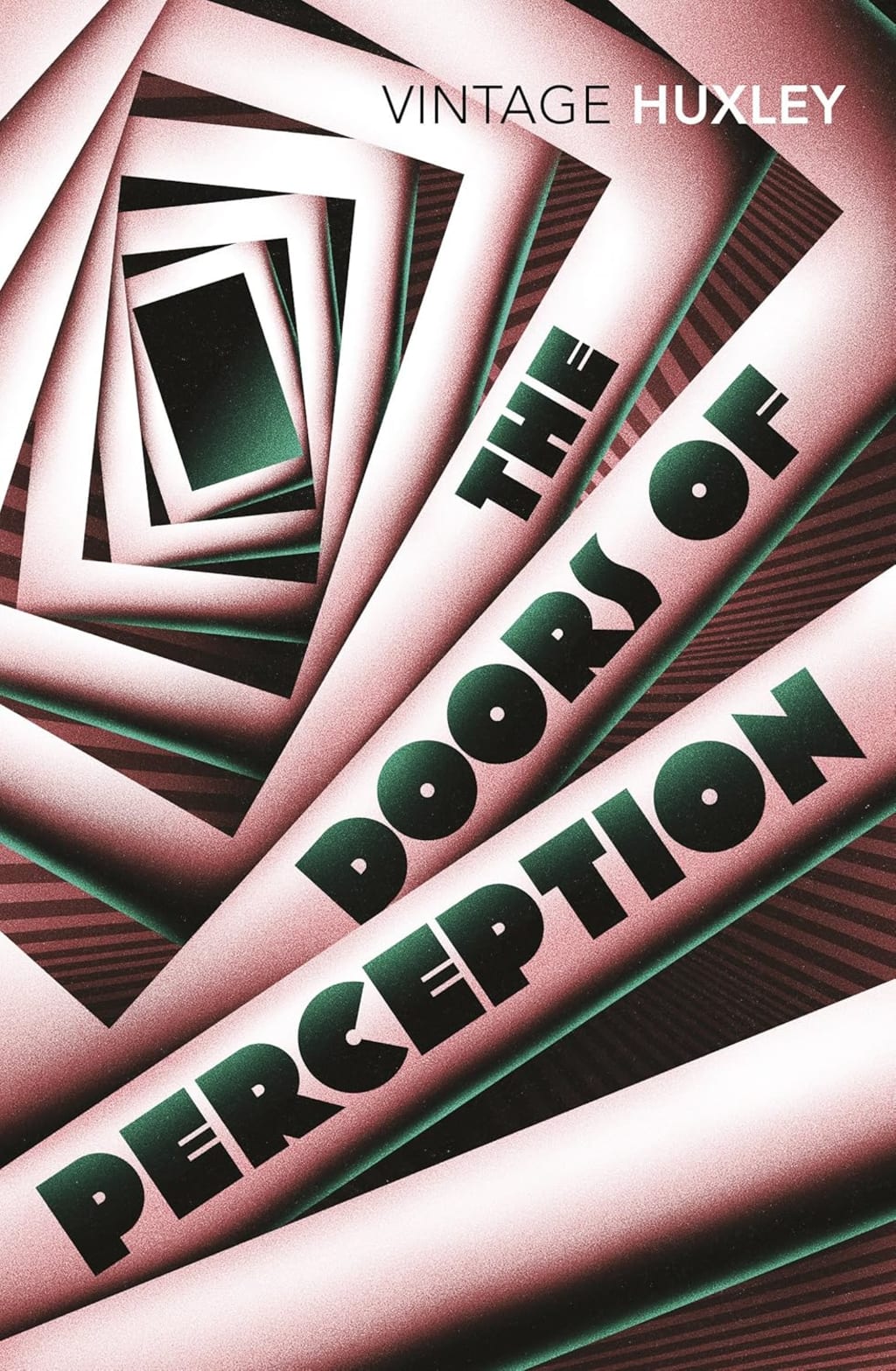
Aldous Huxley is probably best known for his controversial, but brilliant book Brave New World which in some ways, rivals George Orwell's 1984 in its depiction of dystopia. I have enjoyed other works by Aldous Huxley and I have to admit it, I've read Doors of Perception before. I just found a free copy of it and made the snap decision to give it a reread. I was always quite surprised by this book because it seems so different to the usual requests of Huxley's works. Instead of it being a probably future or a social commentary, this is an actual experience. This is an observation of a whole different kind. It is fantastic.
The author starts by describing and explaining his motivation for going under the drug 'mescaline' - a psychedelic, under the supervision of a doctor named Dr. Humphry Osmond. He wants to understand how psychedelic substances alter consciousness, particularly visual perception and the relationship between mind and reality. This might be something that the reader would find short, but if I could possibly make a recommendation of reading before the reading. Recently, I read a book called How to Change Your Mind by Michael Pollan which is all about the motivations for psychedelic research. Perhaps that book might be a good idea to understanding some background to the 'why'.
Our author then reports the first effects: everyday objects lose their practical identity and appear instead as pure shapes, colours, and forms. A simple chair or flower becomes a luminous, transcendent object. He becomes absorbed in looking rather than thinking. This is quite an interesting observation because he's doing it under the supervision of a doctor and yet, he seems to still be getting the full unfiltered experience. Another interesting thing is that he is 'looking' rather than 'thinking' which perhaps links to the ideas in How to Change Your Mind when Michael Pollan looks to the research claims that psychedelics can help people with mental health conditions and addictions. It can quite literally change their brains to make them think about it less.
Huxley sees that surfaces, draperies, and textures become intensely beautiful. He experiences the world as a series of revelations, objects radiate significance independent of use or symbolic meaning. Art becomes not representation but a mirror of visionary experience. I'm not going to lie, this sounds like lots of fun but of course, I'm not going to take psychedelics. For some reason, I'm sure that you could achieve this another way though I'm not sure any of the other ways could be so controlled (I've often heard of a 'suffocation high' in which people suffocate themselves to get high. Please do not do this at all).
Huxley also describes a softening of the sense of self. He feels no urge to judge, categorise, or organise; instead, he passively perceives. This ego-dissolution leads him to think that normal consciousness is narrow, utilitarian, and impoverished. I'm not going to lie, I could have told him this without the drugs. But I digress, there is something really fantastical and interesting about the way in which Huxley describes the experience because he acknowledges how much it changes him. Many people tend to forget experiences or they seem like they are skewed reports of what actually happened. Huxley does not do this - he acknowledges the change and also seems pretty surprised at himself from time to time.
He links the mescaline-induced state to descriptions by Christian mystics, Vedantic philosophers, and Sufi poets. He argues that visions of unity, radiance, and timelessness recur across cultures and may share neurological foundations. This is something that I found in How to Change Your Mind as well. In many books about psychedelics we often find them to be known as the foundations for mysticism, religion and these strange hallucinations of 'gods' that people have throughout the years. It doesn't sound that far-fetched when you realise how commonplace these natural psychedelics were back in these times but then again, it is a strange thing that is very consistently stated throughout psychedelic research. I've always been interested in how true that might be. Is all religion just based on a bunch of people who got high and imagined things?
Huxley admits that language is inadequate to describe the experience (it's also probably why the book itself is so short). He doesn't think there's enough you could say about it and yet, he doesn't go on and on about his own experience. He looks at artists like Vermeer, religious mysticism, and the way in which things change. Upon a second read, and after reading How to Change Your Mind, this book made a lot more sense. You can definitely draw parallels between the two.
About the Creator
Annie Kapur
I am:
🙋🏽♀️ Annie
📚 Avid Reader
📝 Reviewer and Commentator
🎓 Post-Grad Millennial (M.A)
***
I have:
📖 280K+ reads on Vocal
🫶🏼 Love for reading & research
🦋/X @AnnieWithBooks
***
🏡 UK
Keep reading
More stories from Annie Kapur and writers in Geeks and other communities.
Book Review: "The Fran Lebowitz Reader" by Fran Lebowitz
I've wanted to read this book for a while, but you know me, I need to find it for cheap before I go any further. Even Amazon wasn't really doing it too cheap as when I looked at it. I ended up finding it on a used bookstore again and thus, buying it. I didn't know it was a hardback when I bought it, I tend to steer clear from hardbacks because they are a) harder to store and b) not great if you want to carry them around. I prefer paperbacks or even books on my phone or Kindle. Anyways, the bluntness of one Fran Lebowitz is something to behold...
By Annie Kapurabout a month ago in Geeks
Silver Screen Magic with Mae West
American actress and singer Mae West became a popular film actress during the Great Depression. She started entertaining in vaudeville, then performed on Broadway, and finally went to Hollywood. She signed up with Paramount Pictures and made her debut in the 1932 film “Night After Night.” She also starred in musicals, comedies, and crime dramas. The American Film Institute named her one of the best classic Hollywood actresses.
By Rasma Raisters3 days ago in Geeks
Trump’s Attacks on Iran
Tensions between the United States and Iran have once again drawn global attention, fueled by renewed political rhetoric from former U.S. President Donald Trump and an increasingly fragile Middle East landscape. While Trump is no longer in office, his influence on American foreign policy discourse remains strong, especially regarding Iran. His recent statements and past actions continue to shape how the situation is discussed, both domestically and internationally. The ongoing Iran situation cannot be understood without revisiting Trump’s long-standing approach to Tehran—one defined by pressure, confrontation, and a belief that economic and political force could reshape Iran’s behavior. As events unfold in the region, Trump’s attacks on Iran, primarily through rhetoric and policy advocacy, have reentered the conversation at a time when stability is already uncertain. A History of Confrontation During his presidency, Donald Trump positioned Iran as one of the primary adversaries of U.S. foreign policy. His decision to withdraw from the Joint Comprehensive Plan of Action (JCPOA), commonly known as the Iran nuclear deal, marked a turning point. Trump argued that the agreement was flawed, claiming it failed to permanently prevent Iran from developing nuclear weapons and did not address Iran’s regional influence or missile program. Following the withdrawal, the U.S. imposed sweeping economic sanctions under what the administration called a “maximum pressure” campaign. These measures significantly affected Iran’s economy, targeting oil exports, banking systems, and international trade relationships. Trump consistently framed these actions as necessary to protect U.S. interests and global security. That confrontational posture remains central to Trump’s public messaging today. Rhetoric That Resonates Trump’s attacks on Iran in recent speeches and interviews have focused less on diplomacy and more on strength. He often portrays Iran as a destabilizing force in the Middle East, accusing its leadership of funding proxy conflicts, threatening U.S. allies, and undermining regional peace. This language resonates with segments of the American public who favor a hardline approach to foreign policy. At the same time, critics argue that such rhetoric escalates tensions rather than easing them. Words from influential political figures carry weight, especially when they echo previous policies that brought the two nations close to direct confrontation. Even without immediate military action, strong language can affect markets, diplomatic relations, and public perception across the region. The Current Iran Situation Iran today faces a complex set of challenges. Economic pressure from sanctions continues to strain daily life for many citizens, while internal political dynamics remain tense. Regionally, Iran is involved in multiple theaters through alliances and influence, making it a central player in broader Middle Eastern conflicts. Against this backdrop, Trump’s renewed focus on Iran adds another layer of uncertainty. While the current U.S. administration may pursue different strategies, Trump’s voice amplifies debates about whether negotiation or force is the more effective path forward. Supporters of Trump argue that his tough stance kept Iran in check, claiming that pressure limited its resources and influence. Opponents counter that the approach isolated the U.S. from allies and reduced opportunities for diplomatic solutions, leaving the region more volatile. Global Reactions and Diplomatic Concerns International responses to Trump’s attacks on Iran have been mixed. Some U.S. allies in the Middle East view his rhetoric favorably, seeing Iran as a shared threat. Others, particularly in Europe, remain cautious, emphasizing the importance of dialogue and multilateral agreements. Diplomats warn that escalating language can undermine ongoing efforts to stabilize the region. Even symbolic threats or aggressive statements may provoke responses that spiral beyond control. In a region already marked by conflict, restraint is often seen as a necessary component of effective diplomacy. Political Strategy at Home Trump’s focus on Iran is also tied to domestic politics. Foreign policy strength has long been a cornerstone of his political identity. By highlighting Iran as an adversary, Trump reinforces his image as a leader unwilling to compromise with perceived threats. This strategy plays well among voters who believe the U.S. should project power globally. However, it also raises questions about long-term consequences. Critics argue that consistent confrontation without clear diplomatic off-ramps risks entrenching hostility rather than resolving underlying issues. What Comes Next? The future of U.S.-Iran relations remains uncertain. While Trump’s attacks on Iran currently take the form of rhetoric and policy advocacy rather than direct action, their impact should not be underestimated. Political language can shape expectations, influence decision-makers, and affect the behavior of nations. For Iran, continued pressure may harden positions within its leadership, reducing incentives for compromise. For the United States, balancing strength with diplomacy remains a delicate challenge—one that will define its role in the Middle East for years to come. Conclusion Trump’s attacks on Iran reflect a broader debate about how powerful nations should handle long-standing adversaries. Is pressure the path to peace, or does it deepen divisions? As the Iran situation continues to evolve, the consequences of words spoken today may shape realities tomorrow. In a world already facing uncertainty, the need for measured dialogue, strategic thinking, and global cooperation has never been greater. Whether confrontation or communication ultimately prevails will depend not just on leaders, but on the choices they make in moments of tension.
By Saboor Brohi 5 days ago in Geeks


Comments (1)
This sure does seem fascinating. Also, that suffocation high is soooo scaryyyy! Loved your review!