
Book Review: "Criminal" by Tom Gash
5/5 - an intriguing book which investigates several 'myths' as to why crime is committed and by whom...

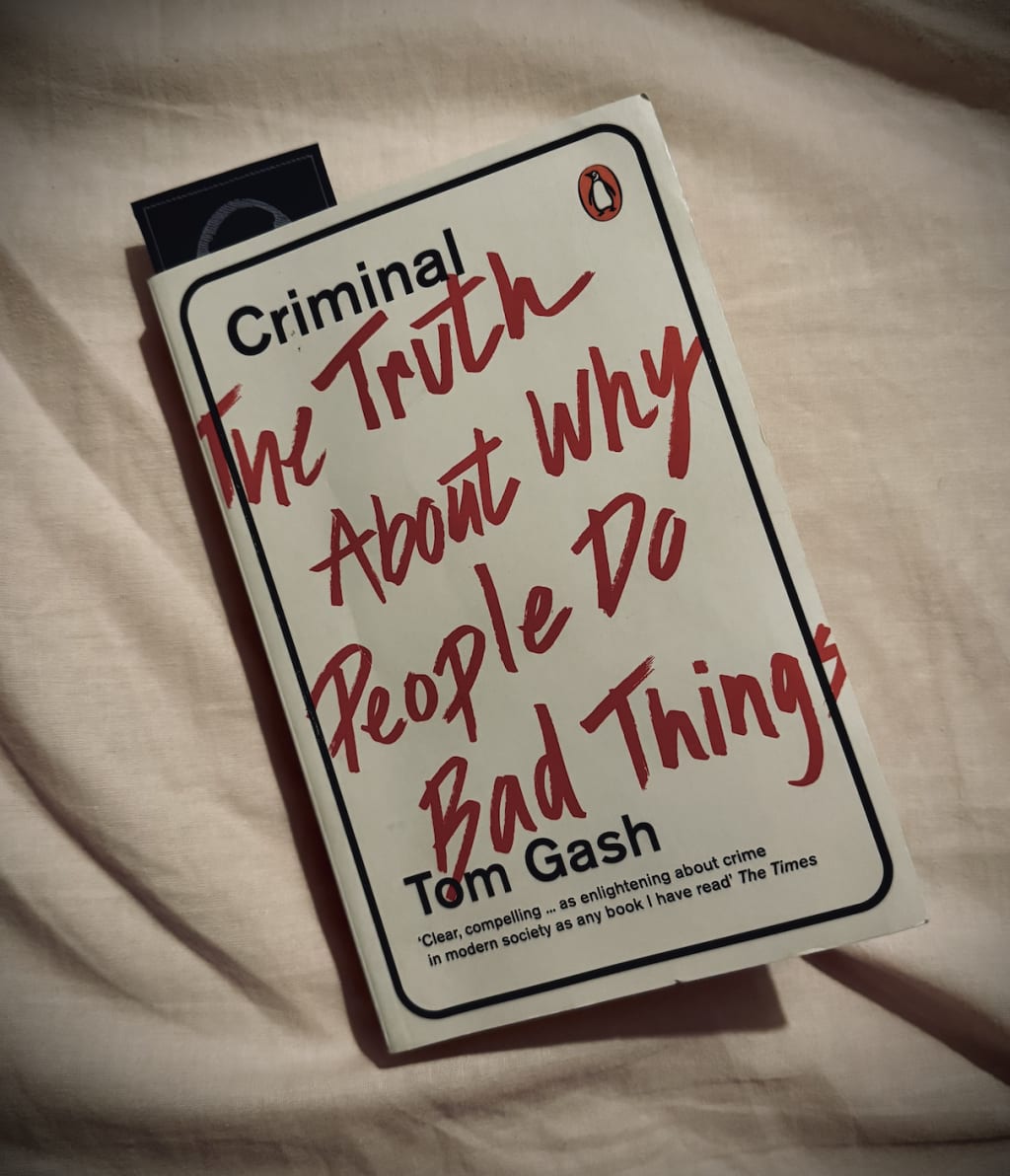
Subtitled The Truth About Why People Do Bad Things, Tom Gash's book focuses on the way in which we interpret crime, how we see factors relative to crime and of course, why those who commit it choose to go in that direction. The book is an interest read complete with graphs and data, but also shows the reader why data and statistics perhaps, may not be able to explain everything and how the amount of variables that are actually within the sphere requires them to be cut down by the researcher - creating implicit bias as to which variable is 'valued' over another. It's a book that works with an incredible amount of research and explanation to tell the story of why people do bad things.
Tom Gash states that the main myth of crime is to tell you it is rising when, in fact, it is either staying relatively the same or it is falling in very small amounts. He suggests that one of the main issues that people have when it comes to crime is that we feel it is rising, and the graphs mean that the staticians who can't fit every variable to do with crime on to them - are biased to choose in favour of what will best represent their own hypothesis. Of course, for anyone who likes to read books about statistics, this is not going to want to make you carry on reading them because the bias is actually quite extreme.

This in turn, has an impact on to the way the data is interpreted and thus the politicians keep parroting the 'we will cut crime' line inserting words like 'violent' or 'misogynistic' in order to get people to vote for them. Apart from this, we are sort of lost on the variables that cause crime; can it really be put down simply to poverty and social inequality? Well, if you're going to believe the statistics, then you might as well believe a graph which compares the winner of the Miss America competition to the number of violent crimes in which steam or something hot was the weapon involved (because yes, that's in the book). Tom Gash basically tells us that there is no way to completely know everything, but in this book he is definitely going to do his best to give us somewhat of a picture, even if it isn't completely coloured in.
If we are to look at the section regarding those who make a life out of crime, we get the 'career criminal'. This, Gash states, is an unattractive lifestyle as the older you become, the less crime you commit. These criminals tend to display a higher crime rate when they are in their teens and twenties - this is important to note suggests Gash as this 'career' aspect of criminality would be, in all aspects, far before any regular person develops an actual career (which is more 30s and 40s). He also takes a look with the problematic ways in which we deal with child criminals. For example: the murderers of James Bugler are used as the prime example. The children who committed the murder are viewed as the statistical anomaly whereas the victim is viewed as the pinnacle of innocent childhood.
This perspective was pushed, Gash states, by Charles Dickens who depicted even the most desperate children living in crime-ridden conditions, to be innocent of all charges and as he shows Oliver Twist as one of these examples, death would be preferable to committing crime. This simply isn't true - states the author. But is it true that children have to be socialised out of bad behaviour? Well yes, especially for boys to whom from an early age, hitting and biting seems an apt way to get what they want. Over some months and years of training and teaching however, this can be socialised out of them. An interesting take, but the two don't quite link together in my head that easily. I have to admit, I found it difficult to believe that if you were to socialise a child out of bad behaviour from an early age, they would go on to commit no crime.

Another chapter seems to tackle the idea that organised crime is an exception rather than a rule, and honestly I couldn't agree more. A lot of people tend to overestimate how involved organised criminal gangs, mobsters and mafia figures are in the world of politics, criminal activity and the like. To treat these people as if they are the rule misses a bigger picture that could be looked at in order to determine how politics might actually be influenced by which companies the politicians themselves hold shares in. It is not always as easy as pointing to a Corleone-like mafia figure. But it is also true that these figures seem to kill each other more often than taking hits on random people.
Gash goes through the possibilities for biological determiners for criminality. He starts with addressing the case that in some cases, there have been brain issues, such as damage or tumours, found in a few examples of killers - including one man who threw his unconscious wife from a 12th story window. He rightly states that this cannot be used as a crux for murder, but that it is important to determine it whenever there is a murder case. On top of this, we see that places like the pre-frontal cortex - the part of the brain responsible for reason and the understanding of consequence - is much slower in the minds of those who commit violent crime (as depicted by an experiment referred to in the text).
Poverty doesn't equal criminality, states Gash in one of the chapters and honestly, I have to agree. Gash shows us that there is no evidence that someone being in poverty increases their chances of becoming a criminal. However, the communities that experience poverty and loss of services are more likely to be those that have rising crime rates. The author gives the example of Detroit, Michigan and how it got rid of the block where Diana Ross once grew up, knocking them down as a 'symbol' of reinvention without very much movement afterwards. Be that as it may, he does give us some updates because of the little bits of levelling up the city is trying to do. All in all, we are shown that poverty, immigration and the like do not necessarily mean (nor do cause) the crime rate going up. Also, the wealthy are probably even more likely to see the opportunity for crime to be committed in a situation where there is something to be gained from it.
To conclude this lengthy review, the book is an interesting look into the world of criminality and basically proves that it isn't going up - we are just gaining more access to more of it via our news sources that are ever-evolving. When it comes to the root cause of crime though - it is both everything and nothing at the same time. There are so many different theories as to why criminality exists but Tom Gash does a special thing - he tries to teach us how we can help solve it.
About the Creator
Annie Kapur
I am:
🙋🏽♀️ Annie
📚 Avid Reader
📝 Reviewer and Commentator
🎓 Post-Grad Millennial (M.A)
***
I have:
📖 280K+ reads on Vocal
🫶🏼 Love for reading & research
🦋/X @AnnieWithBooks
***
🏡 UK
Keep reading
More stories from Annie Kapur and writers in Geeks and other communities.
Book Review: "Pseudoscience: A Very Short Introduction" by Michael D. Gordin
If I've said it once, I've said it a thousand times: I love free books. I also love dipping my toes into the Very Short Introduction series, especially when I'm between bigger books. I've read those on Biblical History, I've read some on philosophy and now this one, is on pseudoscience. From UFOs to Anti-Vaxxers, from eugenics to how the Russians basically made up their own science during the height of communism, from the planets to the human body - pseudoscience is everywhere. But what is it, where did it come from, and what are the different forms it can arise in? Well, the truth is that pseudoscience is just as old as science itself...
By Annie Kapur2 days ago in Geeks
Marvel Zombie
The last entry into our 2025 superhero projects catalogue is Marvel Zombies. This was a show that was anticipated by absolutely no one and it disappeared from the public consciousness as quickly as it was released. There was nothing special about the project that made it a must see, or a must remember. In fact if anything it's a must forget.
By Alexandrea Callaghan27 days ago in Geeks
Superstar Sanjay Dutt & Filmmaker Rahul Mittra get a rousing welcome in Nepal
Kathmandu witnessed a surge of excitement as Bollywood star Sanjay Dutt, accompanied by close friend and noted filmmaker actor Rahul Mittra, arrived in Nepal for a culturally significant visit that blended spirituality, heritage, public interaction and personal camaraderie.
By Dena Falken Esq5 days ago in Geeks



Comments
There are no comments for this story
Be the first to respond and start the conversation.