
Book Review: "Butcher" by Joyce Carol Oates
4/5 - it may not be subtle, but it was still very interesting to read...


It’s getting later into April 2025 and I’m currently sitting in a coffee shop listening to a new episode of a great podcast. I’ve just drank an Americano and now, you’re going to be subjected to another review. Joyce Carol Oates is a great writer. Her novel “The Book of American Martyrs” is probably one of the most moving books I’ve ever read. Another book by her I loved was called “The Sacrifice” which is relative to that last one.
I’ve probably read around ten of her works and for Joyce Carol Oates’ output, that probably isn’t a lot. Another great book you should read by her is called “Carthage” - it’s awesome. All three of these books have one thing in common: they deal with the strained relationship between men, women and real life and how there can be good and bad people in both genders. So, as we wade into the waters of this book entitled “Butcher”, we must keep that in mind.
From a fairly obscure background of failing to court a few women, Dr. Silas Aloysius Weir is a 19th century physician who slowly climbs the ladder to become the director of the New Jersey State Asylum for Female Lunatics. He believes that women's mental illnesses stem from their reproductive organs, leading him to perform invasive and often brutal procedures. As we read the book, we start to see what he is actually doing unfold. From learning his craft to looking fairly pathetic before he becomes the director - Dr. Silas Weir seems to take his failure to gain a mate out on the most vulnerable of them. Joyce Carol Oates writes about his ascent to power as a mixture of idiocy, nepotism and societal norms against women at the time.
The asylum serves as a setting where these societal norms and medical practices converge to oppress women. In the style I can only relate to Josef Mengele, there are very invasive surgeries that women are subjected to without consent which include, but are not limited to sterilisations. This environment underscores the systemic misogyny embedded in 19th-century medicine and society at large. It is also the perfect place for Dr. Silas Aloysius Weir to flourish in his beliefs that female madness originates from something ingrained within their reproductive system. I know it sounds crazy but you have to remember that this is the 19th century we are talking about.

Brigit, a deaf and mute Irish adolescent, becomes one of Weir's primary subjects. Her inability to communicate makes her his perfect victim in a style I can only relate to a sort of Titus Andronicus situation. Her experiences of him 'correcting' a fistula in her are only the beginning of Brigit representing marginalised and disabled people who were unable to communicate their needs during an era that was so heavily skewed against them. She also characterises that vulnerable class that were only about to be exploited by people in power during that period. It is horrifying what she is subjected to.
The narrative is seen through Weir's eldest son who wavers on his father. On one hand, he rejects his father's legacy but on the other hand, we don't quite know where he actually stands. It is inspersed with these moments of 'editor's notes' amongst other things. It is clear the narrative is not entirely linear but tries its best to be something along those lines. I love the way it begins as we get a flavour of the graphic body horror that is to come. Joyce Carol Oates sure does know how to put a story together. It reminds me of her other books where narratives overlap and events we see through one eye, we also see through another. As perspective shifts, the 19th century oppression of women remains an under-current of the book.
I was probably most surprised to learn that this was based on a real person and the real doctor treated the writer Charlotte Perkins Gilman (The Yellow Wallpaper) with bed rest. Bed rest is not where you are physically too ill to get out of bed, but it is instead voluntarily lying in bed for long periods of time in order to cure an illness. He also treated Virginia Woolf and she hated it so much she satirised him in her book Mrs Dalloway. It is clear that the real doctor had several female patients suffer horribly under his care and that The Yellow Wallpaper is actually directed at him.
All in all, I thought this book interesting though not really one of Joyce Carol Oates' most subtle. It is captivating as it is disturbing and still a book for all JCO fans to read out there if they have not done so already.
About the Creator
Annie Kapur
I am:
🙋🏽♀️ Annie
📚 Avid Reader
📝 Reviewer and Commentator
🎓 Post-Grad Millennial (M.A)
***
I have:
📖 280K+ reads on Vocal
🫶🏼 Love for reading & research
🦋/X @AnnieWithBooks
***
🏡 UK
Keep reading
More stories from Annie Kapur and writers in Geeks and other communities.
Book Review: "A Haunting on the Hill" by Elizabeth Hand
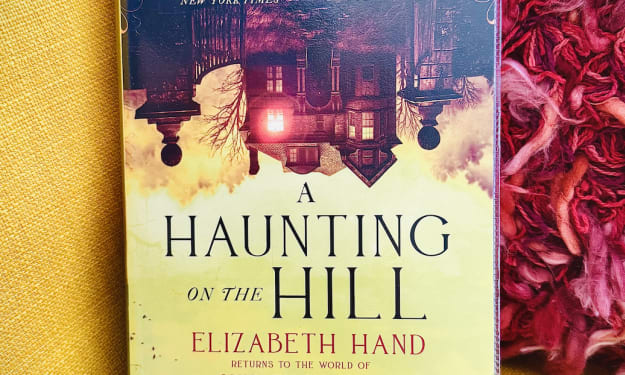
So, we have returned to the world of The Haunting of Hill House and it's only May. I will make it my business to read the horror books, especially these that are quite rare in which they pay homage to another story. I am not going to lie, I went to the library and basically raided the horror section picking up anything that sort of looked good. I know you shouldn't judge a book by it's cover, but there was something so intense about this cover that I almost missed the subtitle in which it talks about returning to the world of Shirley Jackson. So, let's dive in...
By Annie Kapur8 months ago in Geeks
The Rachels - 2025
Much to my surprise, I have kept a list of the films I‘ve seen this year. I daresay it isn’t complete. There will be films that snuck in on a late night in front of the TV that I would’ve forgotten to note. Or others, that I went to watch at the cinema, but then had a red wine and promptly forgotten about. But it’s not a bad approximation of the films I’ve seen this year. In total, there are 53 films listed, so an average of one a week and one for good luck.
By Rachel Robbins26 days ago in Geeks
Jujutsu Kaisen Season 3 Dropped in Quality, and Here’s What Went Wrong
Jujutsu Kaisen Season 3 had a remarkable opening, with its first two episodes being exceptionally well-made. We got two back-to-back episode releases, and the way it was produced left everyone awestruck. However, when Jujutsu Kaisen Season 3 episode 3 dropped, it was very apparent that this particular episode was not that great. It was filled with details, and the pacing was hard to get through. But is it because the quality of Jujutsu Kaisen Season 3 dropped, or was this a necessary strategy for the makers to prepare the audience for what’s to come?
By Dena Falken Esq2 days ago in Geeks


Comments (2)
Damn, that sounds intense. Oates really doesn’t hold back. I hadn’t heard of Butcher before, but now I’m weirdly curious even if it sounds kind of horrifying. Thanks for the heads-up.
You've got an interesting take on Joyce Carol Oates' books. I haven't read these, but the themes you mention sound compelling. It's eye-opening how you connect her work to the misogyny of the 19th century. Makes me wonder how she manages to bring such dark historical aspects to life so vividly. Do you think her writing style makes these tough subjects more accessible or just more disturbing?