
Book Review: "A Small Revolution in Germany" by Philip Hensher
2.5/5 - halfway marks for a halfway book...

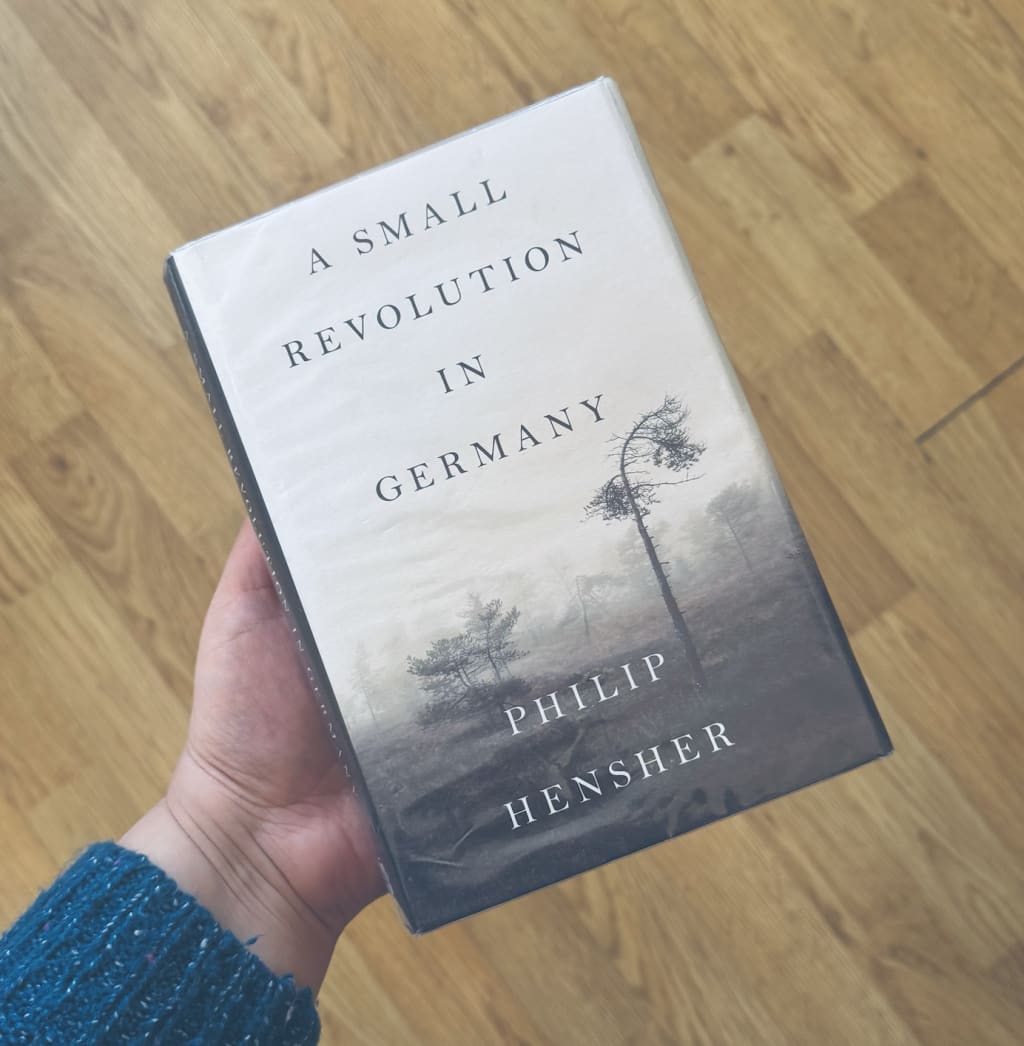
It's late April 2025 and I am a bit stuck. I have no idea whether I actually enjoyed this book but what I do know is that I found it a bit difficult to get my head around the main message. I think that was because what I thought was not the message of the text was in fact, the message of the text: radical thoughts age. Here's where I find a problem: the author goes on about this message for so long that I feel by the end of the book, it has sort of lost its meaning. I didn't come out of the book feeling the way I do when I've read something enlightening. Instead it fell a little flat for me. Let's explore what it's about.
The novel starts with Spike telling us about being a teenager in an independent school where he witnesses a boy named Percy Ogden stand up to the headmaster about the point of sending boys into the military. Apart from the familiar linguistics associated with going to these types of schools which I am quite familiar with, I did feel like the speech Percy made was kind of ridiculous, however what I didn't know is that the entire point of the book is based off this one instance. It doesn't really make for reading that moves you, but I guess it would be fun if you were relatively the same age as the characters within the book at the time.
There are moments in the early stages of the book where they sit in cafés and talk about the philosophies and politics of being a revolutionary. This is not only a highly unusual thing to do for teenagers who before this particular speech by Percy didn't discern themselves as having an interest in this sort of thing, but it is also just a bit of a cliché at this point. I enjoyed reading about the weird arguments they got into, for example: there was one about whether the owner of the café had a son who made the cakes at home and that, in some cases, you were able to taste the emotion he had made them with in the cake. The reply was that perhaps there was no son, and perhaps the tags on the cakes were either there to begin with or someone changed them around - stealing the true cakes. Even though this conversation in particular went on for a little longer than I might have liked, it was still fairly interesting to consider.
The whole novel itself though is Spike's flashback upon his existence as a revolutionary thinker on the sort-of-outside of a circle of even more revolutionary thinkers in the 1980s. In the present day, some decades later, he is almost longing but also upset about the lost days of being that person in conversation once. One of the friends named James is someone Spike recalls very well as a man who once smelt terrible and was the child of a strange pub landlord. However, Spike states that James completely reinvents himself to become Home Secretary. I can't help but think how honest Spike is being about his memory. I mean would you remember the exact smell of someone all those years later?
At moments, the book can be funny about the way in which politics can be a simply stupid game for immature rich boys to play. From copying the salons of the days of Diderot, to a scene where a bunch of teens hurl a television out of a window and attack an elderly woman. The author does a good job at exploring the difference between the then and now by producing a character in full form. Spike is an openly gay man living with his partner, the relationship is written very well and with a lot of depth but, the way in which the author explores the past is riddled with overtly long sections of satire which kind of take away from the humour of the situation and memories which seem like they couldn't really be remembered so accurately.
All in all, I found this book to be a middle-of-the-road read. I didn't absolutely hate it, but I also didn't enjoy it as much as I thought I would. There was something constantly missing for me in this book. I'd say read it and decide for yourself whether you feel so too. Perhaps it's me who is missing something. It is a good book, it just could have been more than it was.
About the Creator
Annie Kapur
I am:
🙋🏽♀️ Annie
📚 Avid Reader
📝 Reviewer and Commentator
🎓 Post-Grad Millennial (M.A)
***
I have:
📖 280K+ reads on Vocal
🫶🏼 Love for reading & research
🦋/X @AnnieWithBooks
***
🏡 UK
Keep reading
More stories from Annie Kapur and writers in Geeks and other communities.
Book Review: "Shakespeare's Book" by Chris Laoutaris
I think I can speak for all of us friends when I say that we would all like to know how Shakespeare's First Folio was created. Shakespeare's First Folio was the first compiled collection of Shakespeare's plays. Published in 1623, it has a really cool sketch of Shakespeare on the front and compiled by Edward Blount, William Jaggard and Isaac Jaggard. With just over 230 known to be in existence after a possible 700 copies having existed once - I would be so excited if we found more. I find that if you would like to know more - the Wikipedia page seems to be pretty good for it, the information is correct and accessible. A great resource before you take flight with this beautiful book by Chris Laoutaris.
By Annie Kapur8 months ago in Geeks
Silver Screen Magic with Mae West
American actress and singer Mae West became a popular film actress during the Great Depression. She started entertaining in vaudeville, then performed on Broadway, and finally went to Hollywood. She signed up with Paramount Pictures and made her debut in the 1932 film “Night After Night.” She also starred in musicals, comedies, and crime dramas. The American Film Institute named her one of the best classic Hollywood actresses.
By Rasma Raisters7 days ago in Geeks
Jack of All Trades
Johnny Sins is a name that has become synonymous with versatility and charisma in the adult entertainment industry. Known for his diverse career, Johnny has built a reputation as the "Jack of all trades," a title that he has earned through his multiple roles within the industry and beyond. From his notable performances in adult films to his successful career as a content creator, Johnny Sins has become a pop culture icon. In this article, we will explore who Johnny Sins is, why he is referred to as the "Jack of all trades," and how he continues to captivate audiences worldwide.
By John Smitha day ago in Geeks


Comments (1)
I get what you mean about the book losing its impact. The long-winded message did seem to drag. And those teenage philosophies felt forced. I've read books where characters' deep talks felt natural. Here, it was like they were trying too hard. Did you think the story could've been salvaged if the focus was tightened? Or was it a lost cause from the start?