
Book Review: "A Quiet Evening: The Travels of Norman Lewis" by Norman Lewis
5/5 - a gorgeous, anti-sensational travel narrative...

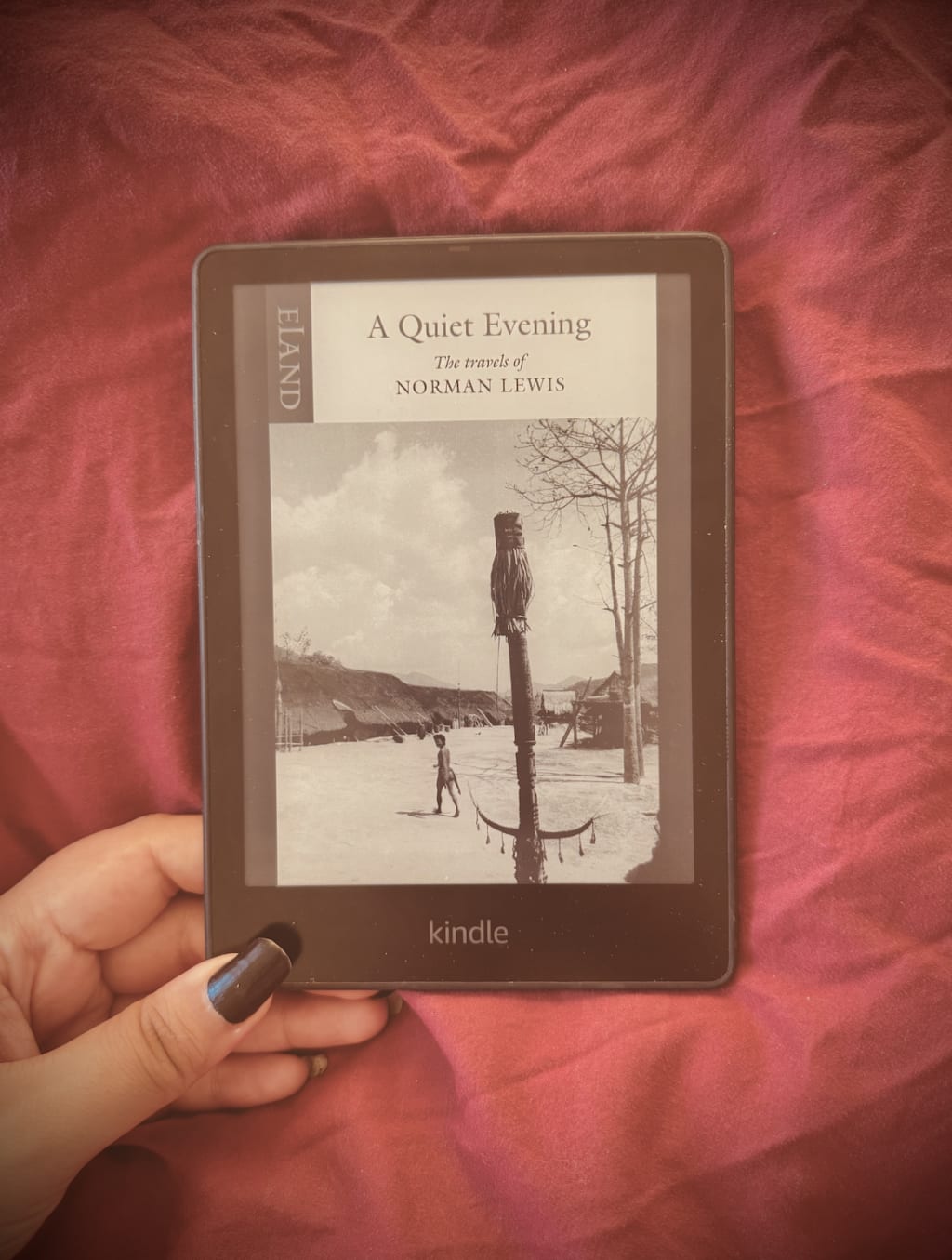
Norman Lewis was a man I had heard of before. I knew a little about his travels and the way in which he went purposefully off the beaten track. This edition of his travels was published in 2022 and made for apt reading between books. When it comes to travel literature, I've normally enjoyed everything from Kerouac to Bryson and then all the way to Jan Morris' writings on Italy. I don't always read travel narratives, but if you pay close attention to my blog, you'll notice I published a piece by Paul Theroux recently. Let's take a look at this collection then...
The collection begins with Norman Lewis situating himself in a kind of twilight stage of his career: an older writer recalling decades spent on the road, often in overlooked, fragile, or vanishing communities. Rather than telling a continuous story, Lewis stitches together episodes from many journeys in Asia, Latin America, Africa, and the Mediterranean. What unifies them is not geography but his sensibility: understated, observant, sympathetic to ordinary people, and quietly critical of power. He avoids sensationalism and tries to depict every one of these places as realistically as possible. If you've read about the life of Norman Lewis this makes perfect sense. His comments on conversations and fragments are so intricate as he focuses on details rather than large landscapes and generalisations.
One of the strongest sections recalls Lewis’s travels in Indochina, including Vietnam, Cambodia, and Laos. Unlike most Western accounts of the region in the mid-20th century, which were dominated by war reportage, Lewis focuses on the quieter rhythms of life: Buddhist rituals, village ceremonies, and the resilience of rural communities. He notes how, in a context of political upheaval and violence, daily life nonetheless goes on: monks chant, children play, markets bustle. I love the way he uses the way these images to show us that life under such conditions still continues, if not changed very slightly according to how close to the political upheaval they are.
Lewis devotes several chapters to Latin America, especially Guatemala, El Salvador, and Nicaragua, regions where indigenous traditions coexist uneasily with military regimes and creeping modernisation. He writes with deep sympathy for indigenous communities, noting their attempts to preserve language, dress, and ritual in the face of both cultural erasure and outright violence. His depictions are stark: soldiers in plazas, propaganda on walls, but also weavers at work and farmers tending fields as they always have. His analysis of cultures as they are seems to be one of the highlights of the book, but if we were to mix this into his attention to detail what we have is a very genuine picture of a travel rather than an experience of landscapes and glamorisation. His places are realistic, his voices are very human and his ability to comment on the time is done without the sensation of media writing. It is simply so raw.
His writing on the Caribbean highlights the creativity and endurance of small island societies. He visits places where colonial legacies are visible in architecture, bureaucracy, and class structures, yet where music, storytelling, and spiritual practices provide continuity. He describes survival economies: fishing, small-scale farming, informal trade, all carried out under the shadow of external economic pressures. There is something both affecionate and melacholic. He finds joy in the festivals and gatherings, but notes how the poverty also persists in these places. Instead of glistening beaches, he analyses real life and keeps that sympathetic tone no matter how much his dry humour tries to surface.
Lewis repeatedly notes the loss of languages, rituals, and local economies under the pressures of globalisation, tourism, and political change. He does not indulge in nostalgia for an imagined “pure” past, but he is attentive to how quickly difference vanishes. Villages he once visited are transformed into tourist resorts within years; traditions once central are reduced to performances for outsiders. He takes a slightly elegiac tone and well, as things change - he must accept it even if he mourns it too.
All in all, there is so much in this book to explore about a man who has not only travelled far but has also observed the very truths of the cultures throughout his journeys. He acts not only as this observer, but as the communicator between the people and the reader - he sends us no glamour and no sensation, but a raw experience of those who live their everyday in these places that are far more complex than we usually care to think about.
About the Creator
Annie Kapur
I am:
🙋🏽♀️ Annie
📚 Avid Reader
📝 Reviewer and Commentator
🎓 Post-Grad Millennial (M.A)
***
I have:
📖 280K+ reads on Vocal
🫶🏼 Love for reading & research
🦋/X @AnnieWithBooks
***
🏡 UK
Keep reading
More stories from Annie Kapur and writers in Geeks and other communities.
The Lizzie Borden House
Welcome back to 'Why It's Shifty' and today we're covering the Lizzie Borden House. The story of Lizzie Borden is a famous one no matter what you believe about the verdict. The legal implications of the time are as fascinating as the story of the house itself. It has become one of the most incredible narratives of houses next to the Winchester Mansion. Let's take a look at the case, the aftermath and the theories that shine a light on what goes down at the Lizzie Borden House...
By Annie Kapur4 months ago in Geeks
Silver Screen Magic with Mae West
American actress and singer Mae West became a popular film actress during the Great Depression. She started entertaining in vaudeville, then performed on Broadway, and finally went to Hollywood. She signed up with Paramount Pictures and made her debut in the 1932 film “Night After Night.” She also starred in musicals, comedies, and crime dramas. The American Film Institute named her one of the best classic Hollywood actresses.
By Rasma Raisters6 days ago in Geeks




Comments (2)
Great review, but probably not for me, but you amaze me with the number of books you get through. I once read a 700-page Dean Koontz novel in a single sitting, but that doesn't happen very often 👍
Oh wow, I was today years old when I learned what Indochina is 😅😅 This isn't my kinda book but I enjoyed your review!