
Binge-Watching The Bard: Shakespeare During the 'Lockdown'
My (Not-So) Guilty Pleasure


Over the past 12 months I've gorged on 'Ozark', 'Better Call Saul', 'Sherlock', 'Gotham', and watched more CNN than I am sure is healthy for me.
However, in between viewing Benedict Cumberbatch solving impenetrable mysteries, Jason Bateman trying to keep his fictional family intact, Bob Odenkirk being... well, Bob Odenkirk, the ne'er do wells of Batman's hometown being gloriously villainous, and the strangest Presidential election in history unfolding (often painfully) in front of me, I've also binge-watched something else entirely.
Shakespeare.
Lots of it.
Initially, this was done in readiness for my Masters. However, at some point, it stopped being about study, and pure enjoyment kicked in.
Because - although I might have forgotten this - the plays are damn amazing. Honestly, there's a reason why the son of Stratford's words live on.
You want heart-breaking romance? You got it. How about some underhand, political shenanigans? There's loads. Pitch-black comedy? Take a seat - plenty of that to be found. And that's not to mention the unalloyed violence, searing social commentary, and utterly ludicrous cross-dressing.
It's all breathtaking.
If you haven't taken the chance to either immerse (or re-immerse) yourself in Shakespeare during the pandemic, here's my top 5 Bard-related suggestions to help you do so.
All 5 were made for TV (so there's no talk of Branagh's majestic 'Hamlet' or Kurosawa's epic 'Throne of Blood', or Luhrmann's groundbreaking 'Romeo and Juliet.'). All of my suggestions can be found on Netflix, Amazon Prime, YouTube, and the like, and were made to seen that way.
So, strap in, and let me share my (not-so) guilty pleasure: Shakespeare on the small screen:
1. 'Macbeth' (2010)
Let's start with a biggie; 'The Scottish Play.'
Not only is it one of Shakespeare's most famous works, this adaptation is a perfect primer for those apprehensive about the playwright. It's accessible, clear, and wonderfully entertaining.
It's also got Sir Patrick Stewart doing what he does best. Forget Picard, or Professor X; if you want to understand why the actor is so revered, just watch him performing Shakespeare.

In many ways, this adaptation shouldn't work. No longer bound by the restrictions of a theatre stage, the best cinematic or television Shakespearean re-workings 'open up' the world of the play, stressing the epic themes of the plays with visuals to match.
Not here.
'Macbeth' was directed by Rupert Goold, and is an adaptation of his stage production from 2010. And its theatrical origins are clear; it's entirely filmed in one location, Welbeck Abbey in Nottinghamshire, England.
The production makes excellent use of the opulent areas of the residence, but most of the action is confined to the parts of a stately home we don't normally see; the more modern, yet dilapidated, tunnels underneath the sprawling property, the functional, industrial kitchens... after all, isn't that where schemes are ordinarily concocted, behind the scenes?
There is a faded, almost Communist-era aesthetic, supported by the actor's costumes - modern, but slightly out-of-date; we could be in any time from the turn of the twentieth century right up until the 1960's.

Cleverly, the parallels are never rammed home with too much force, but it's not difficult to imagine Stalin or Ceaușescu prowling those spaces, as Macbeth does, wracked with paranoia, fretting over as to should be 'removed' next.
Instead of opening up the world of the play, this one setting locks it down even further, suffocating it. We are trapped in this one place, smothered by an ever-increasing sense of claustrophobia.
And that is simply perfect.
For, despite the geopolitical narrative, 'Macbeth' isn't about kingship, or even leadership. It's about one couple's unstoppable spiral downwards, about their descent into bloody, violent madness. The more power the Macbeths acquire, the more damaged they become.
And the more broken they become, the more trapped they are, caught in a brutal world of their own making. One from which escape is impossible.
The limited location accentuates this. We - like them - are caught in this one place. The only two things that can free us are death, or the end of the play.
Sadly, I've never been able to see Stewart 'live.' And, based on his performance here, I have missed out on something wonderful.
Initially, I thought him too old to play the battle-hardened general, but that's only due to a misguided preconception based on the fact that Macbeth is normally played by actors in their middle-age. In reality, there is no reason why an older actor can't play Macbeth.
Lear HAS to be old, as does Prospero. At the other end of the scale, Romeo HAS to be relatively young. However, Macbeth can be any age an actor or director chooses. If anything, making him older adds an extra edge to the play, and makes his ambitious greed even more believable.
In Stewart's rendering, Macbeth has spent decades being his monarch's 'blunt instrument' - how many times has he committed carnage to keep the King on the throne? How many battles has he fought in, how many people has he killed? And for what? A new rank. Nothing more.
Although unforgivable, we can understand why Macbeth jumps at the chance to receive a greater reward. After all, given all that he has done, why shouldn't he be more important, more powerful? Surely he deserves it?
He certainly thinks so.
Except, as he discovers, once he starts on that journey, there is no turning back, and no happy ending to be found.
His murderous actions at the outset set in motion a sequence of events he cannot control; the best he can do is not drown as he swept along with them. The infamous lines, "I am in blood, Stepped in so far, that, should I wade no more, Returning were as tedious as go o'er'" never resonated so loudly. We watch, horrified, as Stewart's Macbeth disintegrates in front of us, trapped in a nightmare his own hands have wrought.
However, the Macbeths are a couple; the play simply doesn't work unless BOTH parts are well-cast. And, in Kate Fleetwood, Stewart has the perfect partner-in-crime.

Like her husband, it's established that Lady Macbeth is already unstable from the beginning; the Witches' prophecies might give them both the excuse to embark on their murderous spree, but that impulse was there, dormant, waiting for a spark to be ignited.
And like her husband, once that spark is ignited, Lady Macbeth finds herself ill-equipped to deal with the repercussions. While her husband's madness grows larger, her's collapses in on itself. Fleetwood charts the journey from prepossessed stateliness, to fragility with painful credibility.
Stewart and Fleetwood are supported by a skillful, and experienced cast; from the three witches, to the Royal Family, there's not a bum note.
It's probably the best Shakespeare I've seen on the small-screen. And, as for binge-watching? I've watched it three times since the 'lockdown' began - this weekend will be fourth.
Just amazing. Watch it.
2. 'Shakespeare's Heroes and Villains' (2019)
Let's move onto something a bit different, courtesy of another of England's theatrical titans, the never less than entertaining Steven Berkoff.

Berkoff is the master of the one-man show. He's also not to everyone's taste. Whereas some actors prefer the more naturalistic 'method' style of performance, Berkoff - unashamedly - inclines towards the 'theatrical.'
He's big, bold, and bravura. And never less than entertaining.
'Heroes and Villains' is a fast-paced romp through Shakespeare's biggest and best goodies and baddies. In between some wonderfully enacted renderings of the most famous soliloquies in literary history, the audience is also treated to Berkoff's own, often idiosyncratic, opinions on the characters themselves, and the theatre as a whole.
Given his pedigree as an actor, writer, and director, he knows what he's talking about. You might not always agree with his views, but there are moments of staggering illumination; his explanation behind Richard III's motives are priceless, and it's worth watching the whole thing for those alone.
As is his discussion of 'Henry V', a play that, as a pacifist, I've always struggled with. As Berkoff recites the Chorus' wonderful opening soliloquy, and then goes on to say how that single piece can be seen as the ultimate manifesto as to how to create live drama, I felt myself itching to get back into a theatre.
It's a great show. And the kind of thing that I wished I had been shown whilst at school; trust me, you'll learn more from two hours with Berkoff than five years of English Literature classes.
3. 'The Hollow Crown': Part One (2012)
No list of small-screen Shakespeare would be complete without the BBC. The only issue is choosing which adaptation to select.
In the end I've cheated a bit, and plumped for the first cycle of 'The Hollow Crown', which encompasses the 'Henriad'; 'Richard II',' Henry IV, Part 1', 'Henry IV, Part 2', and 'Henry V.'
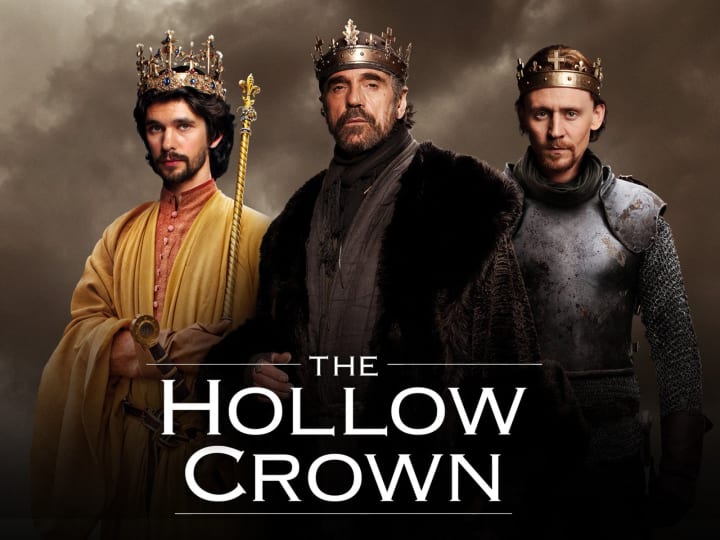
Why this part, and not Part Two which includes - among others - the barnstorming 'Richard III'? Well, exactly for that reason: Part Two is too barnstorming, too obvious, too easy.
Shakespeare actually wrote the plays in Part Two BEFORE those in Part One. And, although they're all astonishing pieces, the plays in Part Two are also the work of a writer at the beginning of their career. They may be wonderful (and, believe me, 'Richard III' is my favorite play after 'Hamlet'), but there is less subtlety, and less nuance, than in those that came later. In a word, they're harder to do well.
For example, any decent actor can make Richard III watchable; he's so villainous, all you've got to is learn the lines, stick on a prosthetic hump, and camp it up. But, Richard II? Making that self-absorbed, arrogant dolt entertaining is a genuine challenge.
As is Prince Hal (later Henry V). When we first met him, he's a party-loving lout; at the end of his journey he's both an inspiring, and brave military leader, and the epitome of noble kingship. Shakespeare charts that maturity beautifully, but it's still some trick to actually pull it off.
And the actors selected to do those jobs did so. With aplomb.
Richard II is NOT an instantly likable character; although piercingly intelligent, he's also vain and capricious. Ben Whishaw balances the two extremes delicately. As Tom Hiddleston does later with Henry V; his arc may be greater than that of Richard's, but Hal's growing maturity is believable: Over the space of a few hours, you fully buy into his transformation from feckless youth, to mighty ruler.
Even better is the embracing of both character's dichotomies.
Richard may be flawed, but Wishshaw skillfully shows us his more admirable traits - it's impossible to ever fully dislike him. Likewise, although Henry has been almost deified by the end of the cycle, Hiddlestone never let's us forget that his character is also still capable of being a bit of jerk. There's a richness, a subtlety, that the characters in Part Two of the cycle don't fully possess.
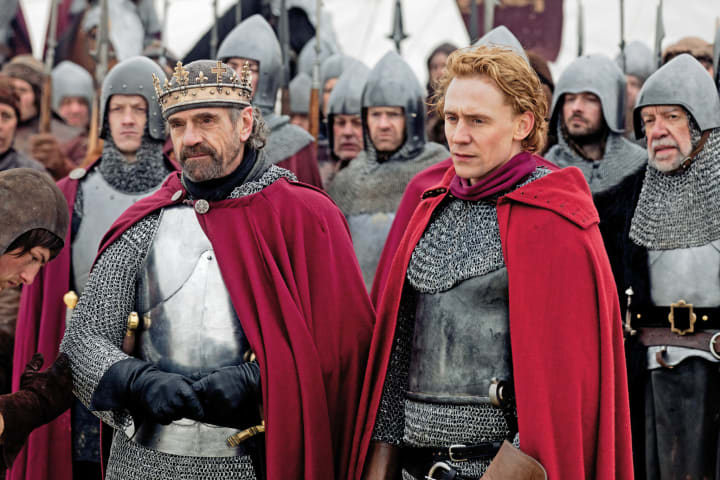
In between these two towering performances, you've also got Jeremy Irons delivering his best performance in decades, as well as a supporting cast that is a veritable 'Who's Who' of British acting, most notably Patrick Stewart, Julie Walters, and Simon Russell Beale, who gives us the best Falstaff I've ever seen.
Yes, it's a long-haul. But it's one thoroughly worth undertaking.
4. 'Being Shakespeare' (2011)
Like Berkoff's offering, this is also based on a one-man show about the writer from Stratford-Upon-Avon.
And, again like Berkoff, we have another ripe, British theatrical giant; Simon Callow.

And, again, this really, really shouldn't work as brilliantly as it does.
Although the script by renown Shakespearean scholar, Jonathan Bate, is meticulously researched, and eloquently written, it's basically a two-hour long history lesson.
Using Jaques' famous 'All the world's a stage' soliloquy from 'As You Like It' as a frame, Bate holds our hands as we walk through the seven ages of Shakespeare, from his birth to death, highlighting each stage with relevant passages from the Bard's work, as well as snippets of arcane - but interesting - Elizabethan / Jacobean trivia. On paper, it hardly sounds thrilling.
Luckily, Bate has the ideal tour-guide.
Like Berkoff, Stewart, Fleetwood, Wishshaw, Irons, and Hiddleston, Callow 'knows' his Shakespeare. He's capable of delivering each soliloquy in way that makes the meaning clear, yet also retaining the words' innate beauty; Shakespeare never sounded so lovely.
It may be slightly less entertaining than Berkoff's exploration, but there's so, so much to be learned. At the end, you may not have gained any penetrating insights into the plays themselves, but you know the man who wrote them; you have a genuine 'feeling' for who the Bard was.
And considering that the majority of Shakespeare's life remains a mystery, that's a mighty achievement.
5. 'King Lear' (2018)
And so we reach the final stage of my Bard-infused play-list.

This joint production between Amazon and the BBC doesn't lack for star-power.
The King's daughters are played by Emma Thompson, Emily Watson, and Florence Pugh. Jim Broadbent, and Jim Carter lend gravitas as two of the monarch's most trusted advisors. While Christopher Eccleston, and Andrew Scott both shine in smaller - yet significant - supporting roles.
Yet, eclipsing them all is the mighty Sir Anthony Hopkins.
For decades, Hopkins eschewed the stage, and the 'classics.' Battling the bottle, stage-fright, and the suffocating weight of the comparisons with the greatest of them all, Olivier, he found cinema a more forgiving medium.
And, based on his performance here - boy - were we deprived.
He is astonishing.
His Lear is by turns boorish, spoiled, peevish, and grossly insecure (after all, England is thrown into turmoil due to an act of grand, needy narcissism at the outset - when Cordelia refuses to fawn over him, she is cut off, and the country begins a long-slide into bloody darkness).
He is also vulnerable, and weak; he might remain the King in name, but this broken old man is essentially powerless, and hostage to a mind and body that can only now betray him. If there's a better representation of battling old age, I've never seen it.

Like Macbeth, Lear is not always likable. In fact, at times, it's easy to hate him. But, we never lose sight of the broken, frail, elderly man caught in the middle of a maelstrom of his own making.
Not just politically, but on a personal level; his inability to comprehend his daughters' actions is heart-breaking, and will hit hard with anyone who has ever struggled with their own family members.
Like Goold's 'Macbeth', Richard Eyre has given his 'King Lear' a contemporary setting. But, whereas the former production kept an air of vagueness, the latter is distinctly modern-day England.
There are times when the anachronisms jar, but when they work they do so wonderfully; setting the opening scene in the Tower of London, with the characters arriving in black, sleek, top-of-the-ranges Bentleys and Range Rovers, is a brilliant touch.
As is the poignant scene of the now-blind Gloucester encountering his exiled son, Edgar, by the side of a busy motorway.
Puritans have taken issue with the judicious cuts Eyre has made to the text, but - truthfully - nothing of note has been lost. It's a pared-down streamlined Lear for these strange, tumultuous times.
And like Stewart in 'Macbeth', at it's center, we have one of our finest ever actors delivering a beautiful performance. And that voice...
If you only know Hopkins from Hannibal Lector, watch this, and not only see why so many worship him, but also why Shakespeare still matters, and just how powerful his language and stories remain.
So, that's it. My not-so guilty pleasure; Shakespeare during 'lockdown.' My five selections are not always easy to watch. To be honest, they will be challenge you.
But, if you're going to while away your hours trapped in 'lockdown' with your eyes glued to the small-screen, I can't think of anyone better to spend your time with than the greatest, most relevant, most inspiring writer of all time: William Shakespeare.
----------------------------------------------------------------------------------------
If you've liked what you've read, please check out the rest of work my on Vocal.
You can also find me on Elephant Journal and The Mighty.
If you've really liked what you've read, please share with your friends on social media.
If you've really, really liked what you've read, a small tip would be greatly appreciated.
Thank you!
About the Creator
Christopher Donovan
Hi!
Film, theatre, mental health, sport, politics, music, travel, and the occasional short story... it's a varied mix!
Tips greatly appreciated!!
Thank you!!
Keep reading
More stories from Christopher Donovan and writers in Geeks and other communities.


Comments
There are no comments for this story
Be the first to respond and start the conversation.