
Berlin, Alexanderplatz by Alfred Döblin
Why It's a Masterpiece (Week 93)


Alfred Döblin’s Berlin, Alexanderplatz, first published in 1929, is regarded as one of the greatest modernist novels of the 20th century. Döblin, a German writer of Jewish descent, was deeply influenced by expressionism, psychoanalysis, and the political turbulence of Weimar Germany. His background as a practising physician, particularly in psychiatry, gave him a great perspective on the psychological and social struggles of marginalised individuals, this is something we see over and over again in his literature.
The novel came out of a period of social, political and even economic horror in Germany. The late 20s saw a surge in unemployment, crime and a great amount of political extremism. These are all reflected in the confines of the book - the portrait of Berlin is chaotic as it is a brutal and indifferent city. Written in a montage style, the novel has multiple perspectives and documentation, there are slogans and monologues to maintain this fragmented style and yet, it still remains an immersive narrative all the same.
The book follows Franz Biberkopf, an ex-convict who is released from prison and struggles to reintegrate into society. His journey is one of moral downfall and existential crisis. It is a metaphor of what it means to be an individual in a time of fragile autonomy in Berlin at this time. Döblin drew inspiration from James Joyce’s Ulysses and the cinematic techniques of montage, creating a novel that captures the pulse of Berlin’s streets with horrific immediacy.
Upon its publication, Berlin, Alexanderplatz was amazingly respected, but it was also controversial. It was hailed as a masterpiece of modernist literature, but its complexity and bleak depiction of urban life made it a challenging read (and some people still think it is very challenging to this day). The novel was later banned by the Nazis due to Döblin’s Jewish heritage and his critical portrayal of German society - the political extremism shown in the novel has come true for the author. Forced into exile, Döblin fled to France and later the United States, where he continued to write but never regained the same literary prominence.
Plot

Franz is released from prison after serving a four-year sentence for the manslaughter of his girlfriend, Ida and determined to lead an honest life, he steps into the tumultuous streets of Weimar-era Berlin, a city teeming with crime, political unrest, and social decay.
At first, he attempts to live respectably, working as a newspaper vendor and labourer. However, his efforts are continuously thwarted by his own weaknesses and the city’s corrupt underbelly. He drifts through bars, brothels, and cheap lodgings, forming relationships with an array of crooked businessmen, prostitutes, and petty criminals.
Franz soon becomes entangled with Reinhold, a manipulative and sadistic gangster who gradually draws him into the world of crime. Reinhold, resentful of Franz’s ability to attract women, repeatedly tricks him into taking his discarded lovers, treating him as a pawn in his own cruel game. This twisted relationship gathers in betrayal when Reinhold, seeing Franz as a liability, throws him out of a moving car during a heist, causing Franz to lose his right arm.
Physically and emotionally shattered, Franz is hospitalised and falls into a delirium, where he experiences surreal visions and philosophical debates on fate, morality, and the nature of existence. There is a social disintergration of Berlin that is also happening all around him and we can see it within the main character himself.
Upon recovering, Franz tries to start anew but is drawn back into the underworld through his relationship with Mieze, a kind-hearted prostitute who becomes his greatest source of emotional support. However, tragedy strikes again when Mieze is brutally murdered, a crime orchestrated by Reinhold, further deepening Franz’s sense of fatalism and despair.
In the final chapters, Franz is re-arrested and re-enters the prison system, his fate seems inescapable. The novel closes on an ambiguous note: has Franz learned from his experiences, or is he doomed to repeat his mistakes?
Into the Book

Berlin as a brutal and unforgiving force:
Berlin itself is not just the setting of the novel it is an active force that shapes, crushes, and consumes its inhabitants. Döblin paints the city as chaotic, fragmented, and pulsating with mechanical energy, reflecting both its allure and its danger. The author's use of montage, overlapping voices, and disjointed narratives mirrors the disorienting experience of modern urban life.
Berlin is depicted as both a symbol of opportunity and a machine of destruction, particularly for those on the fringes of society. Franz’s journey is, in many ways, the journey of the modern individual struggling against an impersonal metropolis.
"The city was always restless, whirring and rumbling. It was impossible to get away from it; it pressed in from all sides."
- Berlin, Alexanderplatz by Alfred Döblin
Do we really have free-will?:
Throughout the novel, Franz repeatedly tries to reform, but his efforts are continuously undone by external forces and his own nature. Döblin suggests that free will is an illusion, and that individuals are powerless against the machinery of fate.
The novel frequently references the Book of Job, framing Franz’s suffering in biblical terms. Yet unlike Job, Franz receives no divine justice, only endless cycles of misfortune. His ultimate return to prison suggests that his destiny was written from the start.
"Men think they are free, but they are bound to the wheel."
- Berlin, Alexanderplatz by Alfred Döblin
The illusion of agency:
Döblin explores how modernity reduces people to cogs in a vast, uncaring system. Franz is constantly stripped of his agency, dignity, and even his body, culminating in the loss of his arm, a symbolic castration that represents his powerlessness. This theme is reinforced through the novel’s industrial imagery, where humans are frequently compared to machines or animals.
Franz’s descent into the underworld of crime, exploitation, and violence mirrors the novel’s larger critique of capitalism and urban alienation, where individuals are discarded as soon as they cease to be useful.
"They clanked and rattled, these men, running to work like clockwork figures, stamped and beaten like iron in the factories."
- Berlin, Alexanderplatz by Alfred Döblin
Why It's a Masterpiece
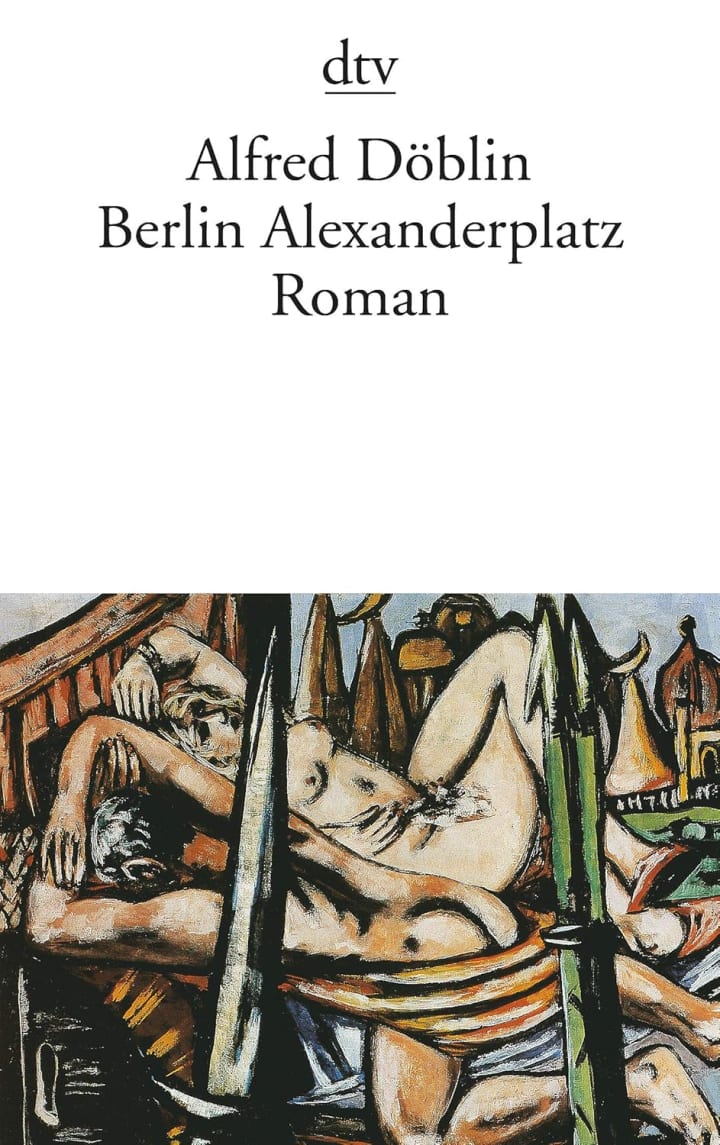
One of the great modernist novels, this book was regarded as a masterpiece for its narrative techniques (fragmented) and its psychological depth. Its unflinching social critique is one of the things us readers have loved about it for years. His use of montage and stream-of-consciousness make us feel as though we are watching a film rather than simply reading a narrative and it was so revolutionary at the time that people didn't really know what to make of it. It would go to have a profound influence on W.G Sebald among others.
We get a kaleidoscopic view of Berlin, capturing the chaos and energy of the city, but also capturing all of its rather unsavoury parts. It merges the realistic detail with the poeticism the city still held at this point. There is something really extreme about this - the social decay is real but only if you allow yourself to see past a painting of a city that is trying to hold itself together. It is so much worse than what we initially thought. It gives a new meaning to 'existential meditation'.
Conclusion

Urban alienation and human suffering are the two main points of this book. The struggle for identity and the brutality of modern life still resonate in our own time as recession after depression hit our society. The uncertainty of this novel was one thing that always got to me. I love the way in which we are left uncertain as to what is really going to happen to Franz and whether he can actually change his fate. However, by the end of the book, we know that this trouble he has is almost burned into his blood.
Next Week: This Side of Paradise by F. Scott Fitzgerald
About the Creator
Annie Kapur
I am:
🙋🏽♀️ Annie
📚 Avid Reader
📝 Reviewer and Commentator
🎓 Post-Grad Millennial (M.A)
***
I have:
📖 280K+ reads on Vocal
🫶🏼 Love for reading & research
🦋/X @AnnieWithBooks
***
🏡 UK
Keep reading
More stories from Annie Kapur and writers in Geeks and other communities.
Book Review: "Doors of Perception" by Aldous Huxley
Aldous Huxley is probably best known for his controversial, but brilliant book Brave New World which in some ways, rivals George Orwell's 1984 in its depiction of dystopia. I have enjoyed other works by Aldous Huxley and I have to admit it, I've read Doors of Perception before. I just found a free copy of it and made the snap decision to give it a reread. I was always quite surprised by this book because it seems so different to the usual requests of Huxley's works. Instead of it being a probably future or a social commentary, this is an actual experience. This is an observation of a whole different kind. It is fantastic.
By Annie Kapurabout a month ago in Geeks
Marvel Zombie
The last entry into our 2025 superhero projects catalogue is Marvel Zombies. This was a show that was anticipated by absolutely no one and it disappeared from the public consciousness as quickly as it was released. There was nothing special about the project that made it a must see, or a must remember. In fact if anything it's a must forget.
By Alexandrea Callaghan17 days ago in Geeks
Everything We Know About 'Dune 3' So Far
When Dune: Part Two concluded, Denis Villeneuve did not simply finish a story—he detonated one. The film’s ending left audiences exhilarated, disturbed, and quietly unsettled as Paul Atreides finally embraced the role destiny had been forcing upon him. Victory came swiftly, but so did dread. The holy war had begun, and Paul knew it.
By David Cook3 days ago in Geeks



Comments (2)
mam can i talk to you ? i need a help
This story designate for me, I just took a survey about letting a prisoner out early. In this case, Franz killed his girlfriend and was let out 4 years after. He has not learn his lesson, when things do not workout he give in easily to commit evil. Karma ending , where his girlfriend was killed by someone and he is back in jail. That must be some read going inside this book world. Thanks for this interesting review.