
Bad Books and We Who Write About Them...
A Conversation


I was perusing social media (yes, I said perusing) when I came across a strange question about books: what do we do about bad books? Now, my opinion of this has changed over time so let's go through what the author of the post meant to start off with. The question we want to answer is about the exact wording of the question which, by the way, I have been thinking about since.
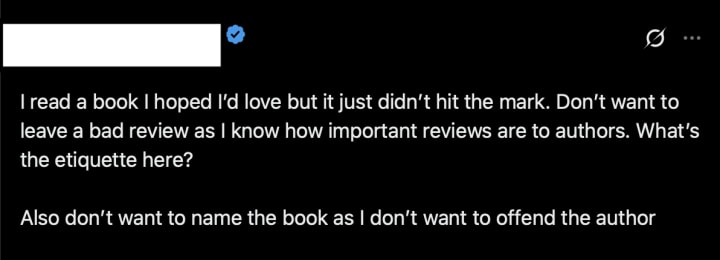
The answers ranged from 'don't tag the author' to 'if you haven't got something nice to say, don't say anything at all'. My opinion for the record is: it really depends how much you didn't like it and what you have to say about it.
I have to admit I was once one of these book-truthers. I felt like you had to be brutally honest about everything you had read and make sure that you got the point across if you didn't like an author's latest output. Then I started writing my own stories and found that it was a lot harder than I thought. By the time I got to university and started my hand at having my work professionally critiqued, I found that there was a good way to criticise without being brutally honest and actually being constructive in the argument.
I can't remember who said it but I think it was on Reddit where someone wrote along the lines of: "People who say they are being 'brutally honest' don't have any interest in being honest, they just want to be brutal." And I think that's pretty true. But let's get back to the main point. So, how are you supposed to handle it? As I said before, it really does depend on the following factors:
- How much did you not enjoy the book?
- Why did you not enjoy the book?
- Is the author significant enough to not care what you think?
- Are you articulating yourself properly in that regard and not just being mean for the sake of it?
Let's face it, not everyone enjoys everything they read. I think you guys have heard me ranting about Finnegans Wake and The Unbearable Lightness of Being enough. But there is a common denominator between those two writers: they're dead. I've also voiced my opinions of Rupi Kaur that even though I was being intentionally mean, she probably wouldn't care given her status as a big social media influencer. I think I had number three covered therefore.

BUT...
I also publish reviews of books I may not have enjoyed as much as I had hoped. Books which only get two or three out of five stars and I'm sat there a little underwhelmed by the book. Now, if it is fair game in which nobody's reputation is at any stake and I'm not being mean about it - I'll publish the review. I've often published reviews of books I didn't like, but I like to keep an open mind especially if I haven't read anymore of the author's work. I don't like judging people based on one thing they've written because that seems unfair.

HOWEVER...
There are reviews you, reader, have not seen. There are those that do not see the light of day but are written - yes, written - in my drafts and stay there until I finally have the strength to delete them. These are reviews of books where I have become so angry at the sheer wasted time on them that I have taken them apart piece by piece and quite possibly insulted the author multiple times. I won't name the books or the author because that again, is not fair. But I like to call this a kind of reading catharsis. I get something out of my system but I never publish the review because I hated the book so much I just needed an outlet to rant about it on.

SO...
We can gather that if you're going to say something about a book you didn't like, nobody is stopping you. But please stop and think that there is someone on the other end of that review. Unless you are absolutely sure that the author is big enough not to care (for example: I have a few choice words for Benjamin Labatut even though I didn't necessarily hate his novle 'The Maniac'), or unless you are sure the writer is dead (like I have my opinions about Finnegans Wake) - you should probably not go around shouting about how much you hated the book. Give it some time, leave it in drafts and then come back and think about whether that sounds like something you want to put out about yourself.
There are books I have really not enjoyed in 2025 and yet, I think twice before posting what I have written about them - mainly because I am left to think that someone has worked quite hard on that book and especially if they are a debut author - it could be very upsetting for them to read that.
Always think of the feelings of others.
About the Creator
Annie Kapur
I am:
🙋🏽♀️ Annie
📚 Avid Reader
📝 Reviewer and Commentator
🎓 Post-Grad Millennial (M.A)
***
I have:
📖 280K+ reads on Vocal
🫶🏼 Love for reading & research
🦋/X @AnnieWithBooks
***
🏡 UK
Keep reading
More stories from Annie Kapur and writers in Geeks and other communities.
"The Strawberry Grows Underneath the Nettle"
Background and Context Same as before: These are all expansions of random notes from back when I went to university a while ago. I will move on from Shakespeare when I'm almost done with him Check out the secondary sources - there's some good stuff in there Enjoy
By Annie Kapur10 months ago in Geeks
Marvel Zombie
The last entry into our 2025 superhero projects catalogue is Marvel Zombies. This was a show that was anticipated by absolutely no one and it disappeared from the public consciousness as quickly as it was released. There was nothing special about the project that made it a must see, or a must remember. In fact if anything it's a must forget.
By Alexandrea Callaghan27 days ago in Geeks
Emma Watson, Sir Lenny Henry and Sir Elton John lead British Diversity Awards
The prizes will be handed out at a glittering ceremony in London on March 25 2026 and Harry Potter actress/activist Watson will compete with Henry and John for the top gong of Media Personality of the Year with the musician competing alongside his husband David Furnish.
By Dena Falken Esq7 days ago in Geeks



Comments (1)
This is a really insightful piece, Annie; I have so many thoughts. I’m one of those reviewers that is always brutally honest about how much I enjoyed or didn’t enjoy a book, and I’m quick to judge a piece of work I didn’t enjoy and drag it through the mud; this opened my eyes to the downsides of that. Authors are human too, and I absolutely understand how hurtful it can be to read negative reviews about something they worked so hard on. I completely understand the hypocrisy, too, of someone like me, who has never published a book, critiquing someone else’s, like they’re thinking I know I could do better. I never want negative reviews to come across as me thinking I’m better or smarter than a writer whose story I didn’t like, because that’s absolutely never the case. At the same time, I see negative reviews that are honest and well written as fair game. I recently (attempted to) read a book called Fourth Wing, and I found it pretty unenjoyable. I posted a book review of it on here, and despite all the things I railed against, I still found nice things to say about it—and with ease. Almost every book I haven’t personally enjoyed has at least one thing I admired about it. Being open and honest about all things good and bad, and not dehumanizing the writers you don’t enjoy, is how I like to navigate less than stellar remarks about books I wasn’t vibing with. Like you said, if you’re not being mean just to be mean, there’s nothing morally reprehensible about leaving negative reviews—especially not about extremely popular literature. To me, critique of the art is almost never critique of the person or their character; if it is, then it’s because the author’s negative messaging or morality seeped its way into their literature. Whether we’re interacting with art that is either good or bad, passion is often incited either way. We love what we love, and we hate what we hate. And I respect the hell out of any author for putting any book out there; I think I always make that clear. As long as a book isn’t bad because it’s boring, if it’s making you feel something, it can’t be all bad. Anyway, a bunch of babbling—this was a great opinion piece, Annie!