


For centuries, people have been listing blood-sucking villainous monsters as things they have seen, especially down in Eastern Europe. Today, in Why It's Shifty, we're going to delve into the question of whether vampires are real and if they are, what are they? It seems like they are far from the glittering immortals of literature and film but possess the same thirst for blood and murderous instinct.
This week, we uncover the story of real-life vampires and what people believed about them. Let's not get confused, of course vampires are created as fictional characters, but they had to have come from somewhere...right?
Plot
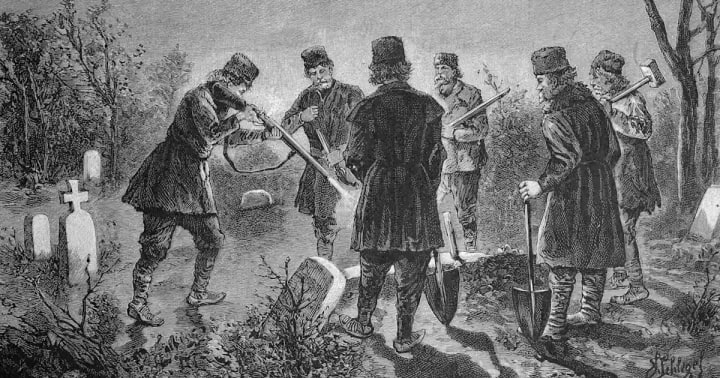
In folklore and centuries over, civilisations across the world have shared eerie tales of the undead: creatures who rise from the grave to feast on the blood or life force of the living. These vampire legends were not simply the stuff of ghost stories; in many parts of Eastern Europe during the 17th and 18th centuries, they were taken as serious threats. During outbreaks of plague or mysterious deaths, villagers would often exhume corpses and perform rituals: staking, decapitating, or burning bodies believed to be responsible.
One of the earliest documented cases was that of Peter Plogojowitz, a Serbian peasant whose grave was disturbed in 1725 after locals claimed he had returned to strangle them in the night. Official reports described his body as undecomposed, with blood at his mouth. Terrified villagers, with support from authorities, drove a stake through his heart and burned his remains. These accounts were often recorded by military or religious officials, blurring the line between myth and sanctioned reality.
A similar case involved Arnold Paole, a soldier also from Serbia, who reportedly believed he had been attacked by a vampire and took countermeasures, such as consuming dirt from the creature’s grave. After his death, locals blamed him for a string of unexplained deaths. His corpse was exhumed weeks later and, once again, described as looking “fresh” with bloodied features.
Despite advances in medicine and science, such reports were taken seriously, especially when coming from supposed experts. The term “vampire” began to appear in scholarly and diplomatic documents, and these stories helped solidify the vampire in the Western imagination. But while these accounts may seem outlandish now, they reveal a genuine struggle to explain illness, death, and decay at a time when few other answers existed.
In more recent history, however, the term “vampire” has been used not for corpses but for real human beings whose crimes echo the grotesque mythology. One chilling example is Kuno Hofmann, dubbed The Vampire of Nuremberg. In the early 1970s, Hofmann: a deaf and mute man with a fascination for the occult, broke into graves, mutilated corpses, and drank their blood. Eventually, he escalated to murdering a young couple in their car, from whom he also attempted to extract blood.
Unlike the villagers of old, Hofmann was not acting out of fear, he believed he needed blood to survive and gain strength. Though psychiatrically disturbed, he was considered aware of his actions and was institutionalised indefinitely. His crimes shocked Germany and drew disturbing parallels with centuries-old vampire lore, except this time, the vampire walked among the living.
Into the Theories
So where do vampires come from?
Disease and Medical Misunderstanding
Many scholars believe vampire legends arose from attempts to explain mysterious illnesses before modern medicine. Diseases such as tuberculosis, rabies, or even porphyria (a rare blood disorder) caused symptoms that resembled "vampiric" traits: pale skin, aversion to sunlight, sensitivity to smells, or aggression. During plagues, whole families would die in sequence, and people believed one of the dead was draining the life from the others. In the absence of scientific understanding, these deaths were blamed on supernatural forces.
Decomposition and Premature Burial
Before embalming was common or death was fully understood, bodies were sometimes buried alive by mistake, later discovered clawing at the coffin lid. Others were exhumed during vampire panics and found to be “fresh,” bloated, or with blood around the mouth, all natural signs of decomposition. These disturbing sights convinced people the dead were rising to feed. The lack of visible rot or a “sleeping” appearance led many to conclude that the corpse was undead.
Folklore and the Fear of the Restless Dead
In many cultures, especially in Eastern Europe, there was a strong belief that the dead could return if they weren’t buried properly or if they died violently or unrepentant. These souls became revenants (spirits or walking corpses who sought revenge or fed on the living). Vampires are thought to be one specific kind of revenant. This belief predates Christianity and likely comes from pagan rituals and early burial customs designed to "tie down" the dead.
Why It's Shifty
The idea that vampires exist is controversial because it challenges scientific understanding and rational belief. Modern medicine explains "vampiric" symptoms like: pale skin, sensitivity to light, or a craving for blood, through diseases such as anaemia, porphyria, or psychological disorders. On top of this, claims of vampires rely heavily on folklore, anecdote, and misinterpreted signs of decomposition. While some cultures have deeply rooted legends, there is no empirical evidence to support the existence of actual undead beings. Belief in vampires often reflects societal fears, superstition, or a need to explain the unknown, making the topic fascinating but scientifically unsupported and therefore, widely disputed.
Conclusion
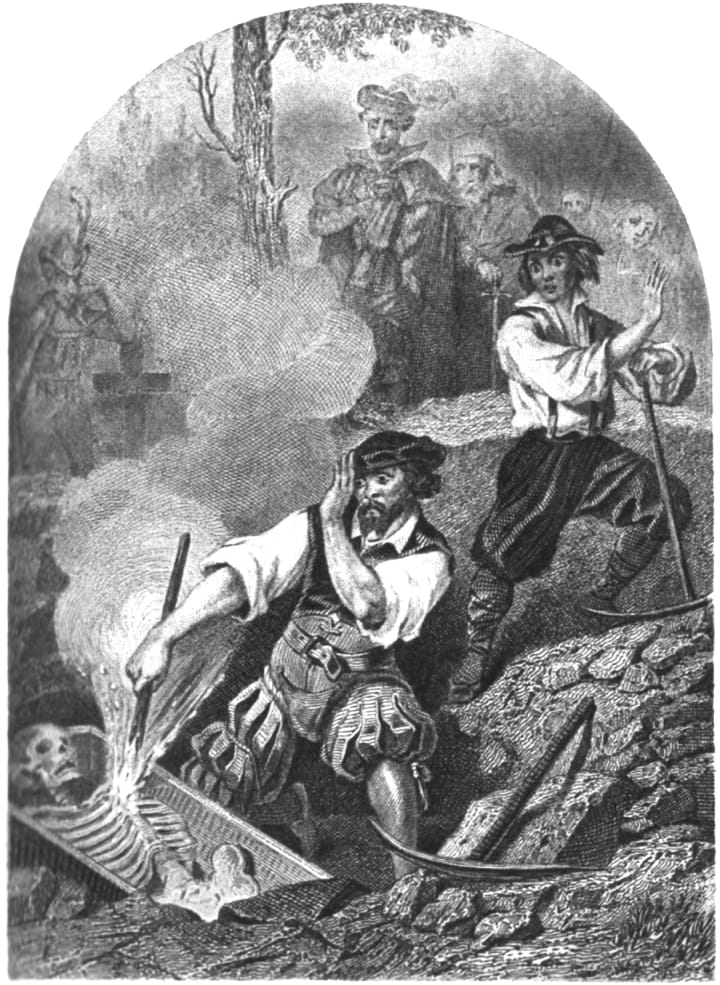
It is most likely the vampire myth was born out of a mixture of all of these on top of a fear of death. Decomposition of bodies after burial also created frightening signs mistaken for signs of the undead. Combined with cultural beliefs about restless spirits, these factors created the vampire myth: an expression of human fear and the need to explain the unknown, rather than evidence of a real creature.
Next Week: The Bunny Man
About the Creator
Annie Kapur
I am:
🙋🏽♀️ Annie
📚 Avid Reader
📝 Reviewer and Commentator
🎓 Post-Grad Millennial (M.A)
***
I have:
📖 280K+ reads on Vocal
🫶🏼 Love for reading & research
🦋/X @AnnieWithBooks
***
🏡 UK
Keep reading
More stories from Annie Kapur and writers in Geeks and other communities.
Book Review: "On the Calculation of Volume: 1" by Solvej Balle
I have been seeing this book everywhere and charging what Kindle was charging for it, it felt like I would never actually get to read the thing. Of course, until one day where the price came shooting down and 'Best Price in 30 Days' read '£0.99' and I was very quick to buy. With the language being a mix of minimalism and philosophy, the themes being that of entropy and realisation, this book definitely deserves all the hype it has been getting. If I am lucky I might be able to read the second part. I just have to hope that it is still on sale.
By Annie Kapur6 months ago in Geeks
Silver Screen Magic with Mae West
American actress and singer Mae West became a popular film actress during the Great Depression. She started entertaining in vaudeville, then performed on Broadway, and finally went to Hollywood. She signed up with Paramount Pictures and made her debut in the 1932 film “Night After Night.” She also starred in musicals, comedies, and crime dramas. The American Film Institute named her one of the best classic Hollywood actresses.
By Rasma Raisters7 days ago in Geeks
Kartik Aaryan suffers first major setback after minor dating controversy
Kartik Aaryan recently suffered first major setback after getting caught in a controversy of dating a minor. It all started when the 35-year-old actor’s newly released film, Tu Meri Main Tera Main Tera Tu Meri, became a box office bomb.
By Dena Falken Esq3 days ago in Geeks


Comments (3)
Excellent piece, Annie, and I agree with Greg. This should totally be a video series. I'd watch, too!
This was such a fascinating deep dive into the origins of vampire myths. This definitely proves that sometimes, real-life stories are more disturbing than fiction.
This should be a video series - Why It's Shifty with Annie Kapur - I'd watch that regularly! All jokes aside, fantastic work as always. The fact that some of these 'vampires' were just average Joes who were buried alive is just...*shiver*