
"Animal Farm" made one major mistake.
"All animals are equal, but some animals are more equal than others"
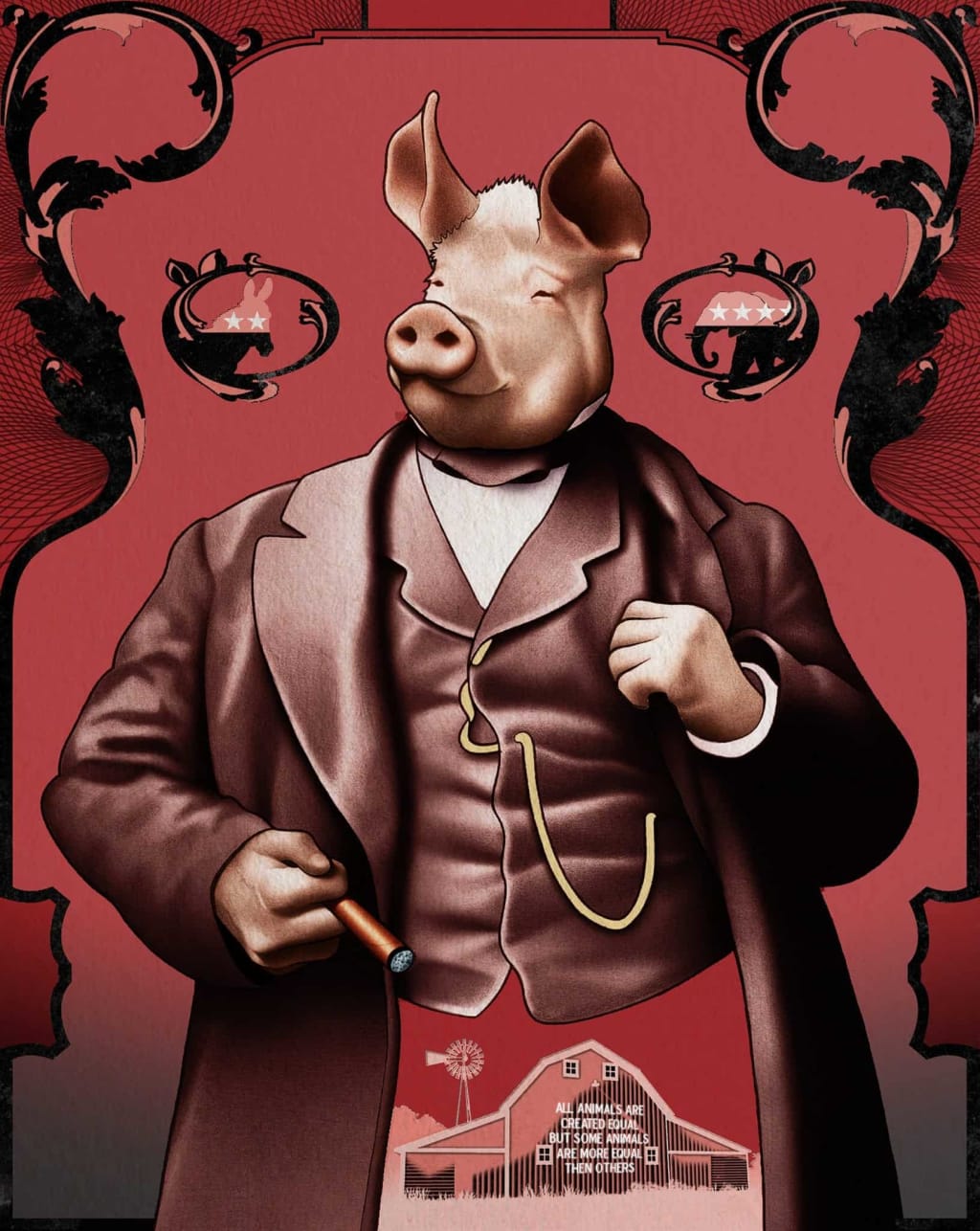
"Animal Farm" is one of George Orwell's best-known novels, second only to "1984". The novel describes how the animals from a farm in England rebel against their human farmer and try to create an animal society where every animal is equal and has a good life. However, things go horribly wrong and the animals end up even worse than before the revolution. It is an allegory for the events of the communist revolution in Russia and Stalin's dictatorship. It's recommended that you read the book before continuing with this article.
As mentioned above, the book is an allegory for the Bolshevik revolution, but I think that George Orwell made one major mistake in his representation of the events, more specifically, in portraying the reasons for the pigs' rise to power.
Let's start at the beginning: in chapter one, the oldest pig on the farm, Old Major, gives a speech which boils down to the fact that the only things making the animal's lives miserable are humans and their oppressive rule. Old Major says that if humans were to be eliminated, the living conditions will drastically improve. However, he is wrong, as the role of humans simply gets replaced by the pigs. So it turns out that the human species isn't the cause of the animals' suffering. In my opinion, this cause gives the book a dark meaning, which I don't agree with, and it is the reason that makes me think that the whole allegory is problematic. To find the cause, we will look at the five reasons why the pigs were able to concentrate all of the power.
1. The animals are naive.
In chapter three, when the pigs are confronted about the absence of the milk and the apples, Squealer explains that the pigs need the extra food for their brains to function, and that this is somehow a selfless act. The other animals accept this without any questioning. This shows that they are way too trusting of authority and extremely naive. This naivety will be used against them pretty often. For example, later on, when Napoleon drives away Snowball from the farm and disbands the Sunday meetings, no one questions this. When the animals do try to resist, for example, when the hens protest their eggs being sold, it is already too late as Napoleon is ruling with an iron fist, thanks to his army of dogs and the introduction of the death penalty.
2. The animals are fearful.
When the dogs were first used to drive away Snowball, and then to execute animals, a counter revolution should have started immediately, but the animals were too scared and unable to recognize the extent of the danger these dogs represented.
3. The animals are indifferent.
The fact that Napoleon was able to raise the puppies by himself and turn them into his personal army was a huge mistake on the animals' and Snowball's part, partly due to their naivety, and partly due to their indifference towards the puppies' upbringing. Speaking of indifference, Benjamin the donkey is aware of everything that is happening, and he could intervene, but he rarely does.
4. The animals are forgetful.
When the pigs start telling false versions of the past, most animals, even the ones who were present for the events, either forget what happened, or, due to their naivety, come to the conclusion that their memory is faulty and the pigs are telling the truth. One example of this is when Boxer puts into question the fact that Snowball was a traitor before the Battle of the Cowshed. Once he hears that Napoleon said that Snowball was indeed a traitor, he gives up on questioning and accepts it, forgetting that both he and Snowball got military awards after the battle for their bravery. The animals also forget the commandments, so the pigs alter them easily.
5. The animals are stupid and the pigs are smart.
This is ultimately the main reason for everything. The animals' cognitive ability seems to be different for every species. The pigs are the smartest, being able to read and write almost perfectly, while most of the other animals, like ducks, hens, and sheep, can't get past learning the letter A. Boxer, who represents the working class, can only learn four letters at a time, while the horses that were brought into the farm at the end of the book can't even manage that, implying that the working class got dumber under communism.
In conclusion, the pigs get all of the power because they are inherently smart. The dogs get second place because they are physically dangerous and loyal to Napoleon, while the other animals become miserable because they are stupid, forgetful, scared, naive, or indifferent. This supports meritocracy, an ideology that holds that a perfect society is one where every person gets the spot they deserve, according to their abilities. Looking through the lens of meritocracy, we can see that at the start of the books, the pigs, a species that is smart and willing to take action, isn't at the top of the hierarchy, but instead, farmer Jones, who has become incompetent due to drinking, and he doesn't deserve to rule anymore. By the end of the book, balance is restored, and at the top of the hierarchy are the competent pigs or the sober humans from the neighboring farms. In the middle are the dogs, and at the bottom are either only animals too dumb to rise up (like the horses and sheep) or unwilling (like Benjamin).
This is why I think this analogy between animals and humans is ultimately troubling. Humans, unlike species of animals, aren't that different overall. The majority of humans are on an equal playing field, some slightly better than others, but to claim, like George Orwell did, that the working class is inferior to the ruling class is absurd. The majority of the population of Russia during the revolution were indeed illiterate, but they weren't given any reading/writing classes like the animals did in chapter three. A lack of access to education was the main cause. My opinion is that every person, irrespective of their inherent abilities, should have the right to happiness and the right to not be exploited.
About the Creator
Keep reading
More stories from Dorin Ceolac and writers in Geeks and other communities.
Squid Game doesn't deserve to be this popular.
Squid Game is the show that took the world by storm when it launched this September, and it quickly became the most popular show on Netflix. It is regarded as a masterpiece by a lot of voices, but that title seems to be thrown around too easily nowadays. The reasons for its popularity are many, such as it being really accessible to non-english speakers and producing a lot of memes. However, an above average content quality isn't one of them. Here's why:
By Dorin Ceolac4 years ago in Geeks
Silver Screen Magic with Mae West
American actress and singer Mae West became a popular film actress during the Great Depression. She started entertaining in vaudeville, then performed on Broadway, and finally went to Hollywood. She signed up with Paramount Pictures and made her debut in the 1932 film “Night After Night.” She also starred in musicals, comedies, and crime dramas. The American Film Institute named her one of the best classic Hollywood actresses.
By Rasma Raisters7 days ago in Geeks
Silver Screen Magic with Lillian Gish
Director D.W. Griffith directed the 1915 film “Birth of a Nation.” The film starred Lilian Gish, Mae Marsh, and Henry B. Walthall. This is an American silent epic drama. The screenplay was adapted from the 1905 novel and play “The Clansman: A Historical Romance of the Ku Klux Klan” by Thomas Dixon Jr.
By Rasma Raisters3 days ago in Geeks


Comments
There are no comments for this story
Be the first to respond and start the conversation.