
An American Tragedy by Theodore Dreiser
Why It's a Masterpiece (Week 75)


Theodore Dreiser’s An American Tragedy, first published in 1925, is a seminal work of American naturalism, drawing on real-life events to explore themes of ambition, class conflict, and moral ambiguity. Dreiser was inspired by the infamous Chester Gillette case of 1906, in which Gillette was convicted of murdering Grace Brown, a young woman who was pregnant with his child. The trial and its sensational coverage captivated the nation, providing Dreiser with a compelling framework for his novel.
Dreiser began writing An American Tragedy in 1920, working tirelessly for five years to craft a detailed and unflinching portrayal of societal pressures and personal failings. The book was shaped by Dreiser’s commitment to the naturalist movement, which emphasises the deterministic forces of environment and heredity in shaping human behaviour. His writing style, characterised by its psychological depth and unadorned realism, sought to strip away romanticised notions of the American Dream.
The novel’s publication was met with significant controversy. Its frank depictions of premarital sex, abortion, and murder drew criticism from conservative groups, while others praised its unvarnished examination of societal hypocrisy. There is no doubt that this novel stared tragedy right in the face with absolutely no detail spared for the feelings of the reader or the reservations of the critics.
Plot
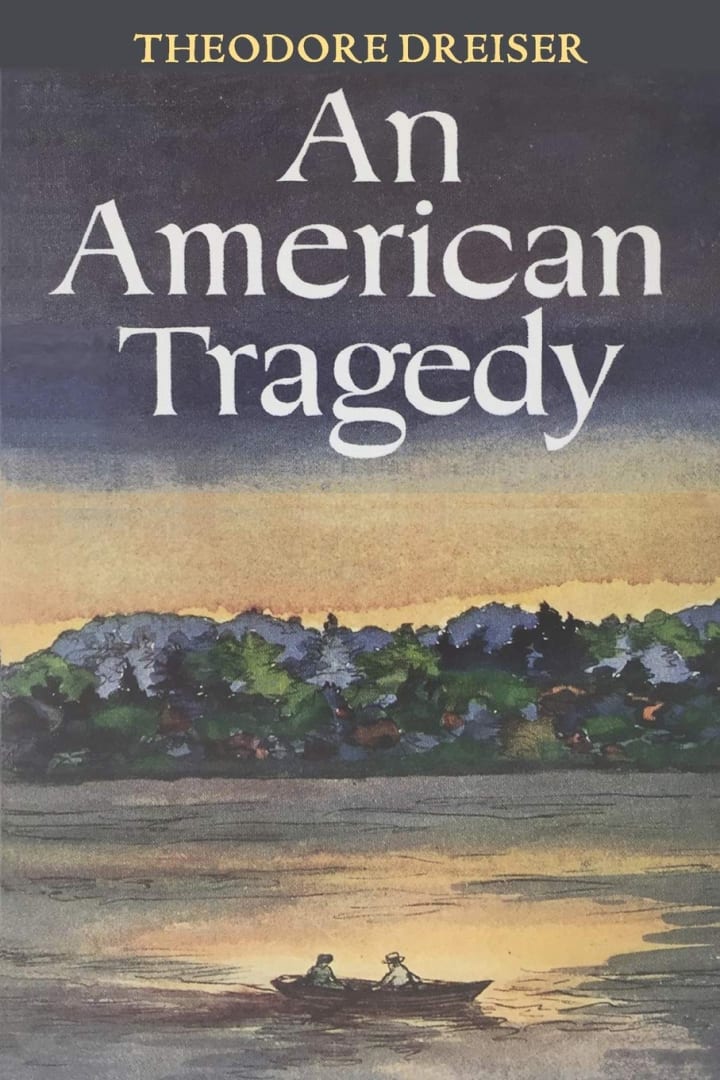
The novel follows the rise and fall of Clyde Griffiths, a young man whose desire for social status and material wealth leads him down a path of moral corruption and ultimate ruin. The novel is divided into three parts, tracing Clyde’s journey from poverty to ambition, and finally, to his tragic downfall.
The story begins with Clyde’s childhood in a poor, deeply religious family in Kansas City. His parents run a mission, and Clyde grows resentful of their austere lifestyle. As a teenager, he takes a job as a bellboy at a luxurious hotel, where he is introduced to the allure of wealth and the pleasures of hedonism. His association with wealthy patrons and his affair with a young woman, Hortense Briggs, highlight his growing desire to escape his impoverished roots.
In the second part, Clyde relocates to Lycurgus, New York, where he secures a job at a factory owned by his wealthy uncle. Here, he becomes romantically involved with Roberta Alden, a poor and virtuous young woman who works under his supervision. Their relationship becomes complicated when Clyde meets Sondra Finchley, a beautiful and wealthy socialite who represents the life of privilege he covets. Torn between Roberta, who becomes pregnant, and Sondra, who offers a path to social ascension, Clyde’s desperation leads him to contemplate murder.
The novel’s third part details the tragic culmination of Clyde’s ambitions. He takes Roberta on a boating trip, intending to kill her to eliminate the obstacle to his future with Sondra. Although Clyde hesitates, Roberta accidentally drowns, and Clyde is charged with her murder. The trial exposes the stark inequalities of the justice system, as Clyde’s humble background and moral failings are dissected before a prejudiced court. Despite his internal conflicts and moments of remorse, Clyde is convicted and sentenced to death.
Through Clyde’s story, Dreiser crafts a scathing critique of the American Dream, illustrating how the relentless pursuit of wealth and status can lead to moral decay and personal destruction. The novel ends on a sombre note, with Clyde facing his execution, his dreams shattered.
Into the Book

The American Dream:
One of the central themes of An American Tragedy is the critique of the American Dream and its hollow promises. Clyde’s relentless pursuit of wealth and social status embodies the belief that success is attainable through ambition and hard work. However, Dreiser exposes the moral compromises and societal barriers that render this dream unattainable for individuals like Clyde.
Clyde’s yearning for a better life begins when he takes a job at the hotel in Kansas City. The opulent lifestyle of the guests captivates him, igniting his desire to escape his humble origins. Dreiser writes, “He was like a moth drawn to the flame, dazzled by the glittering promise of wealth.” This desire becomes the driving force behind his actions, leading him to betray his values and relationships.
Clyde’s infatuation with Sondra Finchley exemplifies the false allure of the American Dream. Sondra represents everything Clyde aspires to: beauty, privilege, and social acceptance. Yet, his pursuit of her reveals the harsh realities of class divisions, as Clyde’s impoverished background becomes an insurmountable obstacle. Dreiser critiques the societal structures that perpetuate inequality, demonstrating how the dream is reserved for the already privileged.
“She turned; she bruised under her heel the scaly head of this dark suspicion-as terrifying to her as his guilt was to him. 'O Absalom, my Absalom! Come, come, we will not entertain such a thought. God himself would not urge it upon a mother.”
- An American Tragedy by Theodor Dreiser
Class Conflict:
Class conflict is another prominent theme in the novel, as Clyde’s life is shaped by the rigid social hierarchies of early 20th-century America. Dreiser depicts a society where wealth and privilege determine one’s opportunities and moral standing.
Roberta Alden’s plight exemplifies the intersection of class and gender oppression. As a working-class woman, she is vulnerable to exploitation and bears the brunt of Clyde’s ambitions. Her pregnancy underscores the double standards of the era, as Clyde seeks to escape responsibility while Roberta’s options are severely limited.
The trial scene starkly portrays the biases of the judicial system. Clyde’s poverty and moral failings are used to paint him as inherently guilty, while the wealthy Sondra remains untouched by scandal. Dreiser writes, “Justice was not blind; it was a mirror reflecting the values of the society it served.”
“Who were these people with money, and what had they done that they should enjoy so much luxury, where others as good seemingly as themselves had nothing? And wherein did these latter differ so greatly from the successful?”
- An American Tragedy by Theodor Dreiser
Moral Ambiguity:
Dreiser’s naturalist approach underscores the theme of moral ambiguity, portraying Clyde as both a victim of circumstance and an agent of his downfall. Clyde’s internal conflict is central to the novel, as he grapples with his conscience and the pressures of his environment.
Clyde’s hesitation during Roberta’s death highlights his moral complexity. He does not explicitly murder her, yet his inaction and premeditation implicate him. Dreiser’s depiction of Clyde as neither wholly good nor evil challenges readers to question the nature of guilt and responsibility. “He was not a monster,” Dreiser writes, “but a man overwhelmed by the tides of his own desires and fears.”
The deterministic forces in Clyde’s life (his upbringing, societal expectations, and economic conditions) shape his actions and underscore Dreiser’s belief in the power of environment over free will. The novel’s unrelenting focus on these forces suggests that Clyde’s tragedy was inevitable, a product of the flawed society in which he lived.
“What a wretched thing it was to be born poor and not to have any one to do anything for you and not to be able to do so very much for yourself!”
- An American Tragedy by Theodor Dreiser
Why It's a Masterpiece
An American Tragedy is widely regarded as a masterpiece for its ambitious scope, psychological depth, and scathing social critique. Theodore Dreiser’s unflinching portrayal of Clyde Griffiths’ rise and fall offers a profound exploration of the human condition and the societal forces that shape it.
The author's meticulous attention to detail, was groundbreaking in its time. Dreiser’s ability to capture the intricacies of human psychology, particularly Clyde’s internal conflicts, added layers of complexity to the narrative. His depiction of moral ambiguity challenges readers to confront uncomfortable questions about guilt, ambition, and societal responsibility.
Conclusion
An American Tragedy remains a vital work of literature because of its intense examination of human ambition, societal pressures, and moral complexity. Dreiser’s portrayal of Clyde Griffiths as a flawed but relatable protagonist invites readers to wrestle with philosophies regarding inequality, justice, and the cost of the American Dream. I remember studying this book for a short time, wondering why more people had not read it. Honestly, it is highly recommended by this series and beyond. It is the ultimate wreckage of the American Dream.
Next Week: The Wonderful Wizard of Oz by L. Frank Baum
About the Creator
Annie Kapur
I am:
🙋🏽♀️ Annie
📚 Avid Reader
📝 Reviewer and Commentator
🎓 Post-Grad Millennial (M.A)
***
I have:
📖 280K+ reads on Vocal
🫶🏼 Love for reading & research
🦋/X @AnnieWithBooks
***
🏡 UK
Keep reading
More stories from Annie Kapur and writers in Geeks and other communities.
Book Review: "Maggie's Grave" by David Sodergren
I adore David Sodergren's books and I've read quite a few of them. One of my favourites was The Haar which I just ate up entirely. You can read on what I thought about it here. David Sodergren mixes folk and urban legend horror with contemporary themes and thus, his books are right up my street. At times, they can be overwhelming, which is not something I am complaining about - it can be really great to have horror that isn't just about grossing out the reader. So, let's get on with this newest addition to my collection of David Sodergren's books - Maggie's Grave. It's about how the dead...sometimes don't always stay dead.
By Annie Kapur6 months ago in Geeks
Silver Screen Magic with Mae West
American actress and singer Mae West became a popular film actress during the Great Depression. She started entertaining in vaudeville, then performed on Broadway, and finally went to Hollywood. She signed up with Paramount Pictures and made her debut in the 1932 film “Night After Night.” She also starred in musicals, comedies, and crime dramas. The American Film Institute named her one of the best classic Hollywood actresses.
By Rasma Raisters6 days ago in Geeks
Julian Barnes Says Goodbye to the Novel: A Literary Icon Reflects on a Storied Career
In the world of contemporary literature, few authors have commanded as much respect and admiration as Julian Barnes. Known for his incisive wit, keen psychological insights, and elegant prose, Barnes has spent decades shaping modern fiction, producing works that blend philosophical inquiry with human storytelling. Now, the celebrated novelist has announced that he is saying goodbye to the novel, signaling the end of an era for readers who have long followed his literary journey. A Career Defined by Curiosity and Elegance Julian Barnes, born in Leicester in 1946, has been one of Britain’s most distinguished literary figures since the 1980s. Over his career, he has authored a remarkable array of novels, essays, and short stories, earning accolades including the prestigious Man Booker Prize for his 2011 novel The Sense of an Ending. His works frequently explore themes of memory, love, mortality, and the elusive nature of truth, often inviting readers to examine the complex moral and emotional layers of human experience. Barnes’ decision to step away from the novel comes as both a surprise and an inevitability for many of his devoted readers. In interviews discussing his forthcoming farewell, he emphasized that the decision was not born from fatigue, but from a desire to conclude his career on his own terms, rather than letting external pressures dictate his creative output. “I feel I have said what I wanted to say in fiction,” Barnes explained. “The novel has been my lifelong companion, but it is time to part ways with it gracefully, rather than cling to it.” The End of an Era Barnes’ departure from the novel is significant not only for its timing but also for what it represents in the literary landscape. Over the past four decades, Barnes has been part of a cohort of writers who elevated modern British literature, combining literary sophistication with widespread accessibility. His ability to blend narrative innovation with philosophical depth has influenced a generation of authors, from novelists exploring the intricacies of memory to those experimenting with metafiction and historical inquiry. Works like Flaubert’s Parrot and Arthur & George exemplify Barnes’ talent for merging intellectual curiosity with human emotion. In Flaubert’s Parrot, he dissected the life of the French novelist Gustave Flaubert, blending biography, literary criticism, and narrative playfulness in a way that challenged conventional storytelling. Arthur & George, meanwhile, retold the story of a real-life legal case in Edwardian England, illuminating themes of justice, identity, and the human desire for truth. Such novels have left an indelible mark on literary studies and popular reading alike. A Reflection on Literary Form Barnes’ farewell also prompts reflection on the state of the novel itself. In recent years, traditional literary forms have faced pressure from emerging technologies, the rise of digital media, and shifting reading habits. Barnes’ choice to retire from the novel underscores a sense that the literary form is evolving, and that authors must navigate these changes while remaining true to their artistic vision. Critics suggest that Barnes’ departure may inspire readers and writers alike to reassess what the novel can achieve in a rapidly changing cultural landscape. His works have demonstrated that fiction can simultaneously entertain, educate, and provoke deep contemplation—a standard that future authors may strive to uphold. Legacy Beyond the Page Although Barnes is stepping away from the novel, his influence will persist across literary circles and classrooms worldwide. His essays, critical writings, and memoirs offer further insight into his philosophical and aesthetic approach, while his novels will continue to be studied, enjoyed, and debated for generations. Students of literature often cite his deft handling of narrative perspective, temporal shifts, and moral ambiguity as exemplary, showcasing the enduring power of the written word to capture the complexities of life. Barnes’ announcement also raises questions about what comes next for an author who has spent his entire adult life shaping fictional worlds. While he may no longer write novels, he has hinted at the possibility of exploring essays and non-fiction, channels through which he can continue to engage with ideas, culture, and history. A Farewell to Fiction, Not to Thought Julian Barnes’ goodbye to the novel is bittersweet for readers, critics, and literary enthusiasts alike. It marks the close of a chapter not just in his career but in contemporary literature, reminding the world of the profound impact one writer can have over decades of dedicated craft. Yet even as he steps away from the novel, Barnes’ commitment to inquiry, reflection, and storytelling will continue to resonate. “Books have given me a lifetime of joy,” Barnes said. “I hope they have done the same for my readers. Now it is time to let the novel rest, while the conversation it has inspired continues.” In bidding farewell to the novel, Julian Barnes leaves a legacy defined by intellectual rigor, emotional depth, and narrative brilliance. His works will remain essential reading for anyone who seeks to understand the human condition through the lens of literature. And while the novel may no longer see new works from him, the world of fiction will forever bear the imprint of his extraordinary voice.
By Fiaz Ahmed Brohi6 days ago in Geeks



Comments (1)
Ahh, the once banned book. I have read this one. Its an amazing read. But now, One Million Moms want to ban it again.