
Amazon's 'Cinderella' is as Soulless and Corporate as the Company that Made it
Why settle for being a girl when you can be a girlboss instead?

“Capital is dead labour, that, vampire-like, only lives by sucking living labour, and lives the more, the more labour it sucks.” - Karl Marx, Das Kapital, vol. 1
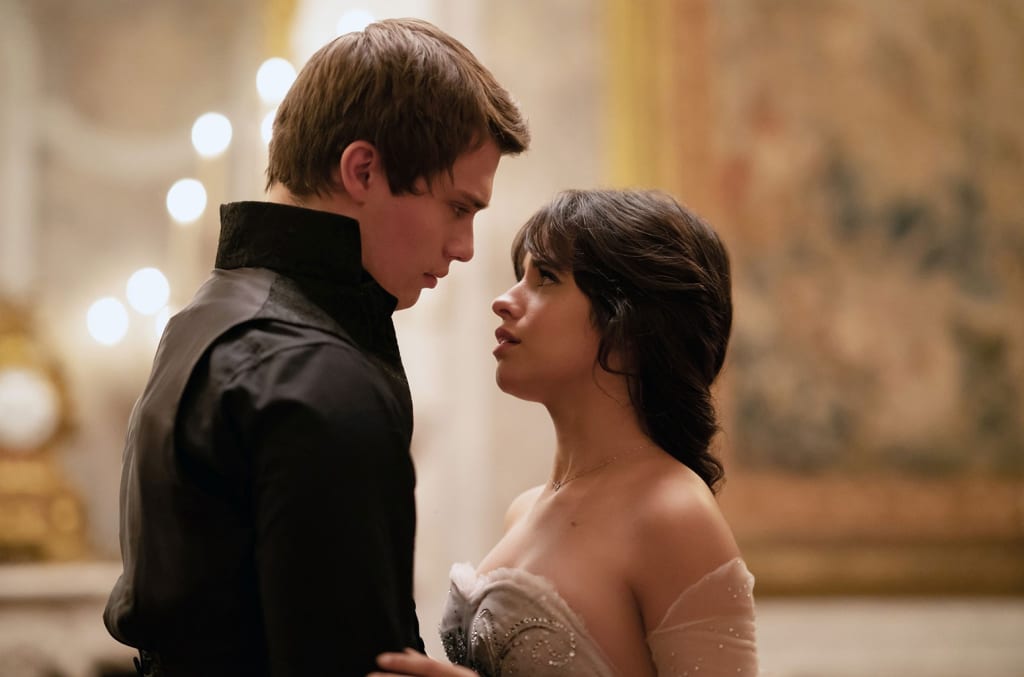
The latest adaptation of Cinderella, starring pop vocalist Camila Cabello, was, allegedly, written and directed by a real person named Kay Cannon (Blockers, Pitch Perfect), but may actually be the first film entirely generated by an AI fed nothing but Top 40 hits and neoliberal “I’m With Her” slogans. Cannon fumbles the long-adapted story--her version taking very, very loose cues from Charles’ Perrault’s Cendrillon--and hollows it out until there’s nothing left but limp showmanship, badly-rendered CGI mice, and an utterly heartless script. Of the many sins this film commits, the most egregious is that Cannon forgets what story she's telling in her constant attempts to grant Cinderella agency.
Cinderella is billed as ‘musically-driven’ rather than a musical proper. It’s more in the line of Hollywood’s earliest sound offerings than Chicago, West Side Story, Cabaret, etc. That is to say that the plot is held loosely together by musical numbers which temporarily derail the narrative in favour of spectacle. However, at least with those early musicals, one had a spectacle to ooh and aah over. Whether it be Busby Berkeley’s dazzling choreography, Irving Berlin’s infectious earworms, or, at the very least, palpable chemistry between duos like Astaire and Rogers; the musical numbers in these films never felt like chores. Cinderella has songs, and it technically has choreography, but is entirely devoid of charm, chemistry, or emotion.
An old musical theatre proverb says "when the emotion becomes too strong for speech you sing; when it becomes too strong for song, you dance". In Cinderella, characters break into song and dance not because they feel strongly, but because they're trying to sell an album. Nearly two gruelling hours of shoestring plot is held together by overproduced covers and underwritten original songs. Moreover, most of the cast doesn't even have the dignity to sound good. Everyone on the album is noticeably autotuned; not even Tony-winning Billy Porter (Fab G) and Idina Menzel (Vivian) are free. Musical numbers range from baffling (‘Rhythm Nation’ as an opening dirge about the patriarchy) to shoehorned in (the ‘Whatta Man/Seven Nation Army’ mashup feels like a bad trip). The only commonality is their low quality.
Songs are either overplayed pop tunes, or cultural mainstays mangled beyond belief. I’m sure Freddie Mercury’s ghost wept at the moment where Prince Robert (Nicholas Galitzine) is instructed to find a bride and performs ‘Somebody to Love’ with all the enthusiasm of an unpaid intern forced to do karaoke with his new colleagues. The most notable case of choreography is actually the glaring lack of it. When Ella and Robert share their first dance, gone is the sweeping camerawork from Kenneth Branaugh’s 2015 Cinderella, forgotten is the heart-stopping romance of Rodgers and Hammerstein’s ‘Ten Minutes Ago’. Instead, the happy couple perform a nauseating cover of ‘Perfect’ by Ed Sheeran while the camera swings around like a tetherball to disguise leads who have neither the instruction nor the talent for ballroom dancing.
Cinderella is a musical born not out of love for the genre or creative ingenuity, but so that teen and preteen girls around the world will stream the soundtrack on Spotify. Cast a pop singer as your lead and you needn’t worry about her acting chops when airplay is guaranteed. The musical numbers are unispired music videos; there is no spectacle and less excitement. Each one is groan-inducing, hollow, and textureless, a product within a product, designed entirely for commercialization.
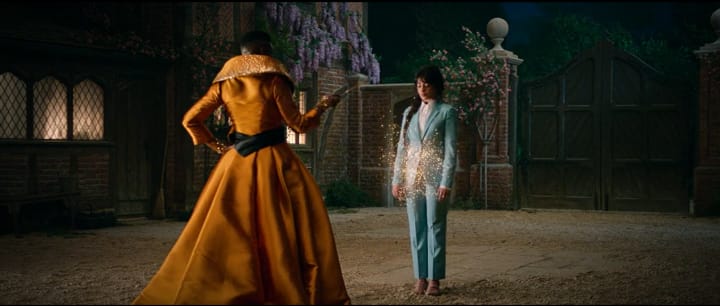
Little girls no longer want to grow up to be princesses, now they aspire to be #BossBabes. Cinderella wants to have its cake and eat it too with regards to its main character’s ambition. Ella is an ambitious caricature of a protagonist, who the screenplay cannot decide whether to take seriously or poke fun at. Her dressmaking dreams may be admirable (though her skills leave much to be desired), but her insistence on owning a business rather than making something beautiful is so hamfisted I can’t tell if it’s supposed to be a joke or not. Her repeated cries that she should be allowed to run a business because women “give birth and run households” leave her sounding like the butt of the joke, but, then again, that could be Cabello’s delivery. The feminism that this film allegedly upholds--the millennial pink yoga pant feminism of high school bullies turned pyramid scheme recruiters--is the same feminism that it mocks none too subtly. To illustrate this point, Fab G first puts Ella in a light blue pantsuit for the ball, saying "I thought you wanted to be a businesswoman”. Adding insult to injury, the pantsuit looks far better than the final fairytale dress which fits awkwardly and looks worse.
The girlbossification of Ella would still be inexcusable, but more bearable if every single female character in this godforsaken film wasn’t also a girlboss. The prince’s younger sister, who wants to be king and whose hairstyle is reminiscent of Sarah Snook’s role in Succession, is a girlboss. The queen, who wishes for her husband to treat her like an equal in a laughably unequal society, is a girlboss. A neighbouring princess desiring nothing but a political marriage with Robert is a girlboss, as is the queen who admires Ella’s dress and hires her as a designer. With every woman hungry for power, for money, for recognition in a world we’re repeatedly told is “archaic” and “traditional” only with regards to strawman misogyny, there is no room left to be just a girl. Being a girl who wants only to live happily and put kindness above monetary greed is no longer enough, and Ella in this film isn’t even kind.
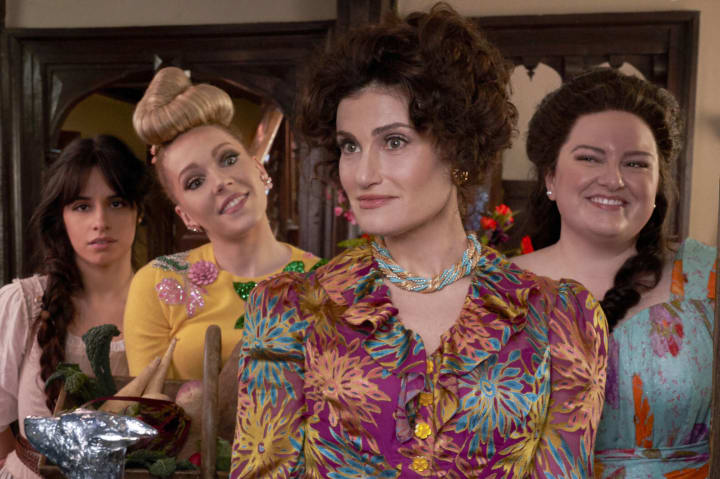
The most unforgivable girlboss in a film which loves marketable-pastel-infographic feminism, is Ella’s stepmother, Vivian. No longer worthy of the title ‘evil stepmother’, the worst she does is pinch Ella’s ear and make a few snippy comments. In this post-Maleficent world where villains can be easily divided into two categories: third act friend-turned-foes and redeemable, tortured souls, there is no room left for good old-fashioned villainy where characters are evil for no reason other than a love of malice. Vivian is a pale imitation of a classic fairytale villain. She goes into agonizing detail about being unable to pursue a career as a pianist because women aren't allowed dreams unless they revolve around marriage and babies. Instead of locking Ella in her room and trying to scheme her own daughters onto the throne, she outright encourages Ella to marry the Prince for financial security. Even when she does try to sell Ella off to a lecherous neighbour, there are no stakes. A plague o'er the studio that sands down stories until there's nothing left.
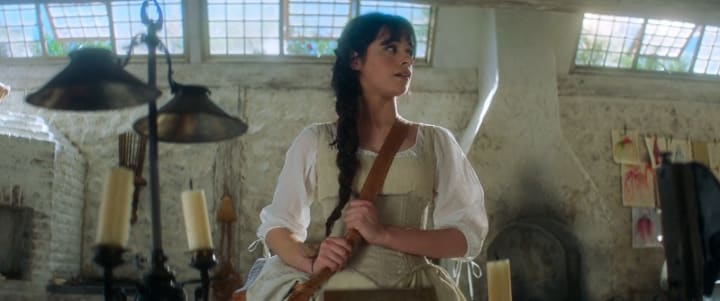
Ella complains that she lives in a basement, but her basement is well-furnished with high ceilings and skylights. No attempts are made to make her look the least bit dusty or tired before she gets glammed up. Camila Cabello’s l’Oreal partnership makes it difficult to tell if you’re watching a film or a feature-length skincare commercial. Her first ballgown is not ripped to shreds by her jealous family but, instead, is splashed small cup of ink. But, Amazon doesn’t want you to believe there is any hardship which cannot be solved by next-day shipping and video on demand. Your stepmother may keep you as an indentured servant, but if you work hard enough, you too can own a carriage whose manufacturer used slave labour during the Holocaust. In a world where villains are no longer villainous, where movies too complex for ‘ENDING EXPLAINED’ videos are labelled 'pretentious', and stories about overcoming abuse are reduced to misunderstood geniuses being slightly bitchy to their stepchildren, why tell a story if you’re determined to make it into something it’s not?
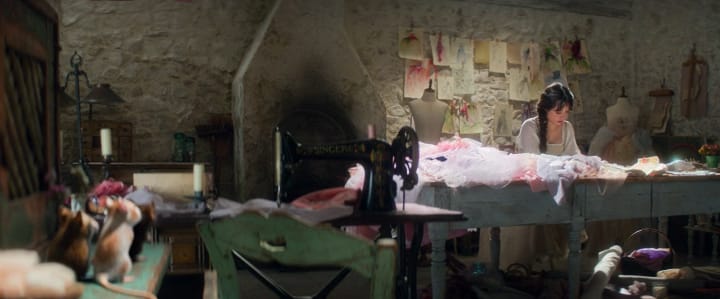
Now, there is a salient point that could be made about how Ella’s dressmaking allows her the economic freedom necessary to escape her abusive situation. Amazon, of course, does not consider this point. And why would they? Why would a parasitic megacorporation that is actively destroying the natural world every second it exists consider that the poor and the oppressed deserve to live without being useful worker drones under Moloch? A film is only as good as its gross, and by making the flattest, most broadly appealing piece of so-called art which refuses to engage in themes, or allow its characters two minutes of genuine emotion without undercutting it with a cheap laugh, studios pander to the widest possible audiences. Amazon does not care about making art, only profit. As if this film’s existence as a shameless cash grab wasn’t obvious enough, look no further than the Mercedes-Benz partnership, or the early shot in which the logo of Ella’s Singer sewing machine is clearly visible. In previous versions of the story, Cinderella makes her own dress because she wants to be closer to her dead mother, or because she wants to wear something other than ash-stained rags. In this Cinderella, her ballgown is a walking advertisement for her talent. What's the point of skills you can't churn a profit from? Why settle for being a girl when you can be a girlboss?
In short, there is nothing in this adaption that you could not get a better version of elsewhere. Lady Tremaine in the 1950 Disney film would eat Vivian for breakfast. The moment in Ever After where Drew Barrymore’s Danielle punches her stepsister in the face and threatens to rip her hair out is leagues more #girlboss than Camila Cabello’s capitalist wet dream could ever strive for. For a recent adaptation with lush production value, check out Kenneth Branagh’s Cinderella; and if you want a ballroom scene that leaves me breathless each time, try Rodgers and Hammerstein’s Cinderella with Brandy. The 4-minute scene in Ella Enchanted where Anne Hathaway knocks ‘Somebody to Love’ out of the park has more heart and soul than the entire 112-minute runtime of Amazon’s Cinderella. However, if what you want out of a motion picture is former mouse James Corden explaining that he pees with his “front tail” after being transformed into a human, then I can’t help you. Get well soon, I guess.
About the Creator
kit vaillancourt
Kit is a former english major writing about niche books, old movies, and general oddities. They dream of disappearing in the Arctic under mysterious circumstances. Follow them on Instagram or twitter @kitnotmarlowe.
Keep reading
More stories from kit vaillancourt and writers in Geeks and other communities.
Ranking all 13 'I Am Canada' Books
Overall thoughts Let me get something out of the way: I didn’t want to read these books. Maybe that’s too strong of a statement. I’m something of a purveyor of children’s historical fiction. Previously, I fulfilled an insatiable decade-old desire lodged in the back of my brain to read and rank all 33 Dear Canada books, and determined that some of them are fantastic. Then, I set my sights a little further south and read and ranked all 43 Dear America books with slightly less exciting results. Then, I was supposed to read and rank The Royal Diaries—which is Dear Canada/America for kids who haven't developed class consciousness yet or, are really into Elizabeth Tudor/Cleopatra/Anastasia Romanova—and then I didn’t. It wasn’t for lack of resources, all of the books were at my local library. Instead, I fell into a reading slump last summer that I’m still crawling my way out of. My chance to include a Royal Diaries installment of this series vanished right before my eyes.
By kit vaillancourt6 years ago in Geeks
Silver Screen Magic with Mae West
American actress and singer Mae West became a popular film actress during the Great Depression. She started entertaining in vaudeville, then performed on Broadway, and finally went to Hollywood. She signed up with Paramount Pictures and made her debut in the 1932 film “Night After Night.” She also starred in musicals, comedies, and crime dramas. The American Film Institute named her one of the best classic Hollywood actresses.
By Rasma Raisters4 days ago in Geeks
Premier League in Australia: How to Watch
The 2025–26 Premier League season is underway, marking the 34th edition of the competition and the 127th year of top-flight English football. Liverpool start their title defense with confidence after lifting their second Premier League trophy last season, but the return of Leeds United, Burnley, and Sunderland ensures fresh rivalries – including the long-awaited Tyne–Wear derby, back for the first time since 2015–16.
By David Cook6 days ago in Geeks



Comments
There are no comments for this story
Be the first to respond and start the conversation.