
AI Transforming the Sports Media Landscape
How AI is Revolutionizing Content Creation, Fan Engagement, Data Accessibility, and the Future of Sports Media Websites


AI in Sports Content Creation
AI is increasingly automating routine sports journalism tasks, from game recaps to stat-heavy reports. Major outlets have begun using AI to generate match reports and summaries, especially for games that previously lacked coverage. For example, ESPN now employs generative AI to write game recaps for certain leagues (like women’s soccer and lacrosse) that were often underserved by human reporters . Each AI-generated article is reviewed by human editors for accuracy and labeled transparently (with a byline like “ESPN Generative AI Services”) so readers know it was machine-written . The goal is to augment coverage, not replace journalists – providing fans with additional content that wouldn’t exist otherwise .
Other organizations have seen similar success with automated writing. The Associated Press has used AI for years to deliver thousands of sports updates that would be impractical to create manually. AP’s automated system produces recaps for every minor league baseball game and even generates previews for over 5,000 college basketball matchups, leveraging data feeds and natural language generation software . This frees up human reporters to focus on in-depth stories while AI handles the repetitive, data-driven pieces. Even smaller newsrooms benefit: one local paper in Argentina developed a “robot reporter” to churn out about 250 short football articles each month, covering matches with basic play-by-play details that a tiny staff couldn’t otherwise report. These real-world applications show AI’s growing role as a team player in sports journalism – handling the heavy lifting of game summaries and stats so that human writers can tackle analysis and storytelling. By automating content creation in this way, sports media websites can scale up coverage to more games and niche sports, ensuring fans get timely updates for virtually any event.
Enhancing User Experience with Personalization and Chatbots
AI is also elevating the fan experience on sports media platforms through personalization, interactive chat, and predictive features. Modern sports sites and apps leverage machine learning to tailor content to individual users – for instance, recommending news about your favorite team or highlighting videos similar to ones you’ve watched. AI algorithms analyze fan behavior (browsing, viewing, and even social media engagement) to predict preferences and deliver customized content feeds. This means a basketball fan might see more NBA analysis on their homepage, while another user gets soccer highlights, creating a more engaging, relevant experience for each person.
Chatbots have emerged as a popular AI-driven tool for fan engagement. Many teams and media brands use conversational AI to interact with fans in real time, answering questions and providing information on demand. A notable example is Arsenal FC’s messenger chatbot “Robot Pires,” which lets fans ask about upcoming matches, player stats, club news and more. Available on platforms like Facebook Messenger and Slack, Robot Pires responds with the requested info – often with a bit of wit and personality – giving supporters instant answers at any time. If the bot can’t handle a complex query, it seamlessly hands off to a human staffer, ensuring fans always get help. Such chatbots make it easy for fans to stay informed and feel connected to their team without digging through websites or waiting on hold. Beyond text chat, some teams have also experimented with voice assistants and AI-powered customer service to help with things like ticket bookings or venue information, all aiming to streamline the fan’s journey.
Predictive analytics further boost user engagement by adding an extra layer of insight to sports content. AI models can analyze live data to generate real-time predictions – for example, win probabilities that update throughout a game, or personalized fantasy sports tips. Many broadcasts now display dynamic stats (like the chance of a comeback) to keep viewers glued to the action. According to a global survey, 63% of fans see data analytics as a positive addition to their viewing experience, and half believe AI will continue to enhance sports broadcasts with features like real-time updates and personalized content. By integrating these AI-driven elements, sports media platforms cater to modern fans who crave not just information, but interaction and insight – making the experience of following sports more immersive and tailored than ever.
Data Accessibility and AI Tools for Sports Insights
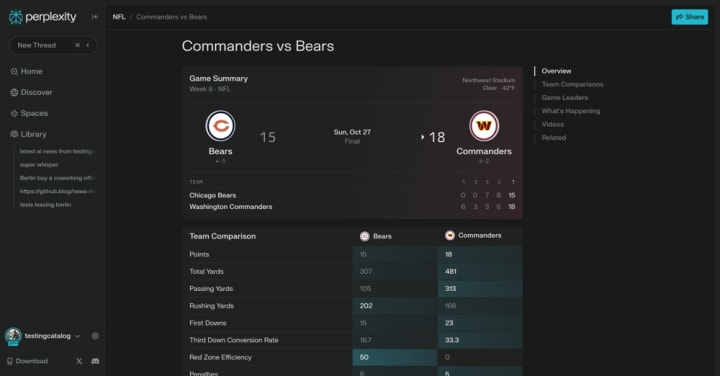
AI-powered answer engines are changing how fans access sports stats and historical data. Instead of manually searching through tables and archives on various websites, fans can now ask intelligent assistants complex sports questions and get instant answers. Tools like Perplexity AI and GPT-based chatbots serve as on-demand sports analysts – retrieving real-time scores, contextual facts, and deep historical insights in a single conversational interface. For example, Perplexity’s new sports feature provides a rich dashboard for queries about games, combining live scores, detailed team stats, player info, and even related videos into one interactive view. A user could type in a query like “Bears vs Commanders game summary” and immediately see the final score, key team stats, and an AI-generated recap, along with links to highlights – all without combing through multiple webpages.
Large language models (like OpenAI’s GPT) can similarly digest and summarize vast sports databases when properly integrated. This improves access to niche facts and comparative stats that might take a human hours to compile. For instance, a fan could ask a GPT-powered assistant, “Who holds the record for most goals in Champions League history?” or “How did weather affect last year’s NFL games?” and get a concise, data-backed answer drawing from historical records. These AI tools excel at natural language queries, meaning fans don’t need to know the exact webpage or technical terms – they can just ask in plain English (or any language) and get useful results. In essence, AI acts as a smart layer on top of traditional sports data sources, making information retrieval more conversational and intuitive.
Crucially, this doesn’t replace the underlying data providers; it amplifies them. AI assistants pull from official stats, curated databases, and reputable news to ensure accuracy. For example, an AI might use live data feeds from a site like NFL.com or Sportradar’s API to update scores, while drawing on historical statistics stored in its training data for context. The end result is that fans and even journalists have unprecedented access to information – whether it’s real-time game stats or decades of sports history – simply by asking. This democratization of data means deeper insights are no longer confined to those who know where to look; anyone can get answers quickly, which enriches discussions and understanding around sports events.
Changing Fan Interaction with AI Commentary and Social Features
AI is also reshaping how fans interact with sports content and with each other. One striking development is the advent of AI-generated commentary for games and highlights. Traditionally, if a match wasn’t covered by a broadcaster, fans had no commentary to accompany the action. Now, AI is filling that gap. In a recent example, the U.S. Open tennis tournament used IBM’s Watson AI to add spoken commentary to highlight videos for every single match – even those on outer courts with no live announcers . The AI was trained on tennis data and terminology, allowing it to generate play-by-play narration and captions that sounded like a reasonable (if slightly robotic) commentator. This meant hundreds of previously silent match clips now had insightful descriptions, making them more engaging and accessible (especially for visually impaired fans). While the quality of AI voiceovers is still improving, it’s a game-changer for coverage of lower-profile events. Fans can follow along with an automated announcer and feel more connected to the game, and they can discuss the action as if it were a televised match because the AI provided the context and emotion cues that spark conversation.
Beyond commentary, AI-driven interactive elements are popping up in sports media. Virtual assistants and second-screen experiences allow fans to ask questions or get explanations during a live game. For instance, a viewer at home might query an AI bot for rule clarifications (“What’s the offside rule?”) or stats on a player who just scored, without having to leave the live stream. Some broadcasts integrate these features so that fans can essentially chat with an AI “co-commentator” during the game. This transforms viewing from a one-way consumption into a two-way interaction. Likewise, on social media, AI is enabling new forms of content that fans share and discuss. Automated highlight generators clip big moments almost in real-time, posting them to Twitter or Instagram moments after they happen. This instant content gives fans fuel for reaction and discussion while the game is still ongoing.
AI can even facilitate fan communities by analyzing and surfacing the most talked-about topics. For example, an AI system might detect that a certain player’s performance is trending among fans and prompt a discussion or poll about it on a sports app. Chatbots and fan forums moderated by AI can keep conversations civil and on-topic by filtering toxic remarks, making online interactions more welcoming. In short, AI is enriching social interaction around sports by providing more to talk about (through commentary and stats), more ways to talk (through bots and interactive Q&As), and a safer environment for fans to connect. The end result is a more engaged fan base that isn’t just consuming content but actively participating in it, with AI quietly orchestrating many of these new interactive experiences.
Future Trends: AI’s Next Play in Sports Media
Looking ahead, experts predict that AI will continue to redefine the boundaries of sports media in exciting ways. One major trend on the horizon is increasingly automated (and personalized) broadcasting. AI-powered cameras and production tools are already making it possible to cover games with minimal human crew, and this will only grow. In 2024, automated camera systems became mainstream even in professional leagues, allowing high-quality broadcasts of lower-tier games that never would have been televised before. By 2025 and beyond, we can expect smarter AI directing these cameras – dynamically zooming and switching angles based on the flow of play, the crowd’s reaction, or even recognizing which player is the fan favorite to follow. Viewers could gain the ability to customize their watch experience in real time: imagine choosing to follow a specific player for the entire game, or selecting an aerial tactical view, all enabled by AI-driven feeds. This level of immersive, on-demand control would make remote viewing much more interactive, almost like directing your own personal broadcast.
Another future development is the creation of richer augmented and virtual reality sports experiences powered by AI. We’re already seeing early steps – for example, AR apps that overlay player stats and trajectories on the screen during replays. Down the line, AI could help render live games in 3D for VR headsets, letting fans “step into” a live stadium environment from home. Generative AI might even simulate scenarios or players (for instance, you could ask an AI to show what a lineup of all-time legends might look like on the field). While still experimental, these ideas point to deeply immersive experiences where the line between game and video game blurs. AI will likely drive such innovations by handling the massive data processing and real-time rendering needed to make them feel seamless.
Sports storytelling will also benefit from AI’s evolution. Broadcasters are expected to use AI to automatically pull up historical parallels and interesting stats during live commentary, enriching the narrative for fans. We may see AI co-hosts that can banter with human presenters on studio shows, providing instant analysis or even playful personality (trained on decades of sports trivia and jokes). Additionally, AI will continue to expand coverage of niche sports and global events. As one industry CEO noted, AI is democratizing sports coverage – sports or leagues that were overlooked in the past can finally get time in the spotlight because AI makes it cost-effective to produce content for them. A small international tournament, for example, could have full match reports, highlight videos, and even AI commentary in multiple languages, all generated at scale to serve passionate fan communities around the world.
Of course, human creativity and insight will remain vital. The consensus is that AI will augment production but not replace the emotional storytelling that expert journalists and commentators provide. The best outcomes will come from humans and AI working together – with AI handling the grunt work and instant data crunching, and humans focusing on creative analysis, interviews, and the emotional pulse of sports. In the future, expect sports media to be a blend of automated efficiency and human touch: ultra-personalized, interactive, and available anywhere at any time, yet still grounded by the authenticity and passion that draw fans to sports in the first place.
Sports Websites vs. AI-Driven Platforms: What Stays and What Shifts
As AI platforms rise, a natural question emerges: what role will traditional sports media websites play, and what content might shift entirely to AI-driven services? The likely scenario is a complementary division of roles. Sports websites will remain indispensable as primary sources for authoritative data, official news, and in-depth journalism. They are the origin for live scores, detailed box scores, standings, and breaking news updates – the raw information that AI tools need to function. It’s hard to imagine these core data resources disappearing from the web; if anything, they’ll become more structured and accessible via APIs for AI to ingest. Fans who want to dive deep into statistics or read a comprehensive investigative piece will still visit websites or apps of outlets like ESPN, BBC Sport, or Yahoo Sports. Certain rich content – think long-form feature articles, exclusive interviews, or opinion columns – will reside on traditional platforms because it’s unique human-generated material that AI can summarize but not truly replace.
On the other hand, AI-driven platforms will handle the on-demand delivery of information and personalized experiences that once required manual browsing. Routine queries that a user might have navigated several pages to answer can be offloaded to an AI assistant. For example, instead of clicking through a website’s menus to find “Team X’s all-time top scorers,” a fan might simply ask an AI chatbot and get that list immediately, sourced from the website’s data. In this way, AI acts as a new front-end for consuming the data that websites provide. We may see a shift where casual fans rely on AI chatbots or voice assistants for quick updates (“What’s the score?”, “When is the next game?”) and simple analyses, while power users and enthusiasts go directly to the sites for richer content. Some traditional sports media brands are already adapting to this by building their own AI tools and integrations. By offering official chatbots or partnering with AI platforms, they ensure that when fans ask an assistant for news about, say, the NFL, the answers still pull from the NFL’s official site or its media partners.
In terms of what might shift entirely to AI-centric platforms: highly customizable experiences are a prime candidate. Fantasy sports advice, for instance, could be delivered by AI agents that know your league settings and comb the entire web for player news and stats, rather than you reading multiple articles. Similarly, personalized highlight reels might be compiled by AI based on your viewing habits, rather than you searching a video archive yourself. However, even these AI services will depend on the underlying content produced by leagues and media websites (game footage, statistical databases, etc.). It’s less a wholesale migration and more of an evolution in interface. The content backbone provided by sports media sites remains, but AI-driven platforms present and curate that content in a new way.
Ultimately, traditional sports websites and AI tools will likely converge into a more integrated ecosystem. We can expect sports sites to embed AI chat features, allowing users to ask questions on the site itself. Likewise, AI platforms will link back to source websites for users who want to “learn more” or verify details (for example, providing a citation or a read-more link to an ESPN article when summarizing it). Rather than an either-or scenario, the future points to collaboration: websites providing the verified data and rich storytelling, and AI providing the convenience of instantaneous, personalized delivery. The sports media companies that thrive will be those who embrace AI as a means to enhance their distribution and fan engagement, without compromising on the quality and integrity of the content that is their foundation.
Conclusion
already seeing the early impact – automated systems drafting game stories, algorithms tailoring what we see and hear, and chatbots ready to talk sports anytime. These innovations promise a more abundant and personalized sports media landscape, where fans can get coverage of any game, at any time, in any format they prefer. At the same time, the human element – insightful journalism, passionate storytelling, and the communal joy of sports – remains at the center. The integration of AI is not about removing people from the equation, but empowering both content creators and fans with better tools and access. As one survey suggested, many fans are optimistic that AI will enhance their sports experience with more data and interaction. The trajectory suggests they’re right: from AI commentators narrating a last-minute goal to predictive models making our debates more interesting, AI is enriching the fabric of sports fandom. The playing field of sports media is expanding beyond the traditional website into an intelligent, interactive network – and everyone, from casual fans to industry giants, will need to adapt to this new game. With thoughtful implementation, AI will undoubtedly be a game-changer, delivering more excitement and insight to sports fans while preserving what we love most about the game.
About the Creator
Oscar
I’m a Full Stack Developer building CheckLive.com—a fast, scalable site focused on real-time analytics and user-friendly experiences. Skilled in modern JS frameworks, backend services, and APIs. Always excited to simplify complex problems!
Keep reading
More stories from writers in Geeks and other communities.
10 Times Rotten Tomatoes And I Disagreed
***Disclaimer*** I will be ranking these movies in the following manner: The greater the divide between Rotten Tomatoes and I, the higher up on the list (and I am referring to the critic's score, not the audience score). I will also show Rotten Tomatoes' score on each one in addition to my score. I am curious to know what everyone thinks, please let me know in the comments below!
By Madison "Maddy" Newtonabout 19 hours ago in Geeks




Comments
There are no comments for this story
Be the first to respond and start the conversation.