
A Filmmaker's Guide: "The Colour of Pomegranates" (1969)
Film Studies (p.151)

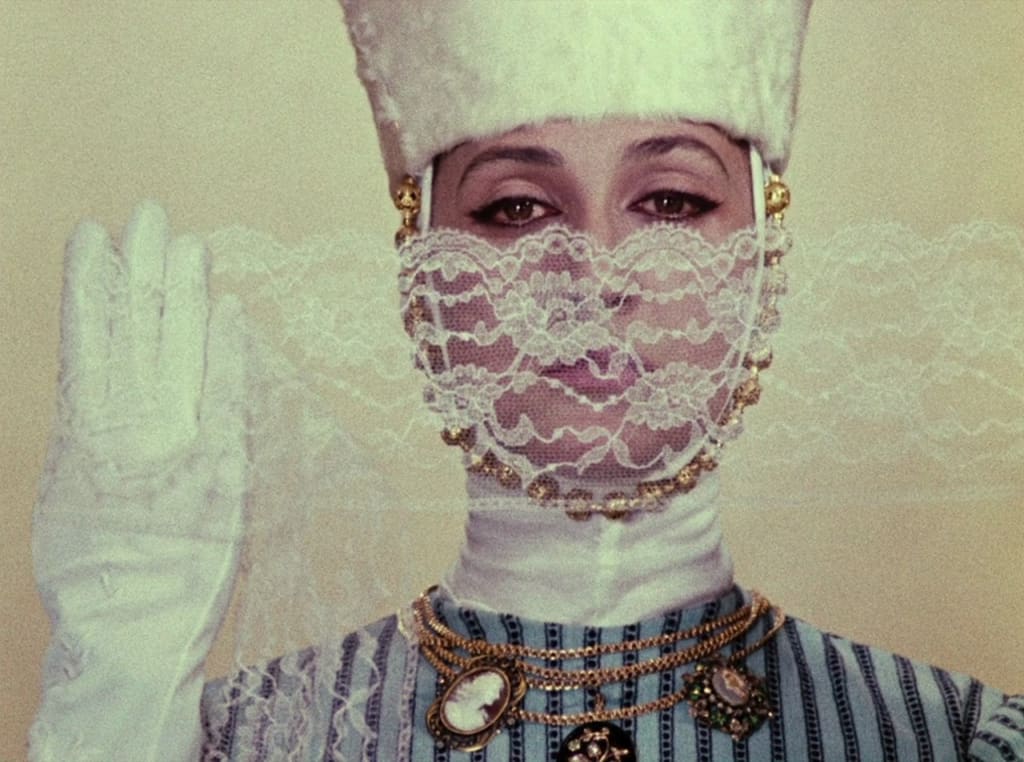
In this chapter of ‘the filmmaker’s guide’ we’re actually going to be learning about literature and film together. I understand that many of you are sitting in university during difficult times and finding it increasingly hard to study and I understand that many of you who are not at university or not planning on it are possibly stuck of what to do, need a break or even need to catch up on learning film before you get to the next level. This guide will be brief but will also contain: new vocabulary, concepts and theories, films to watch and we will be exploring something taboo until now in the ‘filmmaker’s guide’ - academia (abyss opens). Each article will explore a different concept of film, philosophy, literature or bibliography/filmography etc. in order to give you something new to learn each time we see each other. You can use some of the words amongst family and friends to sound clever or you can get back to me (email in bio) and tell me how you’re doing. So, strap in and prepare for the filmmaker’s guide to film studies because it is going to be one wild ride.
The Filmmaker's Guide is back!
After my 150 Films of Golden Age Hollywood (that you can view here) I have come back with something I know you will like - analyses. I have been re-watching some really classic international films and I would like to share some of that analyses I have been writing, with you. From parts 151 all the way through to part 175 then, I shall be looking at European Cinema and the different things it can teach us about its story and its technique.
The film that we are going to start off with is called "The Colour of Pomegranates" (1969) and is an Armenian Soviet Film which is filmed mostly in active tableaux.
Tableaux = a group of people who are motionless. They stand in positions representing the action of the scene. It is the plural of 'tableau'.
Therefore, in active tableaux, we will see these people move into and out of positions that act out the movements and emotions of the scenes before and after.
Active Tableaux = we see people move in and out of the scene, we see people act out the scene without much sound, we also see people create the story from images instead of conversation.
But first, let us have a look at what the film is about:
The Colour of Pomegranates (1969)
Summary: A tale of a poet which is told in order to reveal images rather than a flat-out story, the movie is littered with bits of dialogue and presented with each chapter having different thematic music. The film is told in different chapters including (but not limited to) ones named: childhood, old age and death. It is meant to be an almost avant garde biopic of a fictional character who wanders through Armenia and the Soviet states writing and revealing his poetry to everyone.
Let us now take a look at the different active tableaux that we see in the film. I'm not going to tell you whereabouts these tableaux appear in the film because it will ruin the cryptic nature it presents when you watch it. Instead, I want you to take a guess at what is going on in the still:
Still #1
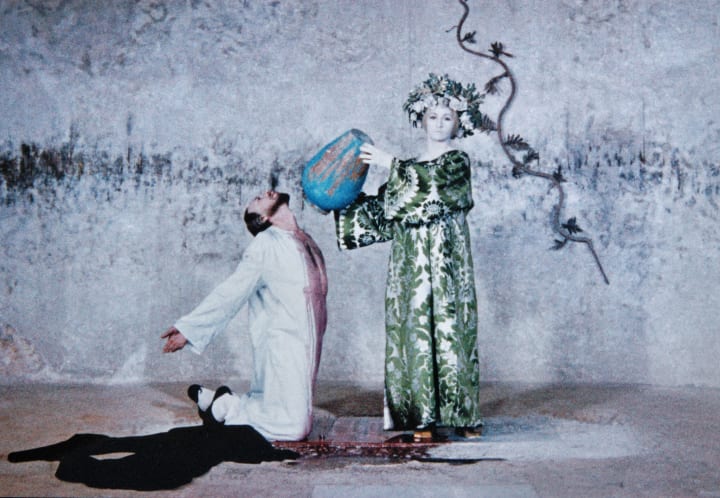
G. Smalley once stated the following about the film:
"If someone sat down to watch The Colour of Pomegranates with no background, they would have no idea what they were seeing."
Do you think this is true or do you think that you could work something out from seeing the still we see above?
Personally, I do not agree with Smalley because I love it when people have different theories about what the film is showing without having an intense knowledgeable background. Basically, it isn't any fun when you know someone is completely correct about a theory. It is more fun to see someone's interpretation.
Still #2
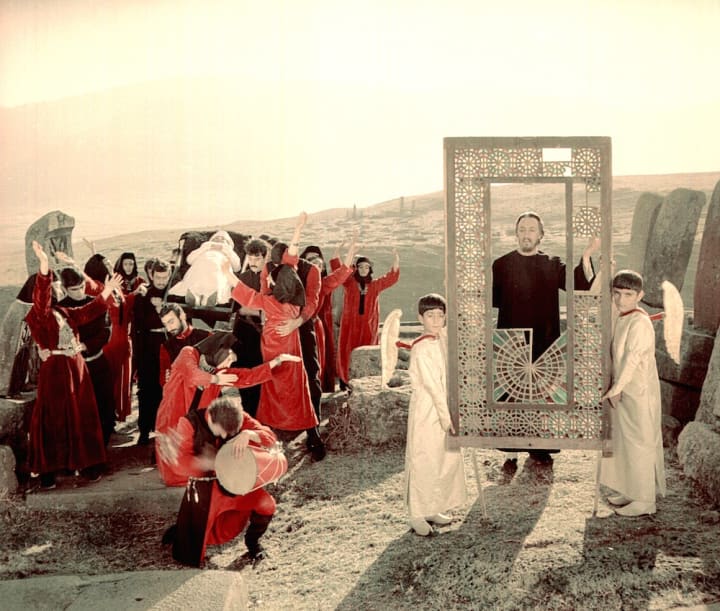
In John Wakeman's book "World Film Directors" Frank Williams made a comment about the fact that this film is a celebrated work of Armenian culture at a time when they were being oppressed. He stated:
"There are specific images that are highly charged—blood-red juice spilling from a cut pomegranate into a cloth and forming a stain in the shape of the boundaries of the ancient Kingdom of Armenia; dyers lifting hanks of wool out of vats in the colours of the national flag, and so on..."
In this still above though, we see characters dressed in a blood red colour and one of the characters holding a broken window up to himself. There is clearly some sort of message of violence but what do you think it is? Note: the angels beside the broken window.
Conclusion
There are many reasons to sit through the film "The Colour of Pomegranates" (1969) but not just because I told you to, there are actually a lot of things we can learn about European Cinema such as:
- The Cinema of Oppressed People
- How movies can be subverted in their style
- The way in which tableaux can be used in cinema
I hope you have found this insightful - now please, proceed to watch the film and enjoy it with all you have learnt.
About the Creator
Annie Kapur
I am:
🙋🏽♀️ Annie
📚 Avid Reader
📝 Reviewer and Commentator
🎓 Post-Grad Millennial (M.A)
***
I have:
📖 280K+ reads on Vocal
🫶🏼 Love for reading & research
🦋/X @AnnieWithBooks
***
🏡 UK
Keep reading
More stories from Annie Kapur and writers in Geeks and other communities.
Book Review: "Murder by the Book" ed. by Martin Edwards
So far, I have read nearly every single British Library Crime Classic book going. I love to read classic crime novels, they are like my guilty pleasure. I have to admit though when crime is written as a short story, it can normally get a bit repetitive and boring as there are only so many storylines you can do in such a short space. Whereas, if you have a whole novel’s length then there are considerably more storylines you can cover. As I was making my way through the series, I have often encountered short story crime classic anthologies that made me rethink my stance on crime short stories. These have included but are not limited to books like: ‘Blood on the Tracks’ (the book by the British Library - not the Bob Dylan album). Another one has been “Deep Waters” which dealt with mysteries at sea and was considerably better than other short stories of the same genre I had read before. And the final one I enjoyed was called “The Long Arm of the Law” which are police stories - as my mother is a retired police officer, I can honestly say that I love reading about the fictionalised version of events that the police may get up to on the job. But, when I read this one entitled “Murder by the Book” I found that once again, I was wrong about short story crime. It can happen and it can happen well. It can happen very well, actually.
By Annie Kapur4 years ago in Geeks
Silver Screen Magic with Mae West
American actress and singer Mae West became a popular film actress during the Great Depression. She started entertaining in vaudeville, then performed on Broadway, and finally went to Hollywood. She signed up with Paramount Pictures and made her debut in the 1932 film “Night After Night.” She also starred in musicals, comedies, and crime dramas. The American Film Institute named her one of the best classic Hollywood actresses.
By Rasma Raisters5 days ago in Geeks
Jay Kelly - A Netflix Movie Review
Are you running to something or from something? Jay Kelly is a 2025 film about a famous movie actor who is beginning to have doubts about his career. While on the train to his next job, Jay reflects on his life, confronting his past and present.
By Marielle Sabbag6 days ago in Geeks
The Devil's Cut
“Comrade, finally you’re awake.” The voice was smooth, sensual. A flickering incandescent bar was all that lit the white, sterile room. All Vladimir remembered was everything going black. He tried to move his arms and found them strapped to the gurney.
By Matthew J. Fromm4 days ago in Fiction



Comments
There are no comments for this story
Be the first to respond and start the conversation.