
A Filmmaker's Guide: "Belle De Jour" (1967)
Film Studies (p.157)

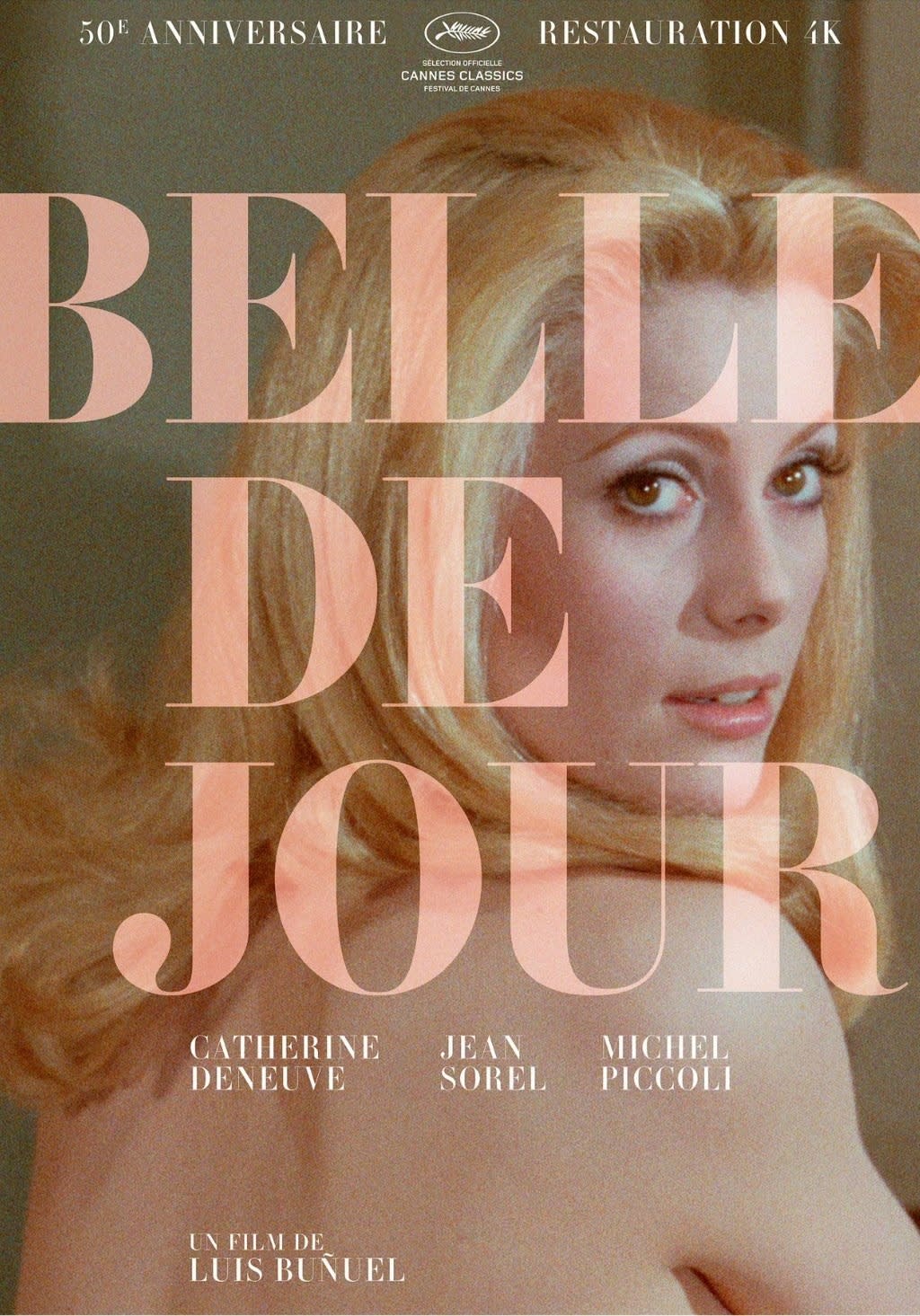
In this chapter of ‘the filmmaker’s guide’ we’re actually going to be learning about literature and film together. I understand that many of you are sitting in university during difficult times and finding it increasingly hard to study and I understand that many of you who are not at university or not planning on it are possibly stuck of what to do, need a break or even need to catch up on learning film before you get to the next level. This guide will be brief but will also contain: new vocabulary, concepts and theories, films to watch and we will be exploring something taboo until now in the ‘filmmaker’s guide’ - academia (abyss opens). Each article will explore a different concept of film, philosophy, literature or bibliography/filmography etc. in order to give you something new to learn each time we see each other. You can use some of the words amongst family and friends to sound clever or you can get back to me (email in bio) and tell me how you’re doing. So, strap in and prepare for the filmmaker’s guide to film studies because it is going to be one wild ride.
Belle De Jour (1967)
The seminal film if you're learning about Luis Buñuel, "Belle De Jour" (1967) is a captivating and intense film about loneliness starring the French new wave actress, Catherine Deneuve.
Throughout the film there are nightmare-based scenes and dream sequences in which things are either the perfect or imperfect world of the Belle du Jour. By the end of the film, we get both the perfect and imperfect worlds shown to us in complete - without really knowing which one the ending is based upon (if you really think about it hard enough). But, in my opinion, it is a film that everyone should see at least once in their lives, as it shows the hypocrisy of the new modern world in which we are constantly drifting apart, experiencing boredom and thus, living in our own minds - some for the worse.
Let us take a look at some stills and see what they can teach us about this character-based narrative:
Still #1
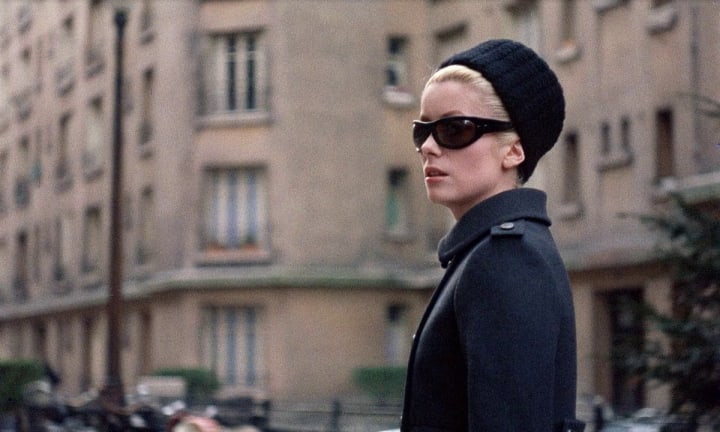
Obviously what we have here is a medium frame in which the Belle De Jour is entering from our right, she is contrasting with the background by wearing black but the most symbolic thing about the whole frame itself is her sunglasses. She wears blacked-out sunglasses to hide her identity, along with a hat to cover her hair. As the Belle De Jour has become a sex worker in order to liven up her daily routine, she feels she must protect what is, her richer and more high society identity.
Still #2
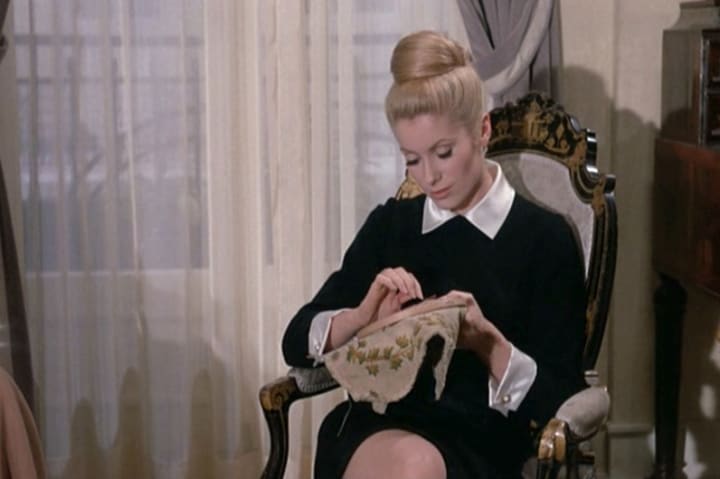
This shot is from later on in the film where the character is at home, notice how she is still dressed in black. This could be for two reasons - 1) there is a mourning going on for a life that might have been (which I will not elaborate on since it would spoil the film) and 2 - she is still, or may be suggesting towards the hidden aspect of her character: the Belle De Jour. She is yet again in medium frame and on our right, obviously suggesting that she is slightly off-centre - in character as well as her mind. She is hardly ever completely centre.
Still #3
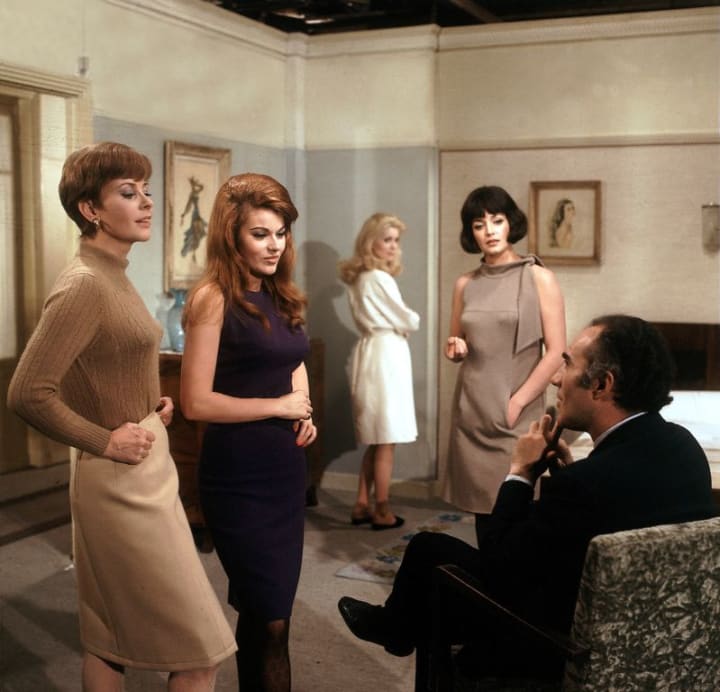
As we can see, the Belle De Jour is now in the centre of the frame - but now she is clearly dressed differently than everyone else. She is wearing brighter colours, has brighter hair and is standing away from the group. This is what we see in the Belle De Jour as different, this is how we continue to differentiate her from the rest of the sex workers. She is continuously dressing differently to the others whilst around them, but by the time she leaves, she has layered up as to not draw attention to herself. It is a brilliant play of character - showing not only contrast, but secrecy in extreme forms.
Conclusion
"Belle De Jour" (1967) is a classic new wave French film which was copied by Hollywood in various attempts at female-led existential crisis films such as the films: "The Night Porter" and "The Marriage of Maria Braun". I feel like this film is very important because of its very casual state of cinematography set against this dream and nightmare state of a woman's life as a high class wife.
About the Creator
Annie Kapur
I am:
🙋🏽♀️ Annie
📚 Avid Reader
📝 Reviewer and Commentator
🎓 Post-Grad Millennial (M.A)
***
I have:
📖 280K+ reads on Vocal
🫶🏼 Love for reading & research
🦋/X @AnnieWithBooks
***
🏡 UK
Keep reading
More stories from Annie Kapur and writers in Geeks and other communities.
Book Review: "Ghostland" by Edward Parnell
October is the time for ghost stories and Halloween tales and I always get into the spirit by trying to read something that is a bit different once in a while. Not just the MR James ghost stories or the Edgar Allan Poe, Shirley Jackson or Stephen King. I like to see new stuff that challenges what we understand to be horror fiction and ghost stories. Last year, I read a book called “The Monster Show” which is a book about Hollywood Monsters and the way in which Horror Film was made from the early ages of Hollywood all the way down to the 90s and onwards. The year before that, I really enjoyed the workings of the movie tie-in book “The Wicker Man” by Anthony Shaffer and Robin Hardy. So we can definitely tell that during the October season of spooks and ghosts, I like to delve deeply into different ideas concerning the genre, looking at different subgenres such as: speculative fiction, sci-fi horror and of course my favourite, folk horror. When it comes to Edward Parnell’s “Ghostland”, I was very excited to see this newer, more critical and more biographical take on the genre rather than simply focusing on the essence of horror fiction. It was a wildly interesting read filled with beautiful passages and an amazing plot line.
By Annie Kapur4 years ago in Geeks
Silver Screen Magic with Mae West
American actress and singer Mae West became a popular film actress during the Great Depression. She started entertaining in vaudeville, then performed on Broadway, and finally went to Hollywood. She signed up with Paramount Pictures and made her debut in the 1932 film “Night After Night.” She also starred in musicals, comedies, and crime dramas. The American Film Institute named her one of the best classic Hollywood actresses.
By Rasma Raisters7 days ago in Geeks
Rachel Reviews: The Spiral Archive by Pieter Hendrik
It's difficult for me to know where to start with a review of this book as it was, for me, an entirely unique experience and one that I'll probably never have again. I don't want that to be interpreted as unenjoyable but it has left me scratching my head a little and ruminating on its content, its themes and its characters.
By Rachel Deeming2 days ago in BookClub


Comments
There are no comments for this story
Be the first to respond and start the conversation.