
40 years of 'Tron', his pioneering and misunderstood bet on CGI
Steven Lisberger's film was so visionary that the director of 'Toy Story' has admitted that it wouldn't exist if it weren't for 'Tron'.


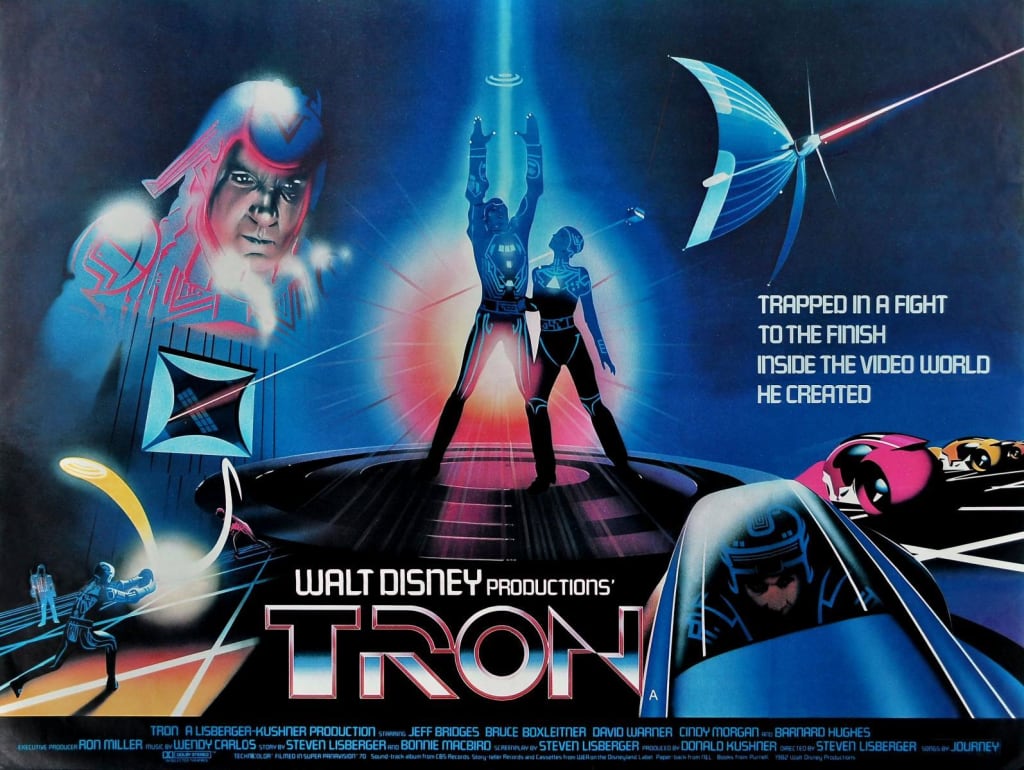
In the early 1980s, four representatives from Walt Disney's animation department went to George Washington University to recruit artists. One of them was John Lasseter, then a 22-year-old animation artist. With him was Tom Wilhite, vice president of creative development, who announced that they were developing a very strange film called 'Tron': "The animation style and story are very integrated, they're using a mixture of computer cartoons and real people. In fact, this will be the first film to combine the two techniques, live action and digital animation."
That young man who accompanied Wilhite, as we already know, would end up leading Pixar, and would say years later that, without 'Tron', he would never have made 'Toy Story'. Without it, there would be no 'Matrix' or the Marvel Cinematic Universe.
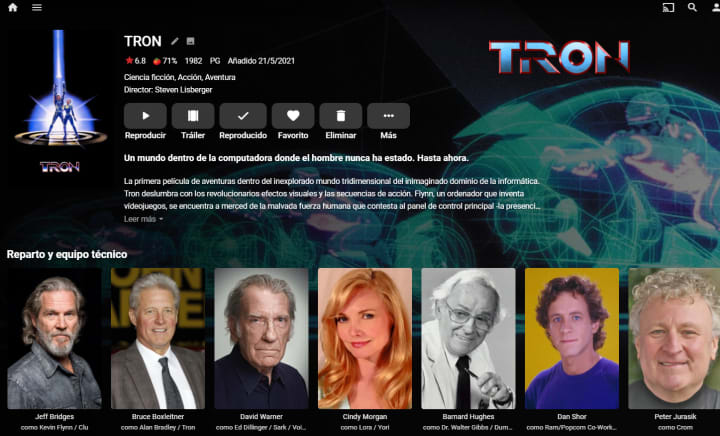
The film conceived and directed by Steven Lisberger and starring Jeff Bridges is a hybrid that could be considered animation with some live-action parts and a pioneering use of CGI. In reality, 'Tron' only has between 15 and 20 minutes of digital animation, more than 800 shots in which the actors are inserted into digital scenarios, but its design and the way the creators worked made it a film that showed that there were new horizons to conquer.
The summer of special effects
In the summer of 1982, movies like 'E.T., the Extra-Terrestrial', 'Poltergeist', 'Star Trek II: The Wrath of Khan', 'Blade Runner' and 'The Thing', which to a greater or lesser extent imagined new realities and made essential use of special effects, both practical and digital. Hollywood was capable of devising more and more new worlds and bringing them to life, something that people like Steven Spielberg were delighted about. The director predicted in a magazine that one day "it will be possible to create an entire civilization for the cost of two days of filming". He was wrong: digital effects have not made the creative process that much cheaper, because they require large, expensive computer equipment and, obviously, many people to control it.
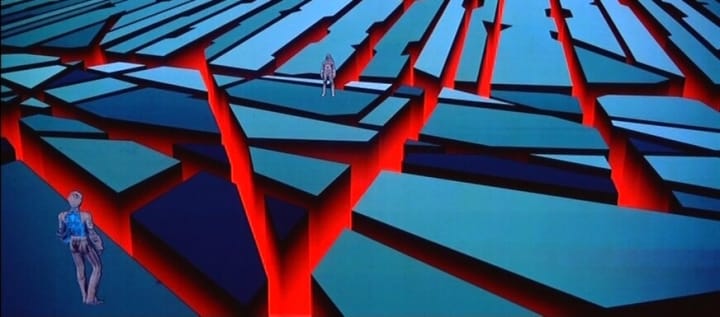
Already that year there were people raising their voices against the abuse of special effects, to the detriment of the quality of the stories. "It seems that, all too often, special effects are becoming the end as well as the means to making certain kinds of movies. The results can range from the brutally dehumanizing to the just plain boring," lamented historian John Culhane in the New York Times.
And in that context, 'Tron' was a pioneering and revolutionary film whose legacy is incalculable. And as is often the case with such feats, it was also misunderstood. After trying to develop it independently and with the help of computer companies, Lisberger and producer Donald Kushner turned to the movie studios. Warner Bros., Metro-Goldwyn-Mayer and Columbia Pictures were not interested, but Disney was.
Disney's return to innovation
The fact that Disney produced 'Tron' was for some a sign that Walt Disney's innovative and experimental spirit was still alive and well in a company that, at the time, was not at its best. "Disney is the first to tell a story with CGI, which Hollywood sees as the harbinger of a major shift in its filmmaking," Culhane announced. "If he were alive today, old Walt would probably say that 'Tron' is his most exciting project in a long time," opined journalist David McClain in Video Games Player Magazine.
The director said in an interview with "Den of Geek" that studio workers felt a similar excitement to what it was like when Walt Disney was alive to make a movie that was "so terrifying and experimental and that people cared so much about." The key to Disney's jumping into making 'Tron' was that there was a new boss at the production company, as young as he was oblivious. "Tom Wilhite, who greenlit the film, was 29 years old and had just become the head of the studio," Lisberger recalls. "Tom told me years later, 'It's a good thing I don't have a lot of knowledge, because if I did I wouldn't have made this movie.'"
But while Disney was "strangely comfortable" making such an experimental film, the director says the digital animation part was not well received. "At the time, that was the devil. I can't explain to you the fear people had of computers back then. And the message the film was throwing out was, 'It scares you because you're not part of it. You don't have access. You have no idea what it is. But if it ends up in your hands, you'll feel empowered.'"
From the computer to the screen, for the first time
'Tron' is not the first movie to use CGI. That would be 'Westworld', better known today for the HBO adaptation. And of course 'Star Wars' and 'The Empire Strikes Back' had shown the great commercial potential of special effects. But 'Tron' was something new: while George Lucas relied mostly on more traditional techniques such as matte painting and the use of miniatures, Lisberger's team created an entire universe directly on the computer, without using physical resources.
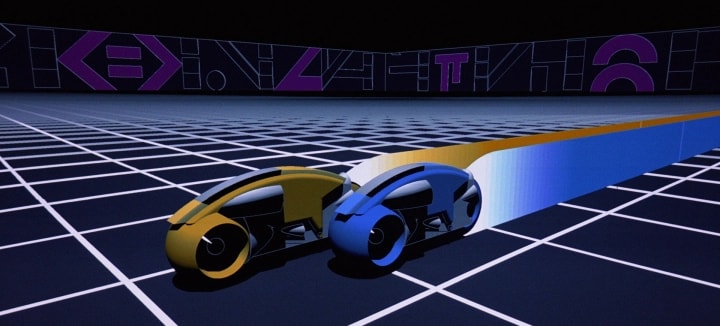
"What's unique about 'Tron' is that you're looking at ideas, not models," explained McClain. "In 'Star Wars,' the ships piloted by Luke and Darth Vader are little models photographed by a moving camera controlled by a computer. But in 'Tron,' there are no models. The motion is conceived and captured by an imaginary camera defined in the computer. The real camera is only used to take a shot-by-shot snapshot of the action choreographed by the imaginary computer camera." Indeed: one of the most impressive features of 'Tron' is that, because computers at the time were not capable of generating motion, animators had to create each frame one by one and then photograph the screen with a real camera. The process was time-consuming and expensive.
"In the beginning we needed to define three things: we needed objects to photograph, a camera to photograph them, and a light source to illuminate those objects," explained Larry Elin, one of the people responsible for the images generated by MAGI. Elin thus summed up, almost without realizing it, the basic principles of CGI.
For every second of animated film in 'Tron,' there were about 100 million bits of information in the computer. They would design each frame and show it to the special effects coordinator, Richard Taylor, over a primitive Internet ("using what is known as a modem, we can send the image from our computer in New York over the phone lines to Richard's office in California," explained Elin).
"When the frame is finished and satisfies everyone, we then photograph it from a high-resolution screen."
To create the computer-generated sequences, Disney turned to four companies that designed digital graphics: Information International, Inc, MAGI, Robert Abel and Associates, and Digital Effects. The problem with working with four different companies is that the film crew then had to do some homogenization work to piece together the images created, discarding some of them.
Every morning a new technological breakthrough
"None of what we needed existed," Bill Kroyer, digital imaging choreographer, explained to Variety. "We didn't come up with the film to exploit existing technology. We came up with the movie and then said, 'We think we can create the technology while we're making it.' For him, working on 'Tron' was "like Christmas morning every day" because they often came into the office to discover a new technological invention.
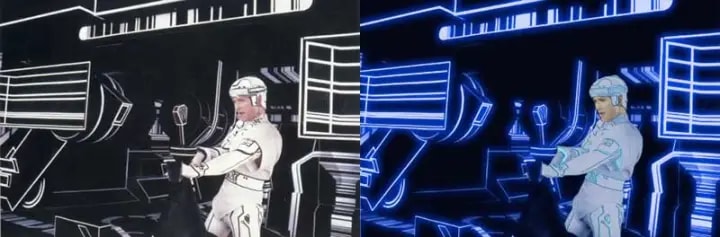
'Tron' used so many novel techniques that not all of them were used again in other productions. One of the resources was backlit animation, which consisted of shooting live-action scenes in high-contrast black and white on a set with a black background (not green or blue, as is done now). These images were subjected to a complex process that ended up creating the scenes in which the characters were in the digital world with the now mythical neon look that the film has. Other more traditional resources used were matte painting and rotoscoping.
The most iconic part of the movie, the motorcycle races, was indeed made with CGI, although the process had nothing to do with how it works now.
The computer with which MAGI created those scenes had only 2MB of memory (a useful comparison: the laptop on which this text was written has 16GB of memory), and they saved the work on a 330MB disk that took up the same amount of space as a washing machine. "Our system wasn't capable of storing enough information for us to create long-distance images," recalls Chris Wedge, who was then an animator at MAGI and would end up co-founding Blue Sky Studio and directing 'Ice Age.' "We had a fog feature that helped, and once we got to a certain distance, we'd blend the bike with the black so it would fade in and out. Richard Taylor used to say, 'When in doubt, mix it with black!'"
Throughout the production process, many of the crew didn't fully understand what was happening on screen. The actors certainly didn't know what the end result would be: they just knew they were shooting scenes in a pitch-black studio, dressed in incomprehensible costumes and fighting the air. The studio executives weren't at all clear either. "It was a hard movie to evaluate as it was being shot because you didn't have the set in front of you," recalls Ron Miller, Disney's president from 1980 to 1984, in an interview with Jim Hill Media. "You had all kinds of parts that would come together and end up creating the scene. But looking at what was shot every day, in my mind, was a little disconcerting. I didn't quite understand what was going on."
Pioneering and groundbreaking, a “box-office flop” and ignored by the Academy
'Tron' was the film that first imagined "cyberspace", and for this the producers hired several artists including Jean Giraud, aka Mobius, and Syd Mead, who also worked on films such as 'Alien' or 'Blade Runner'. But it was also visionary in another aspect: Lisberger, inspired by a video of digital images created by the company MAGI and the first time he played 'Pong', saw the importance that video games were beginning to have in popular culture. By that time, the console industry was already generating between 8 and 9 billion dollars a year, tripling the 3 billion generated by Hollywood. 'Pac-Man' grossed $1.2 billion in 1981, three times what 'Star Wars', then the highest-grossing movie in history, had grossed after five years in theaters.
When it was released, there were reviews for all tastes. Roger Ebert enthusiastically defended it as "dazzling, a technological spectacle of sound and light that is sensational, intelligent, stylish and fun. On the other hand Janet Maslin in the New York Times said that digital animation was exhilarating and novel, but ultimately tiring: "And how could it not be? It's loud, bright and empty, and that's all the movie offers." Variety also lamented that, despite the "visual delights," the story didn't measure up.
The film grossed $50 million worldwide, $33 million of that in North America. That made it Disney's highest-grossing live-action film for five years, but 'Tron' was considered a commercial disappointment. Not only had it cost a whopping 20 million, but the historic success of 'E.T.' caused the box office figures to be revalued upwards that year. From then on, a blockbuster had to gross more than before to be a blockbuster. "I think the movie should have made at least 50% more than it did," Miller analyzed. "I thought it was going to be a much bigger movie because of its freshness and its originality and all that. But maybe we didn't communicate what we had the right way, maybe we didn't sell it the right way. I think people were a little confused about digital animation."
The Academy didn't take kindly to it either. Although it was nominated for Oscars for best costumes and sound, 'Tron' was among the nominees for best special effects. "People were so afraid of CGI in 1982 that the Academy eliminated us from the category because they said we cheated," producer Justin Springer explained to "Den of Geek." Eventually, the Visual Effects Society eventually ranked it sixth on its list of the 50 greatest films, and the Academy has cited its important technological legacy.
Although it inspired the likes of John Lasseter and in some respects overtook George Lucas, visionary Steven Lisberger is far from having built a multi-million dollar empire like them. 'Tron' does deserve the well-known phrase that it was ahead of its time. "The lesson you learn," Lisberger has said, "is that if you go against the status quo you pay a price. It's hard to emphasize how much the computers terrified people, and particularly Hollywood. The threat that 'Tron' represented was that somehow computers were going to get involved in the way we make movies and they were going to get involved in our lives."
Today we can't live without computers, and Hollywood wouldn't know how to make movies without them. Tron' opened the door to a new world of visual effects.
About the Creator
Emby Lat
I like movies, technology, games, art and anything that I find interesting.
Reader insights
Outstanding
Excellent work. Looking forward to reading more!
Top insights
Expert insights and opinions
Arguments were carefully researched and presented
Compelling and original writing
Creative use of language & vocab
Easy to read and follow
Well-structured & engaging content
Excellent storytelling
Original narrative & well developed characters
Eye opening
Niche topic & fresh perspectives
Masterful proofreading
Zero grammar & spelling mistakes
Silver Screen Magic with Mae West
American actress and singer Mae West became a popular film actress during the Great Depression. She started entertaining in vaudeville, then performed on Broadway, and finally went to Hollywood. She signed up with Paramount Pictures and made her debut in the 1932 film “Night After Night.” She also starred in musicals, comedies, and crime dramas. The American Film Institute named her one of the best classic Hollywood actresses.
By Rasma Raisters5 days ago in Geeks
Kartik Aaryan suffers first major setback after minor dating controversy
Kartik Aaryan recently suffered first major setback after getting caught in a controversy of dating a minor. It all started when the 35-year-old actor’s newly released film, Tu Meri Main Tera Main Tera Tu Meri, became a box office bomb.
By Dena Falken Esqa day ago in Geeks



Comments (4)
TRON is my #1 computer movie. I watch it every year once or twice.
Loved this movie so much when young. Thank you for these insights into its meaning in the realm of film uberhaupt.
Excellently written! Really enjoyed this.
Great insight. I like the first torn movie and I love the second one.