
The Strangest Scientific Discoveries That Changed What We Knew About Reality
From invisible universes to immortal creatures - science has shocked as more than fiction ever could

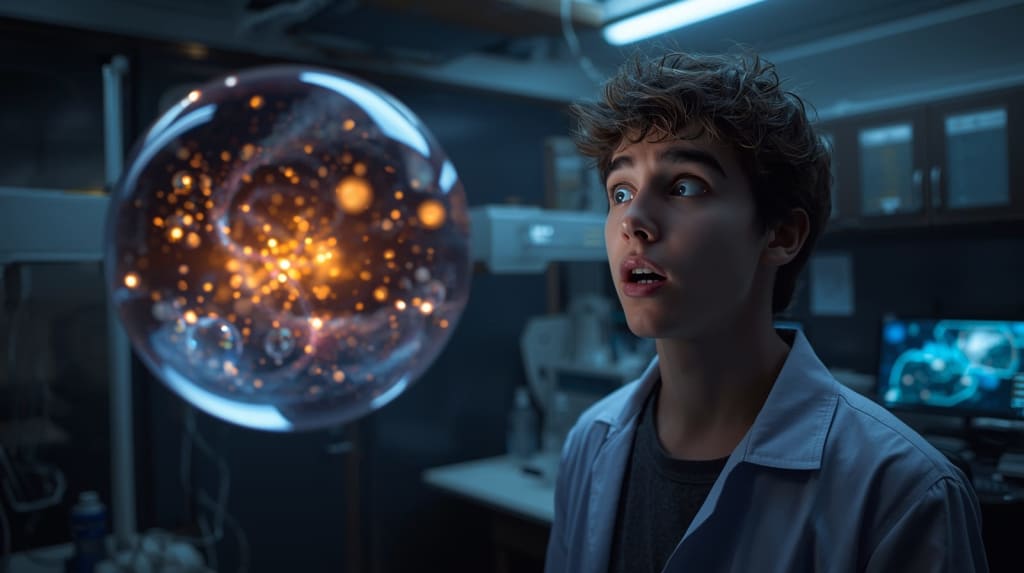
Introduction — When Science Breaks the Rules of Common Sense
There are moments in history when science doesn’t just discover something new — it shatters everything we thought we knew.
From invisible particles shaping the universe to animals that shouldn’t even exist, these discoveries force us to ask.
“Do we really understand reality, or are we just scratching its surface?”
Let’s explore seven of the strangest discoveries that changed not only science — but the very way we see our world.
1. The Quantum Leap: When Reality Acts Like a Game of Dice
Imagine flipping a coin — heads or tails. Easy, right?
Now imagine that, on the tiniest scale of atoms, that coin is both heads and tails at the same time.
That’s what scientists discovered in quantum mechanics.
In 1927, Werner Heisenberg introduced the Uncertainty Principle, showing that particles don’t have definite positions — only probabilities.
It was as if the universe suddenly became a casino, and God was the dealer.
🌀 Why It’s Strange:
Reality isn’t fixed — it’s fluid, uncertain, and probabilistic.
This discovery changed physics forever, forcing scientists to accept that certainty is an illusion.
🧠 The Strangest Scientific Discoveries That Changed What We Knew About Reality
2. The Immortal Jellyfish — A Creature That Defies Death
Meet Turritopsis dohrnii, the jellyfish that refuses to die.
When it gets old or injured, it transforms its cells back into a younger version of itself — literally reversing its aging.
It’s the closest thing nature has to immortality.
Scientists call it biological reincarnation.
💡 Why It’s Strange:
If nature can reverse aging in jellyfish, what stops humans from unlocking the same secret one day?
This tiny sea creature became a living symbol of hope, fear, and scientific obsession with eternal life.
3. The Mandela Effect — When Collective Memory Betrays Us
Do you remember “Febreze” being spelled with two e’s — Febreeze?
Or Darth Vader saying “Luke, I am your father”?
You’re not alone — but you’re wrong.
This psychological phenomenon, known as the Mandela Effect, shows how large groups of people share the same false memories.
Named after people wrongly remembering Nelson Mandela dying in prison, it challenges our belief in objective memory.
🧩 Why It’s Strange:
It’s as if there are multiple timelines — or our brains are syncing with an alternate version of reality.
Whether psychological or quantum, it’s a chilling reminder: reality isn’t always what we remember.
4. The Hidden Universe — 95% of Everything Is Invisible
In the early 20th century, astronomers thought they understood the cosmos.
Then they realized — all the stars, planets, and galaxies we see make up only 5% of the universe.
The rest? Dark matter and dark energy — mysterious forces that don’t emit light and can’t be detected directly.
They shape galaxies, bend space, and accelerate time itself.
🌌 Why It’s Strange:
Everything we know — everything we are — exists in just 5% of the universe.
It’s like discovering that reality itself has a hidden side we can’t touch.
5. The Human Microbiome — You Are Not Fully Human
You think you’re one person.
Science disagrees.our body contains more bacterial cells than human ones.
Your gut bacteria influence your mood, decisions, even your mental health.
💭 Why It’s Strange:
You’re basically a walking ecosystem — a colony of trillions of organisms, all living in harmony (or chaos).
It changes the question from “Who am I?” to “Who are we?”
6. Time Dilation — When Time Literally Slows Down
If you could travel close to the speed of light, time for you would slow down — while for everyone else, it would move normally.
That’s Einstein’s Theory of Relativity in action.
Astronauts aboard the ISS already experience this — by mere milliseconds.
But in theory, someone traveling near light speed could return to Earth and find centuries have passed.
⏳ Why It’s Strange:
Time isn’t universal. It bends, stretches, and warps.
Reality isn’t a clock — it’s a living dimension.
7. The Double-Slit Experiment — Consciousness Shapes Reality
In 1801, scientists fired light through two tiny slits and watched it form waves — like ripples on water.
But when they observed the experiment, the waves disappeared — and light behaved like particles instead.
Observation changed reality.
🧠 Why It’s Strange:
It implies that consciousness itself affects the physical world — that our observation shapes existence.
It’s the most mind-bending discovery in all of science, blurring the line between the observer and the observed.
Conclusion — The Mystery That Makes Us Human
Science isn’t about having all the answers — it’s about daring to ask better questions.
Each of these discoveries broke reality open a little wider and whispered the same haunting truth:
“We don’t live in the universe — we live with it.”
Because maybe, just maybe, the strangest discovery of all…
is that we’re part of the mystery itself.
About the Creator
Rai Sohaib
Writing about life’s hidden patterns and the power of the human mind
Writing poetry and poems
Keep reading
More stories from Rai Sohaib and writers in FYI and other communities.
The Hidden Frequencies That Shape How You Feel
It began on an ordinary morning — the kind that feels too quiet to trust. I was sitting by my window, coffee cooling beside me, when a faint hum slipped through the silence. It wasn’t coming from the street or the walls. It was coming from somewhere else.
By Rai Sohaib 3 months ago in FYI
Silver Screen Magic with Mae West
American actress and singer Mae West became a popular film actress during the Great Depression. She started entertaining in vaudeville, then performed on Broadway, and finally went to Hollywood. She signed up with Paramount Pictures and made her debut in the 1932 film “Night After Night.” She also starred in musicals, comedies, and crime dramas. The American Film Institute named her one of the best classic Hollywood actresses.
By Rasma Raisters5 days ago in Geeks


Comments
There are no comments for this story
Be the first to respond and start the conversation.