
The History of the Calendar
From Moon Cycles to Atomic Precision — How Humanity Measured Its Days and Shaped Civilizations

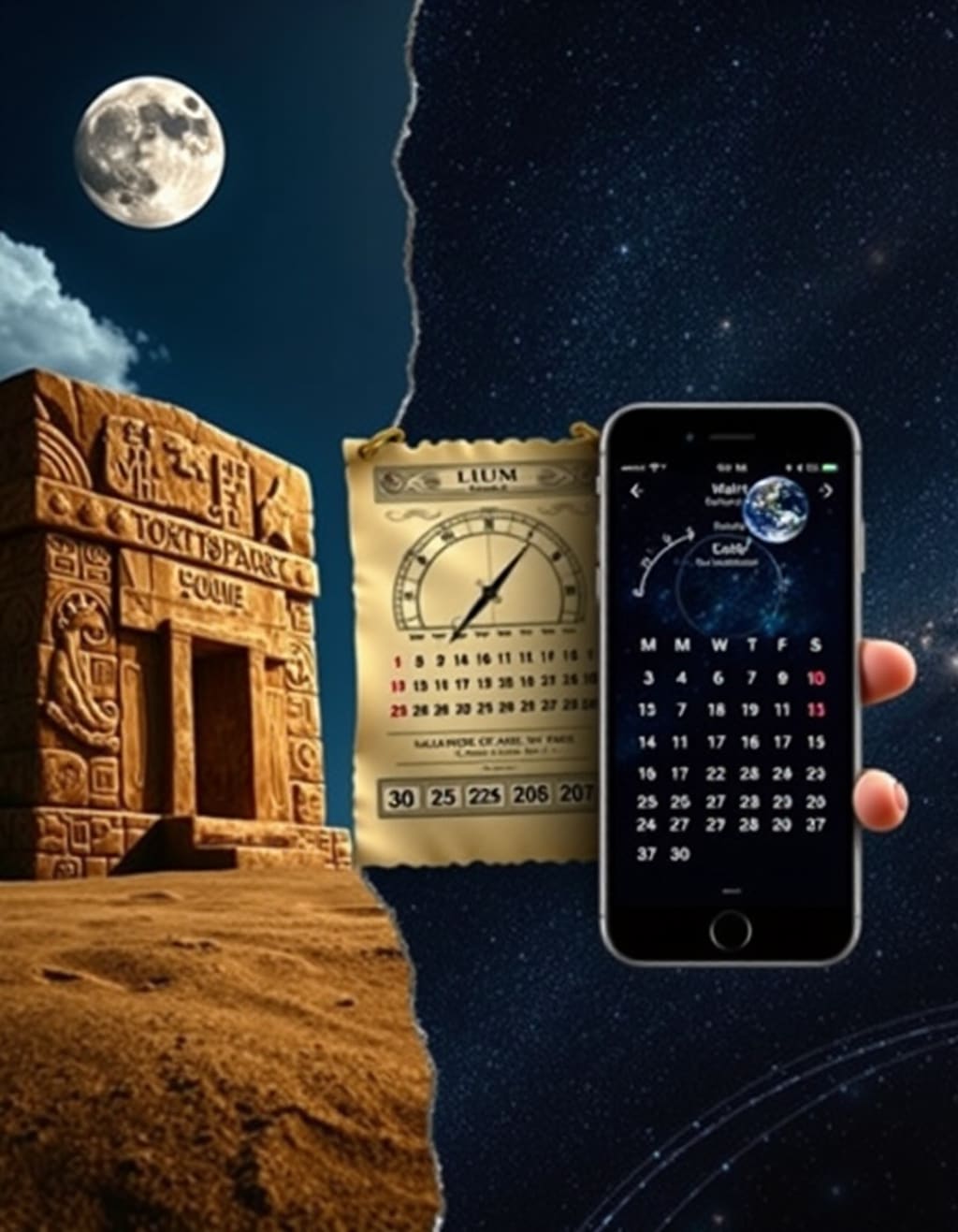
### **Introduction: More Than Just Dates on a Page**
A calendar is more than a chart of days, months, and years. It is a map of human understanding. Behind the simple boxes we check off each day lies a deep and complex history that spans millennia, cultures, and belief systems. The calendar, in all its forms, reflects our struggle to control time, understand the cosmos, and create order in the chaos of existence.
Let us take a journey across time, civilizations, and innovations to discover how we began to measure the immeasurable: time itself.
---
### **1. Time Before Calendars: Nature as the First Clock**
Long before writing or cities, early humans looked to the sky for guidance. The phases of the moon, the rise and fall of the sun, and the changing of the stars told them when to plant, hunt, and harvest. These natural cycles became the first timekeepers.
The lunar cycle, lasting about 29.5 days, was perhaps the earliest guide for early calendars. The changing shape of the moon gave humans a visible and reliable signal of passing time. But the lunar cycle didn’t line up neatly with the solar year, causing early confusion and adjustments.
---
### **2. Ancient Calendars: Egypt, Babylon, and Maya**
#### **The Egyptian Calendar**
Around 3000 BCE, the Egyptians developed a calendar based on the sun. It had 12 months of 30 days, totaling 360 days, plus five extra days added to honor their gods. This made it one of the first solar calendars, and it helped regulate agriculture around the Nile’s flooding season.
#### **The Babylonian Calendar**
The Babylonians, meanwhile, used a **lunisolar** calendar. They combined lunar months with solar years. When their lunar months fell too short, they inserted an extra month to realign the calendar with the seasons. Their calendar deeply influenced Jewish and Islamic systems.
#### **The Mayan Calendar**
Across the ocean, the ancient Maya of Central America created a complex and accurate calendar system based on cycles of time. Their **Tzolk'in** (260-day calendar) and **Haab'** (365-day calendar) were used for rituals and agriculture. They even developed the **Long Count** calendar, which could track time over thousands of years.
---
### **3. The Roman Calendar: Julius and Gregorian**
#### **The Roman Mess**
Early Roman calendars were based on the lunar cycle and were wildly inaccurate, requiring frequent correction. Months had inconsistent lengths, and political leaders manipulated dates for power.
#### **Julius Caesar's Reform**
In 46 BCE, Julius Caesar introduced the **Julian calendar**, with 12 months and a 365-day year. He added a leap day every four years. It brought order, stability, and became the standard across Europe for centuries.
#### **The Gregorian Fix**
However, the Julian calendar miscalculated the solar year by 11 minutes. Over centuries, this error added up, causing seasonal drift.
In 1582, **Pope Gregory XIII** introduced the **Gregorian calendar**. He dropped 10 days to realign the equinox and changed leap year rules. Catholic countries adopted it quickly; others took centuries. Today, it is the most widely used calendar in the world.
---
### **4. Religious and Cultural Calendars**
Not all civilizations followed the Gregorian path. Even today, various religious and cultural communities maintain their traditional calendars:
* **Islamic Calendar:** A purely lunar calendar with 12 months and about 354 days. It does not align with the solar year, so Islamic months shift across seasons.
* **Hebrew Calendar:** A lunisolar system with leap months to keep in step with solar years and religious holidays.
* **Chinese Calendar:** Another lunisolar calendar used for festivals, astrology, and traditional customs. It also determines the Chinese New Year.
These calendars reflect the rhythms of life specific to cultural and spiritual needs.
---
### **5. Calendars in the Modern Era: From Paper to Digital**
By the 20th century, printed calendars were everywhere—on walls, desks, and in diaries. They weren’t just functional but also decorative, filled with art, quotes, and religious dates.
Then came the digital revolution. Calendar apps now sync across devices, send reminders, and integrate with emails. You can schedule events across time zones or receive alerts about lunar eclipses, all with a few taps.
We’ve moved from carving time into stone to manipulating it in the cloud.
---
### **6. Atomic Time and Global Synchronization**
The accuracy of modern calendars depends on precise measurement of time. Enter the **atomic clock**.
Atomic clocks measure time by tracking the vibrations of atoms, often cesium or rubidium. These clocks are accurate to the billionth of a second and form the basis of **Coordinated Universal Time (UTC)**, the time standard used globally.
Thanks to atomic time, GPS, internet communication, and international travel can function in perfect sync.
---
### **7. Philosophical Reflections: Is Time Real?**
While the calendar tracks time, philosophers and scientists still ask: what is time?
Einstein showed us that time is relative. It bends under gravity and speed. Quantum physics suggests time may not be linear at all.
And yet, for human beings, the calendar gives structure to our chaos. Birthdays, holidays, appointments—all the small anchors that give life meaning.
---
### **Conclusion: Measuring More Than Moments**
The history of the calendar is the history of humanity itself. Every revision, every leap day, every ancient calculation is a reflection of our need to understand the universe and our place within it.
From lunar rhythms to atomic precision, we’ve learned to not just mark time, but to live by it.
The next time you glance at a date, remember: you are witnessing the result of thousands of years of thought, observation, belief, and innovation.
About the Creator
rayyan
🌟 Love stories that stir the soul? ✨
Subscribe now for exclusive tales, early access, and hidden gems delivered straight to your inbox! 💌
Join the journey—one click, endless imagination. 🚀📚 #SubscribeNow
Asia Pacific Prebiotics Market Size and Forecast 2025
Asia Pacific Prebiotics Market: A Region Poised for Gut-Health Revolution The Asia Pacific prebiotics market is entering a transformative decade. With rising health awareness, aging populations, expanding functional food industries, and rapid advancements in biotechnology, prebiotics have become a central ingredient in modern nutrition strategies across the region. According to Renub Research, the Asia Pacific Prebiotics Market is expected to reach US$ 5.83 billion by 2033, growing from US$ 2.14 billion in 2024, at a robust CAGR of 11.77% from 2025 to 2033.
By Aaina Oberoia day ago in FYI


Comments
There are no comments for this story
Be the first to respond and start the conversation.