
The Forgotten Letter That Saved Swat — And Changed Pakistan Forever
Hidden in a dusty corner of a decaying school in Mingora, a letter re-emerged decades later — revealing the Wali of Swat’s secret role in Pakistan’s survival during its most fragile days.

1. The Dust of Time
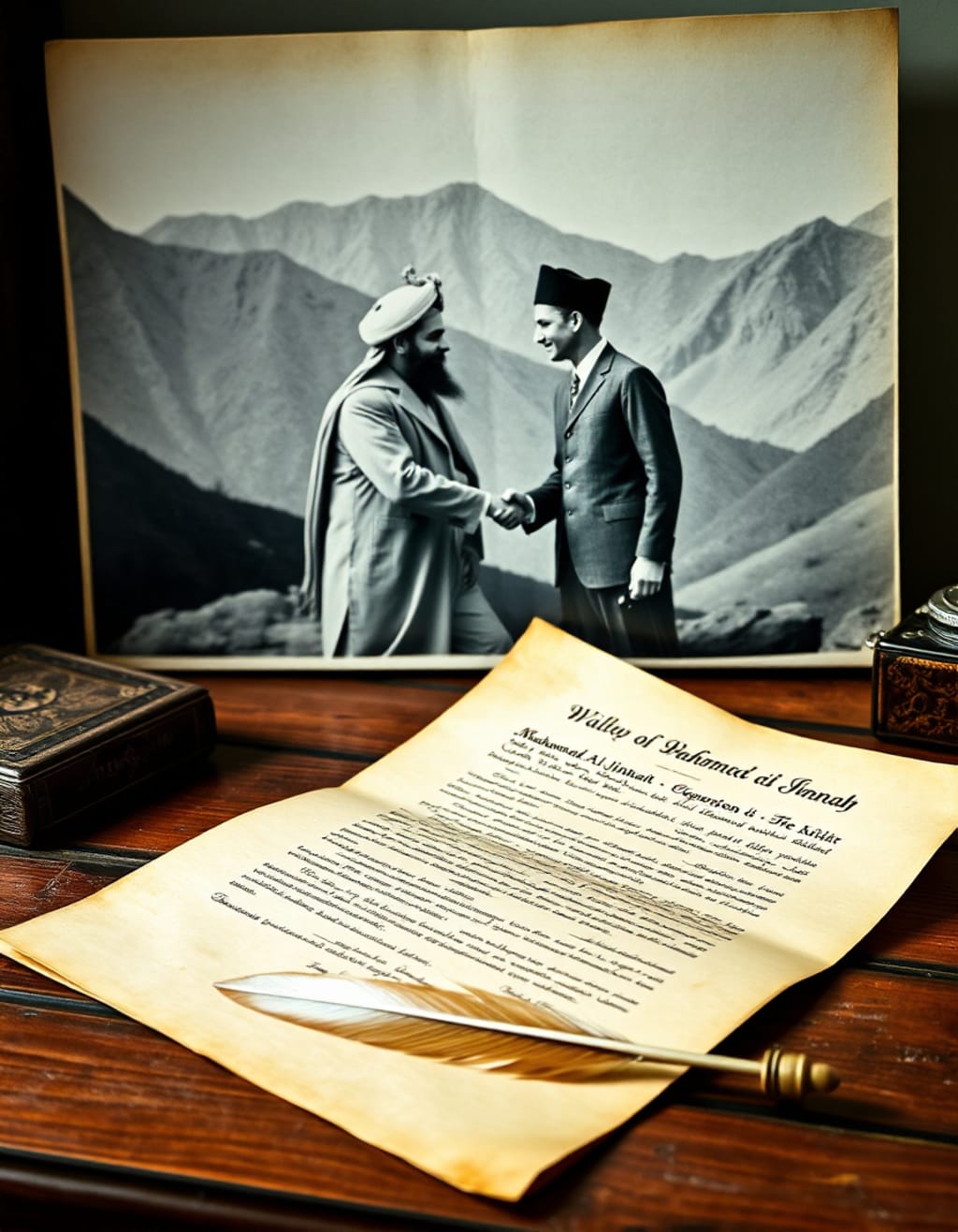
In the corner of a forgotten schoolroom in Mingora, Swat, a thin stack of papers wrapped in wax cloth was found by accident. It was 2022, and workers were renovating the crumbling 1940s-era school building to turn it into a museum. One of the laborers stumbled across the bundle buried behind a false wall — brittle, yellowed, yet unmistakably official.
What lay inside was not just a letter — it was a time capsule. And its author was none other than Miangul Abdul Wadud, the Wali of Swat.
The letter, dated 2nd November 1947, just one day before Swat officially joined Pakistan, revealed not only the Wali’s personal motivations but a detailed warning about the collapse of communication, food, and medical aid across the Frontier if Swat didn’t act fast. It was written directly to Muhammad Ali Jinnah, Pakistan’s new and overwhelmed Governor-General.
But this wasn’t in any official record. Why?
That question would change everything.
2. Swat Before the Storm
Swat in 1947 was no ordinary princely state.
It was a rare example of a Muslim-ruled autonomous region that had built roads, schools, hospitals, and even hydroelectric projects decades before much of British India. Under the Wali’s rule, women received education, tribal conflicts were mediated through a modern court system, and Swat had its own army, postal service, and taxation.
But when the British left, they took stability with them.
Across the Frontier, war broke out — in Kashmir, in tribal regions, and even within cities newly divided between India and Pakistan. Refugees were flooding into Pakistan at an unstoppable rate. Chaos ruled.
And the Wali knew something no one else did.
He had intercepted British intelligence left behind in Peshawar, predicting that if Swat did not accede and support Pakistan logistically, the entire North-West Frontier could fall into rebellion.
3. The Letter That Warned a Nation
The letter, long thought lost, contained an urgent plea and a promise:
“My people are not only willing — they are prepared. I will open the supply routes through Malakand. I will offer Swat’s hospitals to the refugees. I will fund the rebuilding of Peshawar’s rail lines if your government cannot. But you must promise that Swat will be seen not just as a territory — but as a partner in Pakistan’s survival.”
What the Wali offered was far more than symbolic. He placed his entire treasury at Jinnah’s disposal, including his army, transport convoys, and medical corps.
This was the real reason Swat acceded on 3rd November 1947, far earlier than other Frontier states. But for decades, only the formal accession document was remembered — not the emotional appeal behind it.
4. Why Was the Letter Hidden?
The rediscovered letter had been sealed inside a headmaster’s drawer in an old school the Wali had built in 1946. Scribbled on the envelope was a sentence in the Wali’s own handwriting:
“To be found only when Pakistan forgets.”
The Wali feared the growing centralization of power in Karachi and later Islamabad. He believed Swat’s contribution would be buried under politics. And so, he wrote this letter not just for Jinnah — but for the future generation of Pakistanis.
A historian from Peshawar University, Professor Amina Saeed, said during the archival review:
“This isn’t just a letter — this is a last will. A desperate cry of loyalty. A man who wanted to preserve his people’s sacrifices in ink.”
5. Swat’s Critical Role After 1947
After accession, Swat didn't just sit quietly. It acted like a nation within a nation, fulfilling its promise.
Medical Aid: The Saidu Hospital treated over 10,000 Partition refugees in the first two years alone.
Infrastructure Support: Swat’s engineers repaired bridges and roads in Peshawar, Nowshera, and Kohat, where the new Pakistani government lacked funding.
Educational Exchange: The Wali sent scholars and teachers to Karachi and Lahore to help build Pakistan’s early universities.
Stability: While tribal regions around it slipped into conflict, Swat remained an island of calm, largely due to the Wali’s personal authority and relationship with both tribal elders and clerics.
6. A Promise Betrayed?
Yet despite its sacrifices, by the late 1950s, the central government began pushing for “One Unit” — an administrative scheme to centralize power. Swat was pressured to give up its autonomy.
By 1969, under Ayub Khan’s regime, Swat was merged into the province of West Pakistan. The Wali was removed. His institutions were either absorbed or dismantled. Roads went unpaved. Hospitals fell into disrepair.
The people of Swat, once proud contributors to Pakistan’s birth, felt forgotten.
The letter, it seemed, had come true.
7. Rediscovery and National Awakening
When the letter was published in a national daily in 2022, it caused a sensation.
Journalists, historians, and citizens all asked the same question:
Why didn’t we know this story before?
The letter became a symbol — not just of Swat’s role — but of the countless unremembered sacrifices made by Pakistan’s smaller regions. It reopened debates about decentralization, historical memory, and justice.
Young people in Swat began restoring the Wali’s projects as community initiatives. A museum was opened in Saidu Sharif. Even Pakistan’s parliament formally acknowledged Swat’s role in a resolution passed in 2023.
8. A Legacy Restored
Today, Miangul Abdul Wadud is remembered not just as a ruler — but as a visionary patriot.
His forgotten letter is now displayed behind glass in the Swat State Museum, beside his medals, photographs, and the original Instrument of Accession.
And above it, carved into polished wood, are the final lines from his rediscovered letter to Jinnah:
“I give you my land not for glory, but for survival. May we never forget what we build together. And may Pakistan remember the mountains that stood with her in her hour of need.”
About the Creator
rayyan
🌟 Love stories that stir the soul? ✨
Subscribe now for exclusive tales, early access, and hidden gems delivered straight to your inbox! 💌
Join the journey—one click, endless imagination. 🚀📚 #SubscribeNow
Building a New Era: Inside the Indonesia Commercial Construction Boom
Market Overview: The Construction Engine of Southeast Asia Indonesia is currently undergoing one of the most significant infrastructure transformations in its history. As the largest economy in Southeast Asia, the archipelago is moving beyond basic infrastructure development and stepping into a new era of sophisticated commercial construction.
By Sam walter6 days ago in FYI
Miss Persephone's Manual to a Seemingly Ordinary Life
Miss Persephone was found at the dining table, her blue eyes swollen, her tears arriving and retreating like the tides of the ocean. Earlier that day, her family had visited her in the retirement home where she had lived for eight years. It was her eightieth birthday.
By Imola Tóth3 days ago in Fiction



Comments
There are no comments for this story
Be the first to respond and start the conversation.