
The Arrow of Time: Can We Reverse It?
Exploring the Possibility of Turning Back Time


We often wish we could turn back time to correct a mistake or relive past memories. Yet, this is something that remains impossible today. But why is it that we can’t rewind time like we would turn back the hands of a clock, or is there a way we haven’t discovered yet?
A study published in Physical Review Letters delves into the concept of the "Arrow of Time" — a term used to describe the continuous forward march of time — and presents an alternative view on how time manifests at the universal scale. Traditionally, time is defined by a "past hypothesis," which assumes that any system starts in a state of low entropy and, governed by thermodynamics, its entropy increases over time. In simple terms, the past is a state of low entropy, and the future is a state of high entropy — a concept known as thermodynamic time asymmetry.
Even though time doesn't flow backward, we still assign it a direction — an arrow. This is an abstract concept that simply means we can define an order of events. The arrow of time points from the past to the future, from earlier events to later ones. The key distinction here is between a flow of time and a direction of time.
Imagine watching individual frames in a film reel. You can easily define a direction of time based on which frames come first and which come later, even though you’re looking at still images with no motion. Each frame is a snapshot frozen in time. If this concept were applied to the universe, the Big Bang would be seen as the creation of the universe in a state of low entropy, or minimal thermodynamic state. As time passed and the universe expanded and cooled, the thermodynamics of this large system increased. According to this hypothesis, time is fundamentally linked to the level of thermodynamics, or the disorder, in our universe.
Right after the Big Bang, observations indicate that the environment was extremely hot and chaotic with fundamental particles. As the universe matured and cooled, gravity began to play a larger role, creating more order and complexity — from cooling gas clouds to the formation of stars and planets from gravitational collapse. Eventually, elements combined to form organic matter, which evolved into life, giving birth to concepts of space and time. Thus, on the scale of the entire universe, "chaos" has decreased significantly, not increased as the "past hypothesis" suggested.
Flavio Mercati, a scientist at the Perimeter Institute for Theoretical Physics in Ontario (Canada), who contributed to the study, argued that the issue lies in how thermodynamics is measured. Since thermodynamics is a physical quantity with various representations (similar to energy and temperature), it requires an external reference system to be measured. "This can be done for subsystems of the universe, with the rest of the universe set as a reference. But the entire universe — by definition — has nothing outside it to compare against," Mercati explained in an email response to Discovery News.
Furthermore, physical equations do not even provide a direction of time. Time can flow backward, and the laws of physics remain the same. You could say that this is merely a coincidence for physicists. If the direction of time is absent in physical equations, they cannot fully tell the story. Just because we can’t perceive a direction of time in mathematical equations doesn’t mean there isn’t one in the real world.
Mercati illustrated his point with a slightly more complex example, saying that even in the real world, at the atomic level, most processes are time-symmetric. If, during a subatomic process, two particles, A and B, collide and then separate, it would be difficult to tell whether the process occurred in forward or reverse order, as the physical laws suggest both are possible. Similarly, he explained that two new particles, C and D, could be created and fly apart, and it would be impossible to determine the true order of events if you watched a film of the process played backward.
This contrasts sharply with everyday events where we don't need to worry about which direction time is flowing. For example, you never see smoke rising from a chimney to condense back into the chimney, and you can't "un-stir" a cup of coffee once the sugar has dissolved, nor can you see a pile of ash in a fire "stop burning" and turn back into a piece of wood.
What makes these events different from subatomic ones? How is it that most phenomena we see around us never happen in reverse? Surely everything is ultimately made of atoms, and at that level, everything is time-symmetric. So, at what stage does a process shift from time-symmetric to time-asymmetric?
The answer lies in a fundamental law of physics called the second law of thermodynamics. Thermodynamics studies heat and its relationship to other forms of energy. Astronomer Arthur Eddington once stated that the second law holds a supreme position in the laws of nature. While there are three other laws of thermodynamics that deal with the conversion of heat and energy, none is as important as the second law.
The second law states that everything wears down, cools off, separates, ages, and decays. It explains why sugar dissolves in coffee but never the other way around. It also states that a piece of ice in a glass of water will melt because heat always flows from the warmer water to the colder ice, never the other way around.
Complexity is a quantity that doesn’t have a direct direction, but at its core, it describes how a system becomes more complex. Thus, if we look at our universe, complexity is directly tied to time — as time passes, the universe becomes more structured, more orderly. Mercati said, "The question we are trying to answer in our research is: what set these systems in such a low thermodynamic state at the beginning? Our answer is: gravity and its tendency to create order and structure from chaos."
Typically, time is described by the "past hypothesis," which assumes that all systems begin at a very low entropy state, after which thermodynamic processes cause entropy to increase. In other words, the past is low entropy, and the future is high entropy — this is the asymmetry of time.
To test this idea, Mercati and his team created simple computer models to simulate particles in a model universe. They found that no matter how the simulation was run, over time, the complexity of the universe always increased and never decreased.
Since the Big Bang, the universe began in the lowest possible complexity state (like a "soup" of chaotic particles and energy). Over time, as the universe cooled, gravity took over, pulling gas together, forming stars and galaxies. The universe grew more complex, and gravity was the driving force behind this increasing complexity.
As the universe matured, subsystems became independent enough for other forces to create conditions for the arrow of time to emerge in these low thermodynamic systems. In these subsystems — like daily life on Earth — thermodynamics could take over, creating a "thermodynamic arrow of time."
On the scale of the entire universe, our perception of time is governed by the continuous growth of complexity. But within these subsystems, thermodynamics dominates. "The universe is a structure of increasing complexity," Mercati said, "The universe is made of massive galaxies separated by vast distances. In the very distant past, they were much closer together. Our hypothesis is that our perception of time is the result of an irreversible law of increasing complexity."
The next step in their research is to search for observational evidence, something Mercati and his team are currently working on. "...we don’t know if there’s any support for this yet, but we know what kind of experiment could test our idea. That would be cosmic observations." He didn’t reveal what type of cosmic observations they would study but said they would share the details in a forthcoming exciting paper.
In addition, physicist Jim Al-Khalili, from the University of Surrey — author of the famous book Black Holes, Wormholes and Time Machines — stated that the so-called "flow of time" is just an illusion. The laws of physics don’t say anything about the flow of time. They tell us how objects like atoms, pulleys, levers, clocks, rockets, and stars behave under the influence of different forces at specific times. If you know the state of a system at a certain point in time, the laws of physics give you rules to calculate its possible states at any future time. However, there is no mention of time "flowing." The concept of time flowing — or moving in a certain way — is completely absent in physics. We find that, just like space, time simply exists; that’s it. Moreover, genius Albert Einstein also held the view that time is an illusion, even expressing this when trying to comfort the widow of a close friend by saying she should ease her perception that the present moment is any more special than any other moment in the past or future; all moments exist together.
Thus, we can see how perplexing time is when viewed as a separate concept. Even Jim Al-Khalili humorously suggested that if you attempt to understand how time works, you should be ready to familiarize yourself with Einstein's special theory of relativity, where he bound time to space as a four-dimensional spacetime. Professor Al-Khalili concludes that reversing time is like tricking the human senses on a quantum physical level. Nonetheless, on the scale of quantum physics, there is still a possibility.
Indeed, in February 2015, Professor Kater Murch from the University of Washington and his team conducted a quantum experiment. They placed a circuit board in a microwave, then fired photons at it — where the quantum field of the photons interacted with the circuit. After the first photons passed through, the computer's results were "hidden," and experts predicted the next outcome. According to Murch, this was like predicting future events, with a 50% probability of being correct.
Murch’s team claimed that if the future states of each particle were known, the probability of predicting the photon’s trajectory would rise to 90%. He explained that atomic particles are not determined until we measure them. This means that in the past, the particles were undefined, but when we study them in the future, they possess full attributes like shape, weight, and speed. In simple terms, actions in the future have the power to influence past events.
If this theory holds, scientists argue that time and space are symmetrical. In other words, we only perceive time as passing quickly, but in reality, time is a two-way "arrow" that can be completely reversed.
About the Creator
Eleanor Grace
"Dream big.Start small.Act now."
Keep reading
More stories from Eleanor Grace and writers in FYI and other communities.
Robotic Fish: The Future of Smart Aquaculture
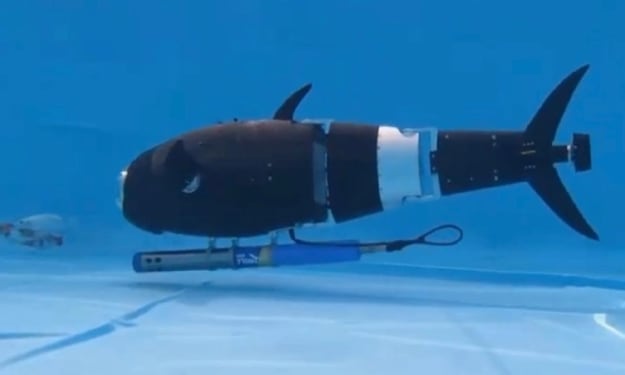
At the National Innovation Center for Digital Fisheries in Beijing, two sleek, metallic-coated robotic fish swim effortlessly in a breeding tank, revealing cutting-edge research that could revolutionize the aquaculture industry. "These are the robotic tuna and dolphin we have developed," said an associate professor at China Agricultural University (CAU). "They exhibit different swimming characteristics, but their core purpose remains the same: to assist fish farms."
By Eleanor Grace10 months ago in FYI


Comments
There are no comments for this story
Be the first to respond and start the conversation.