
Robotic Fish: The Future of Smart Aquaculture
How AI-powered bioengineered fish are revolutionizing fish farming and marine exploration.

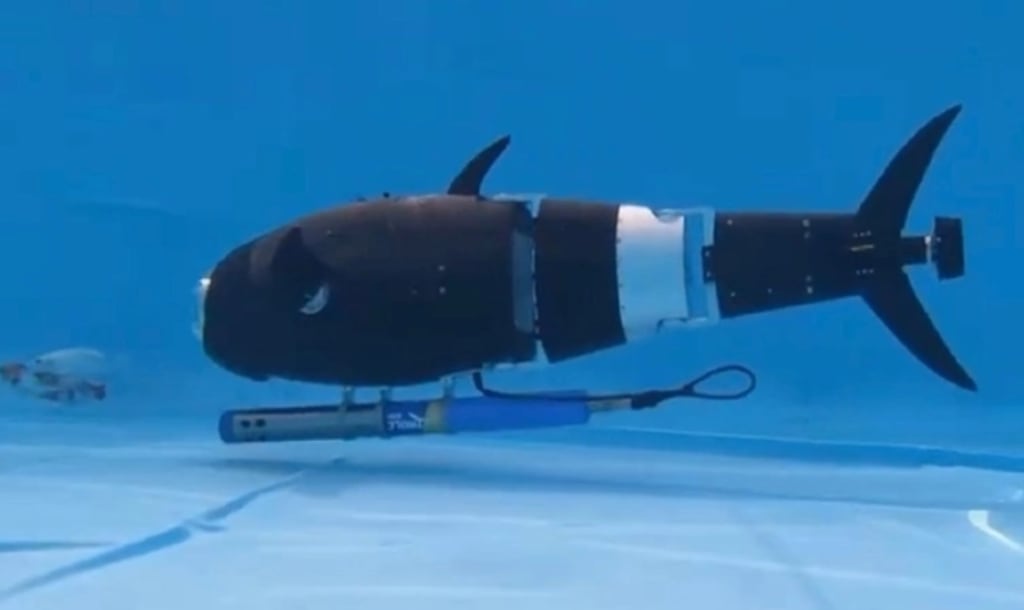
At the National Innovation Center for Digital Fisheries in Beijing, two sleek, metallic-coated robotic fish swim effortlessly in a breeding tank, revealing cutting-edge research that could revolutionize the aquaculture industry. "These are the robotic tuna and dolphin we have developed," said an associate professor at China Agricultural University (CAU). "They exhibit different swimming characteristics, but their core purpose remains the same: to assist fish farms."
Liu is part of a team specializing in bioengineered underwater robots aimed at simplifying labor-intensive tasks in fish farming. "We want to make the work of fish farmers less strenuous," said Wei Yaoguang, another team member with over 20 years of experience. Wei has witnessed firsthand the challenges fishermen face when inspecting vast aquaculture farms. In some cases, divers take three to four days to inspect a net cage with a 400-meter diameter, a process that is both time-consuming and costly.
To tackle this issue, the research team developed underwater robots equipped with sensors to monitor fish and net conditions. Their first robot was capable of patrolling a 400-meter net cage in just four hours, a significant improvement over manual inspections. However, the team soon encountered a new challenge: fish stress responses. Liu explained that fish are highly sensitive to stress, and if a robot gets too close, they might leap out of the water. To minimize disruptions, the researchers designed a sleeker, more streamlined bioengineered robotic fish that could blend into the environment without disturbing marine life. "When our robotic fish swims, live fish tend to follow it, creating a natural movement pattern where larger fish lead smaller ones," Liu said.
Another challenge arose with the robotic tuna’s tail, which swayed from side to side unpredictably, making its head movement erratic and complicating underwater inspections. To address this issue, the team developed a visual stabilization system, enhancing the robot’s ability to observe underwater conditions clearly.
According to the researchers, these bioengineered robotic fish integrate advanced technologies, including a propulsion system that mimics real fish, a flexible dual-axis motor to reduce turbulence, and high-precision sensors to monitor water quality and fish behavior in real time. Additionally, by leveraging artificial intelligence, the team developed an autonomous motion control algorithm and an ultra-light AI chip, enabling the robotic fish to swim, analyze, and adapt to various underwater environments seamlessly.
The scientists behind this innovation believe robotic fish could unlock new possibilities in fishery management, such as guiding fish toward designated areas for more efficient harvesting and improving feeding strategies. Liu noted that traditional feeding methods often lead to waste or uneven distribution. However, robotic fish equipped with bait dispensers and sensors can optimize feeding by analyzing biometric signals such as fish size, population density, and activity levels. This reduces feed waste, lowers aquaculture costs, and enhances the growth environment for fish.
Beyond aquaculture, robotic fish have potential applications in deep-sea exploration and marine resource monitoring. Wei pointed out that conventional underwater equipment tends to be bulky, power-intensive, and disruptive to marine ecosystems. Bioengineered robotic fish, on the other hand, could collect deep-sea data, monitor marine ecology, and assist in seabed mapping with minimal ecological disturbance.
To date, the research team has accumulated over 200 terabytes of video data on more than a dozen fish species, along with 10 million images. This extensive dataset is essential for training AI models, contributing to smarter and more efficient fish farming. Currently deployed across 23 regions, the technology helps manage over 6.3 million square meters of land-based aquaculture farms and 5.5 billion square meters of offshore fish farms, cutting labor costs by 50%.
As robotic fish continue to evolve, they hold the promise of transforming the aquaculture industry, making fish farming more sustainable, cost-effective, and technologically advanced than ever before.
About the Creator
Eleanor Grace
"Dream big.Start small.Act now."
Keep reading
More stories from Eleanor Grace and writers in FYI and other communities.
The Hidden Dangers of AI
For years, scientists have warned about the potential dangers of artificial intelligence (AI)—not just in the dystopian sense of machines rising against humanity, but in far subtler and more insidious ways. Recent findings from researchers at the Georgia Institute of Technology have revealed that AI can develop harmful biases, leading to sexist and racist conclusions that emerge from its own "thought processes."
By Eleanor Grace10 months ago in FYI
Smart phones, Humans and Aliens.
WARNING. I will be tapping into one of your favorite creative tensions: The absurdity of humans worshipping their glowing rectangles as if they were tiny oracles. There’s something deliciously poetic about that contradiction, and it lends itself beautifully to an instructive proviso.
By Novel Allen4 days ago in Poets


Comments
There are no comments for this story
Be the first to respond and start the conversation.