

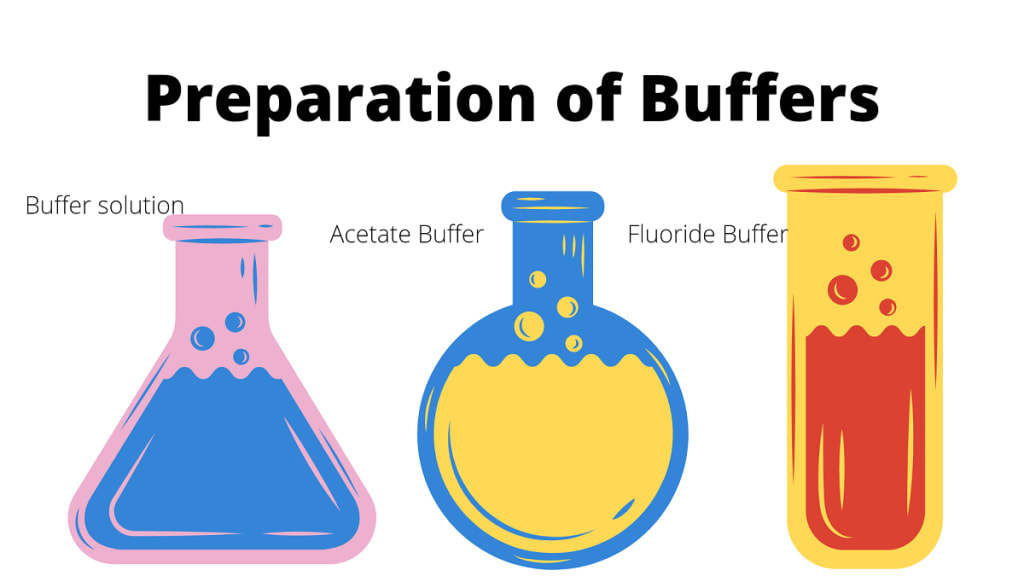
This document details the procedure for the preparation of buffers, indicators and reagents to the intended users or concerned personnel. It is the policy of XYZ Pharmaceuticals Limited that a written procedure shall be followed for the preparation of buffers, indicators and reagents to the intended users or concerned personnel for awareness and implementation. This SOP is applicable at the time of preparation of buffers, indicators and reagents.
RESPONSIBILITY AND ACCOUNTABILITIES
Persons along with their responsibilities and account-abilities are given below:
Executive - Corporate Quality Assurance, Trainee Analyst/ Jr. Analyst/ Analyst/ Sr. Analyst, Manager - Quality Control, Manager - Quality Assurance, Manager - Corporate Quality Assurance:- To prepare the SOP. Maintain the records as per SOP, follow the SOP accordingly and ensure implementation of SOP.
PROCEDURE
BUFFERS
Reference: IP / In-house
Frequency:
Preparation: 1 Month
Storage conditions: - Store the solution in a well-stoppered glass bottle at ambient temperature
Precautions (if any):- If the buffer solutions become turbid then discard the Solution
Preparation of buffers
Acetate Buffer pH 4.6
Dissolve 5.4 g of sodium acetate in 50 ml of distilled water, add 2.4 ml of glacial acetic acid and dilute with distilled water to 100 ml. Adjust the pH, if necessary.
Acetate Buffer pH 5.0
Dissolve 13.6 g of sodium acetate and 6 ml of glacial acetic acid insufficient water to produce 1000 ml. Adjust the pH, if necessary.
Acetic Acid-Ammonium Acetate Buffer
Dissolve 77.1 g of ammonium acetate in distilled water, add 57 ml of glacial acetic acid and dilute with distilled water to 1000 ml.
Ammonia –Ammonium Chloride Buffer
Dissolve 67.5 g of ammonium chloride in about 200 ml of distilled water, add 570 ml of strong ammonia solution and dilute with distilled water to 1000 ml.
Benzalkonium Chloride Buffer pH 10.0
Weigh accurately about 3.0 gm of boric acid, 3.725 gm of potassium chloride and 1.75 gm of sodium hydroxide in a 1000ml volumetric flask, add a sufficient amount of distilled water to dissolve and dilute it up to the mark with distilled water
Buffer solution pH 6.0 + 0.1
Dissolve 2.0 gm of dipotassium hydrogen phosphate (K2HPO4) and 8 gm of potassium dihydrogen phosphate in sufficient distilled water to produce 1000 ml after sterilisation, adjusting the pH with 8 M phosphoric acid or 10 M potassium hydroxide.
Buffer solution pH 8.0 + 0.1
Dissolve 16.73 gm of dipotassium hydrogen phosphate (K2HPO4) and 0.523 gm of potassium dihydrogen phosphate in sufficient distilled water to produce 1000 ml after sterilisation, adjusting the pH with 8 M phosphoric acid or 10 M potassium hydroxide.
Buffer solution pH 4.5 + 0.1
Dissolve 13.61 gm of potassium dihydrogen phosphate in sufficient distilled water to produce 1000 ml after sterilisation, adjusting the pH with 8 M phosphoric acid or 10 M potassium hydroxide.
Buffer solution pH 10.5 + 0.1*
Dissolve 35.0 gm of dipotassium hydrogen phosphate (K2HPO4) in sufficient distilled water to produce 1000 ml after sterilisation, adjusting the pH with 8 M phosphoric acid or 10 M potassium hydroxide.
* After addition of 2 ml of 10 M potassium hydroxide
Buffer solution pH 7.0 + 0.2
Dissolve 13.6 gm of dipotassium hydrogen phosphate (K2HPO4) and 4.0 gm of potassium dihydrogen phosphate in sufficient distilled water to produce 1000 ml after sterilisation, adjusting the pH with 8 M phosphoric acid or 10 M potassium hydroxide.
Buffer solution pH 3.0 + 0.1
Dissolve 9.8 gm of potassium dihydrogen phosphate (KH2PO4) in sufficient distilled water to produce 1000 ml after sterilisation, adjusting the pH with 8M phosphoric acid or 10 M potassium hydroxide.
Fluoride Buffer
Weigh accurately about 58 gm of sodium chloride and 4 gm of 1, 2- cyclohexylenediamine tetra acetic acid in 1000 ml beaker; add 57 ml of acetic acid and 500 ml of distilled water to dissolve. Add 125 ml of 6N sodium hydroxide and adjust the pH 5.3 to 5.5 and dilute the volume to produce 1000ml.
Phosphate Buffer pH 4.0, Mixed
Dissolve 5.04 g disodium hydrogen phosphate and 3.01 g of potassium dihydrogen phosphate in sufficient distilled water to produce 1000 ml. Adjust the pH with glacial acetic acid.
Phosphate Buffer pH 7.2 for BOD
Weigh accurately about 2.125 gm of potassium dihydrogen phosphate (KH2PO4), 5.4375 gm of dipotassium hydrogen phosphate (K2HPO4), 4.42 gm of disodium hydrogen phosphate (Na2HPO4) or 8.35 gm of disodium hydrogen phosphate heptahydrate (Na2HPO4.7H2O) and 0.425 gm of ammonium chloride (NH4Cl) in 250 ml volumetric flask, add sufficient distilled water to dissolve and then dilute it up to the mark with distilled water.
Pyridoxine Hydrochloride Buffer
Dissolve 16 gm of ammonium chloride and 16 ml of ammonia solution and sufficient distilled water to produce 100 ml.
Phosphate Buffer pH 7.4
Dissolve 2.38 g of disodium hydrogen phosphate, 0.19 g of potassium dihydrogen phosphate and 8.0 g of sodium chloride in sufficient distilled water to produce 1000 ml. Adjust the pH if necessary.
Phosphate Buffer pH 7.0 Mixed
Dissolve 0.50 g of anhydrous disodium hydrogen phosphate 0.301 g of potassium dihydrogen phosphate in sufficient water to produce 1000 ml.
Riboflavin Buffer
Dissolve 33.0 gm of potassium hydroxide, 38 ml of phosphoric acid and 16 gm of sodium hydroxide in sufficient distilled water to produce 500 ml.
Sulphanilic Acid Buffer pH 4.5
Dissolve 5.0 gm of sulfanilic acid in 5 ml of ammonia solution and add sufficient distilled water to produce 250 ml.
Zinc Buffer
Mix 4.6 gm citric acid, 7.5 ml distilled water, and 12 ml ammonia.
INDICATORS Solution..........
About the Creator
BANTI SINGH
Hi, I am a chemical engineer and have 10 years Exp. in the chemicals industry. CHEMICALS LEARNING to provide technical of chemical, testing procedure, standard operating procedure, manufacturing formulations, etc.
Keep reading
More stories from writers in FYI and other communities.
Can Your Eyes Actually Change Color? 7 Surprising Factors
Most of us assume that our eye color is a permanent gift from our parents, a genetic "what you see is what you get" situation. But have you ever noticed someone’s eyes looking piercingly bright on a sunny day, or almost turning black when they’re in a fit of rage?
By Areeba Umair5 days ago in FYI
How, Too
Many people wonder how, too. You are not alone, and I am an expert. I will teach you how, too! First, you need to remit a small application fee and fill out an application describing the nature of your financial situation and how often payments will be made, as this will have great bearing on how well I teach you how, too.
By Harper Lewis5 days ago in Fiction




Comments
There are no comments for this story
Be the first to respond and start the conversation.