
Political Crisis in France: Government Collapses After No-Confidence Vote
Shocking No-Confidence Vote Unseats Prime Minister Michel Barnier, Unleashing Political Chaos and Financial Uncertainty Across Europe.

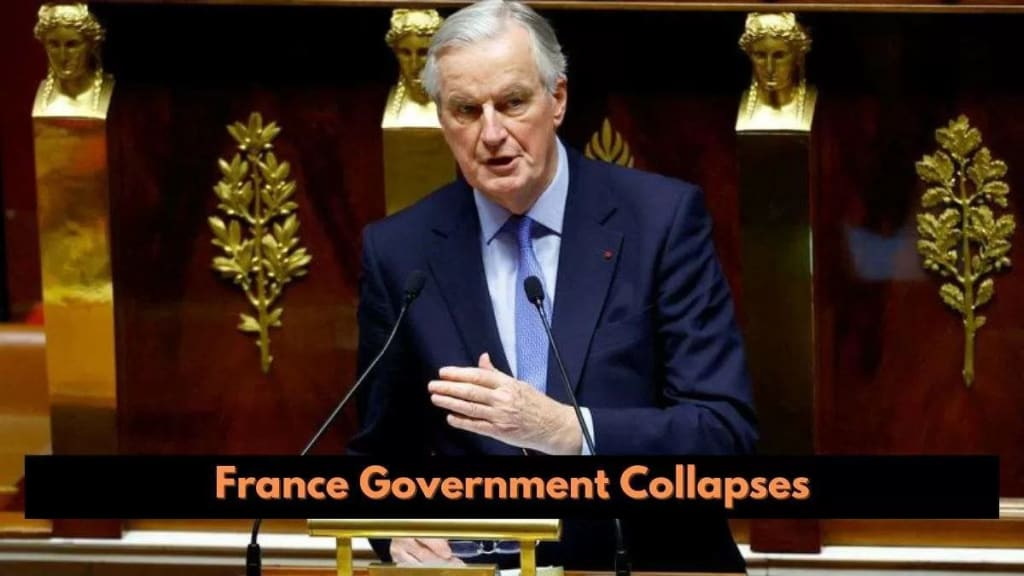
Political Crisis in France: Government Collapses After No-Confidence Vote
France has plunged into political and financial uncertainty after a historic no-confidence vote toppled Prime Minister Michel Barnier’s government. This marks the first time since 1962 that a French government has been ousted in such a manner. The move, spearheaded by a rare alliance between the left-wing bloc and Marine Le Pen’s far-right National Rally, has left the nation in turmoil, with President Emmanuel Macron scrambling to restore stability.
The crisis erupted when Barnier pushed through a controversial budget without a parliamentary vote, citing the urgent need for fiscal reforms. The bold move backfired, with the budget now declared null and void. The dramatic events of the evening have highlighted the deadlock in France’s fractured political system, where consensus has become increasingly elusive.
A Parliament Divided, A Government Toppled
The vote of no confidence was held in the iconic Parliament building in Paris, where tensions had been simmering for months. The seeds of this crisis were sown earlier in the summer when the French electorate delivered a fragmented parliament incapable of forming a cohesive coalition. Despite efforts to create a fragile unity government, it was clear from the outset that its days were numbered.
In a desperate last-minute appeal to lawmakers, Prime Minister Barnier implored them to support his government and avoid plunging the country into chaos. "I can't believe a majority of MPs here will vote to destabilize our institutions at a moment when our country is facing a deep moral, economic, financial, and civic crisis," Barnier declared passionately.
However, the plea fell on deaf ears. A decisive 57% of MPs voted against the government, with the speaker of Parliament announcing the results to a room filled with tension and uncertainty. For a brief moment, politicians from opposing ideological extremes—the far-left and the far-right—found common ground in their opposition to Barnier’s leadership.
"I don't consider this a victory," one MP remarked. "We had a choice to make, and we made it to protect the French people."
A Weakened Macron Faces the Fallout
The collapse of Barnier’s government has left President Macron severely weakened. Returning from a trip to Saudi Arabia, Macron has signaled his intention to remain in office, despite growing calls for his resignation. The parallels to 1962, when President Charles de Gaulle regained control of a fractured parliament, are hard to ignore. However, today’s challenges are far more complex, with France grappling with soaring debt, public discontent, and rising polarization.
A survey of reactions on the streets of Paris underscores the public’s anxiety. "I think it’s tragic," said one woman. "Nobody is considering the consequences." Another man added, "There’s a lot of frustration with both the left and the far-right."
Macron is expected to address the nation, aiming to project calm and stability, but the political landscape looks anything but stable.
Ripple Effects Across Europe
The crisis in France is not an isolated event but part of a broader wave of instability across Europe. Kata Adler, Europe editor, highlights the implications for the European Union. "France, alongside Germany, is traditionally seen as the motor of the EU," Adler notes. "But both countries are now facing significant challenges. Germany’s coalition government recently collapsed, triggering a snap election in February. This is not the strong, united front Europe wants to project."
The timing couldn’t be worse. The EU faces mounting external pressures, from a resurgent Russia to the potential return of Donald Trump to the White House. Trump has been openly critical of the EU, threatening import tariffs and demanding increased defense spending.
Economically, the stakes are high. France, the Eurozone’s second-largest economy, and Germany, its largest, are both in precarious positions. Their instability threatens to drag down other Eurozone nations into economic doldrums, further complicating the EU’s recovery from the pandemic and ongoing inflationary pressures.
What’s Next for France?
France now enters a period of political and financial uncertainty, with no clear roadmap for resolution. Macron’s ability to navigate this crisis will be crucial, but public confidence in his leadership is waning. The opposition, emboldened by their victory, may push for further upheaval, including Macron’s potential removal.
For now, the world watches closely. From Brussels to Moscow to Washington, the fall of France’s government is a stark reminder of the fragility of democratic institutions in turbulent times. Macron’s upcoming speech will be an attempt to reassure the nation and the international community, but the question remains: can France’s fractured political system find its way back to stability?
As France faces an uncertain future, one thing is clear—this is a pivotal moment for the country, with ramifications that will be felt far beyond its borders.
About the Creator
Keep reading
More stories from Cherub Kane and writers in FYI and other communities.
Protest Erupts Outside South Korean Parliament Amid Martial Law Controversy
Protest Erupts Outside South Korean Parliament Amid Martial Law Controversy Late into the night, tensions continue to rise in Seoul as protests gather momentum outside the South Korean Parliament following the imposition of martial law by President Yoon Suk-yeol. BBC producer Jake Kwon reports live from the scene, painting a vivid picture of the unfolding chaos.
By Cherub Kaneabout a year ago in FYI
The Fall of the Iranian Regime Will Destroy Russia
A lot has been happening in the world of geopolitics lately. We’re not even three weeks into 2026, and we’ve already seen wars, bombings, regime changes, capitulations, and escalating unrest across multiple regions. The year has opened at full throttle, and one of the next countries that appears to be teetering on the edge is Iran.
By Lawrence Lease2 days ago in FYI
Wild Card Weekend Recap: What Happens Now?
I think I figured out why I love Wild Card Weekend so much. It's because it's the first playoff anything of the calendar year. The NFL season starts in the fall, and once upon a time, the champion was crowned either on or slightly before New Year's. The evolution of the NFL schedule has resulted in the playoffs starting just into the New Year, and currently, the final week of the season falls on the first weekend of the New Year, with Wild Card Weekend coming a week after that. So yes, chronologically, the NFL's Wild Card Weekend serves as the first playoff anything of the calendar year.
By Clyde E. Dawkins7 days ago in Unbalanced



Comments
There are no comments for this story
Be the first to respond and start the conversation.