
Protest Erupts Outside South Korean Parliament Amid Martial Law Controversy
Protesters Demand an End to Martial Law and the Arrest of President Yoon Suk-yeol as Tensions Mount Outside the National Assembly.

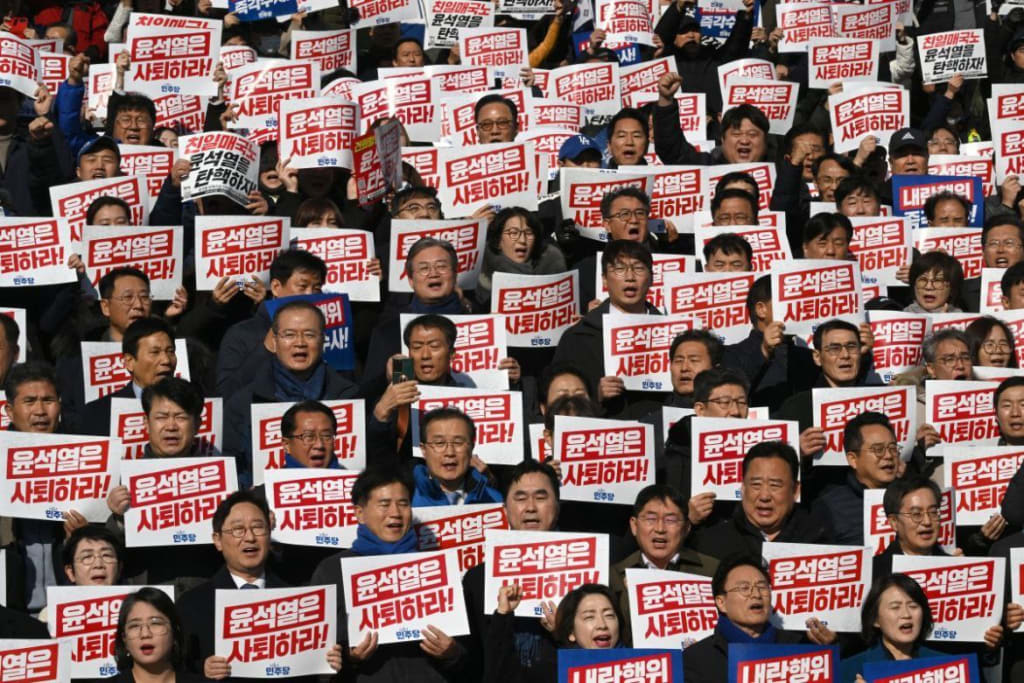
Protest Erupts Outside South Korean Parliament Amid Martial Law Controversy
Late into the night, tensions continue to rise in Seoul as protests gather momentum outside the South Korean Parliament following the imposition of martial law by President Yoon Suk-yeol. BBC producer Jake Kwon reports live from the scene, painting a vivid picture of the unfolding chaos.
Setting the Scene
The area outside the National Assembly is a hive of activity, with hundreds of protesters and riot police stationed across the grounds. The sound of chants fills the air as demonstrators demand an end to martial law, calling for President Yoon’s arrest and chanting slogans like, “Bring down the dictatorship!”
“The atmosphere is charged, with a palpable sense of incredulity among the crowd,” Kwon notes. As news spreads about the parliamentary vote to invalidate the declaration of martial law, the crowd's frustration grows. Some individuals have even demanded that the gates to the Assembly be opened, signaling a readiness to storm the building if necessary.
Security Presence and Uncertainty
Despite the volatile environment, the protests remain largely peaceful for now. Kwon reports seeing “hundreds of police officers in high-visibility jackets,” though many are unarmed and lack riot shields. However, riot police vans and buses line the streets, ready to intervene should the situation escalate.
The sense of unpredictability is heightened by the lack of clear answers from experts on the possible next steps. “We are in uncharted territory,” Kwon explains. Martial law has not been imposed in South Korea since 1979, during a period of political upheaval that led to a military coup.
Inside the National Assembly
Earlier in the day, dramatic scenes unfolded within the National Assembly as lawmakers attempted to convene for a crucial vote on the validity of the martial law declaration. There were reports of police blocking access to the Assembly, with at least one lawmaker scaling a 1.5-meter fence to reach the voting chamber.
The vote ultimately took place, with the Assembly declaring the martial law invalid. News of the decision quickly reached the protesters outside, prompting cheers and renewed calls to confront the authorities. However, questions remain about whether President Yoon will accept the outcome or double down on his stance.
“This is a huge gamble for the President,” Kwon observes. The standoff between the presidential office and the National Assembly has escalated over the past week, with both sides engaging in a heated exchange of rhetoric.
A Nation in Turmoil
The imposition of martial law has sparked widespread fear and anxiety across the country. Restrictions imposed under martial law include limitations on freedom of the press and the suspension of civil liberties, such as protection against unwarranted searches and arrests.
Rumors of an impending curfew circulated on social media, further fueling public confusion and unrest. Kwon describes seeing many protesters glued to their phones, monitoring live streams of the parliamentary proceedings and sharing updates.
“This is a moment of deep uncertainty,” Kwon remarks. The memories of South Korea’s past under military rule loom large, with many fearing a return to authoritarianism. For a country that has prided itself on its democratic progress since the 1987 democratization movement, the current events are nothing short of extraordinary.
A Glimpse into History
Martial law in South Korea has a dark history, with the most recent instance occurring in 1979 following the assassination of then-President Park Chung-hee. The subsequent military rule lasted two years and culminated in a coup. For many South Koreans, the current situation feels like an eerie echo of those turbulent times.
Kwon reflects on the unprecedented nature of the current crisis: “This is the first time martial law has been declared since the democratization of 1987. To see this happening in a country considered one of Asia’s few full democracies is staggering.”
Protesters' Demands
As the night progresses, the protesters remain resolute in their demands. Many are calling for President Yoon’s resignation and immediate action to lift martial law. Most of the demonstrators are believed to be supporters of the main opposition party, further highlighting the deep political divides in the country.
The coming days will be crucial in determining South Korea’s political future. Whether the standoff between President Yoon and the National Assembly escalates further or finds a resolution remains to be seen. For now, the eyes of the nation—and the world—are fixed on Seoul.
About the Creator
Keep reading
More stories from Cherub Kane and writers in FYI and other communities.
Leadership in Question: Concerns Over Pete Hegseth’s Nomination as Secretary of Defense
Leadership in Question: Concerns Over Pete Hegseth’s Nomination as Secretary of Defense In the wake of Donald Trump's controversial nominations for key government positions, Pete Hegseth's proposed appointment as Secretary of Defense has drawn widespread criticism and raised significant concerns about his qualifications and leadership history. Critics argue that Hegseth’s track record lacks the necessary experience and integrity required to lead an $857 billion budget and oversee three million active and reserve personnel in the United States military.
By Cherub Kaneabout a year ago in FYI
Stages and Classes of Heart Failure Explained
Heart Failure is a serious concern, and it is something that happens due to the gradual decline in health. Heart failure at early stages may not present as a serious disease, but over time, it can develop into a serious disease, which can be life-threatening.
By Sophie Blogs7 days ago in FYI




Comments
There are no comments for this story
Be the first to respond and start the conversation.