
The Fall of the Iranian Regime Will Destroy Russia
When Iran Wobbles, Moscow Pays the Price

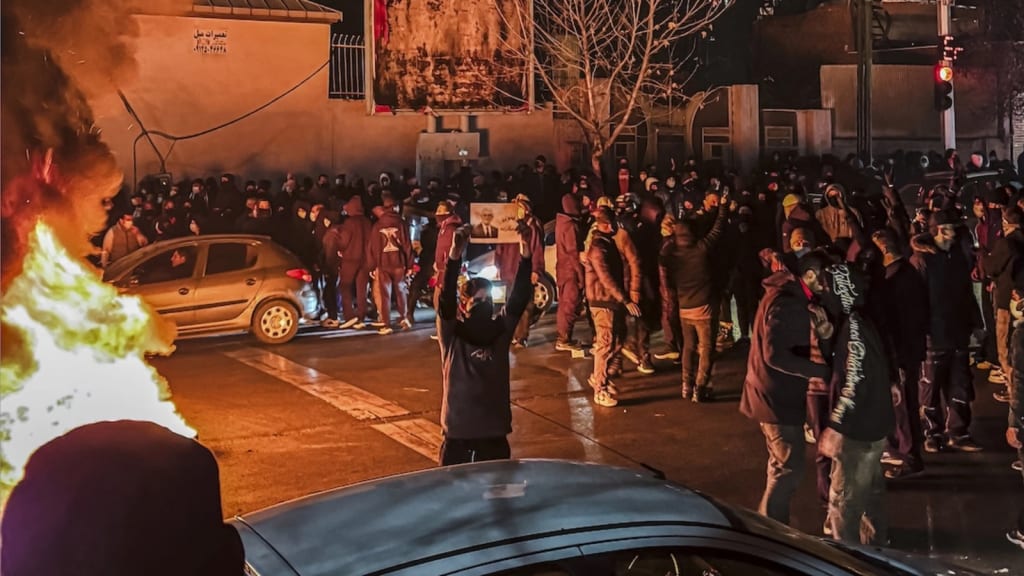
A lot has been happening in the world of geopolitics lately. We’re not even three weeks into 2026, and we’ve already seen wars, bombings, regime changes, capitulations, and escalating unrest across multiple regions. The year has opened at full throttle, and one of the next countries that appears to be teetering on the edge is Iran.
Following a surge in protests over the cost of living at the end of 2025, what began as scattered demonstrations has spiraled into something far larger. Iran has experienced a near-total internet blackout, mass protests across major cities, and thousands reportedly killed by state security forces. Whether it’s called a revolt, an uprising, or a full-blown revolution, this represents the most serious threat to the Ayatollah’s rule in years.
But Iran wouldn’t be the only major loser if Supreme Leader Ali Khamenei were successfully ousted. Russia would be watching from the sidelines—and losing.
For years, Moscow and Tehran have maintained a relationship best described as transactional. It’s an “enemy of my enemy” arrangement, held together by mutual isolation, shared hostility toward the West, and necessity rather than trust. Iran has proven to be a reliable anti-Western partner, helping Russia counter U.S. influence at a time when both nations are increasingly boxed in. If Iran’s regime collapses, Russia loses far more than a diplomatic partner.
The most immediate loss would be materiel. As the war in Ukraine dragged on, Russian artillery stockpiles thinned. Barrages became less frequent, and reports began to surface of shortages across multiple fronts. Moscow turned to North Korea for artillery shells, but Iran filled a different niche—cheap, expendable drones.
The Shahed-136 is not a sophisticated weapon. It’s loud, slow, and relatively easy to shoot down. But it’s also dirt cheap, built largely from commercial components, and easy to mass-produce even under heavy sanctions. That combination made it ideal for Russia’s campaign of saturation attacks against Ukrainian cities. By September 2024, Ukraine claimed more than 8,000 of these drones had been launched. Analysts have since reported that Russia established its own Shahed-style production facilities, with Iran supplying designs, technical expertise, and training.
Russia wouldn’t suddenly lose all of these capabilities if Iran fell tomorrow. It can still build drones and fire missiles. But without Tehran’s direct support, production slows, stockpiles deplete faster, and battlefield flexibility shrinks. The collapse of the Iranian Revolutionary Guard Corps would also sever training pipelines related to drone and missile operations, compounding the problem. For the Kremlin, that means harder choices, fewer options, and higher costs.
Iran has also been central to Russia’s ability to evade sanctions. Through third-party intermediaries, shell companies, and alternative trade routes, Tehran has helped move goods, weapons, components, and services into Russia. The Caspian Sea has been a vital corridor, allowing relatively secure transport by air and ship. The International North–South Transport Corridor, which connects India to Russia, runs directly through Iran. Remove Iran from the equation, and Russia loses one of its most critical logistical arteries.
That loss would force Moscow to rely on longer, riskier, and more expensive routes—burning time, fuel, and money it can’t easily spare. Just as important, Iran’s institutional knowledge of sanctions evasion would disappear. Iran is arguably the most experienced sanctions-dodging state in the world. Losing that expertise would further constrain Russia’s war economy and military sustainment.
Then there’s oil. Russia’s shadow fleet has become infamous, but Iran plays a major role within it. Tankers carrying mixed or relabeled crude, mid-sea transfers, flag switching, and opaque ownership structures have allowed both countries to move oil to gray markets, particularly in Asia. If the Iranian regime collapses, that network doesn’t vanish overnight—but it becomes less efficient, riskier, and more expensive. Given Ukraine’s increasing strikes on Russian energy infrastructure, that added friction matters.
None of this means Russia is on the brink of immediate economic collapse. Predictions of such an outcome after 2022 proved premature. But additional pressure points add up. Russia’s war economy is already expensive: troop salaries, compensation payouts, maintenance, logistics, and equipment all drain resources. Add rising energy costs and reduced export efficiency, and the squeeze tightens over time.
At the macro level, the geopolitical fallout is just as damaging. Without Iran, Russia’s intelligence reach in the Middle East shrinks. Surveillance cooperation weakens. Information-sharing pipelines dry up. Moscow loses a friendly operating environment in a strategically vital region—and with it, influence. Iran’s proxy network has also served as a low-cost way to harass Western interests. If those proxies fade or fracture, Russia’s adversaries can redirect resources elsewhere—potentially toward Russia itself.
Optics matter in geopolitics, and Iran’s fall would be a public relations disaster for the Kremlin. Iran is one of the most isolated states on earth. Its collapse would reinforce the idea that isolated, hardline regimes eventually collapse under their own weight. For Vladimir Putin—who prioritizes regime security above all else—that message cuts close to home. It reinforces the perception of Russia as a paranoid, declining power, making it harder to sell weapons, build coalitions, or command respect in international forums.
It would also raise uncomfortable questions about the so-called anti-Western bloc. Russia has already failed to meaningfully support allies like Syria under Assad or Armenia during the Nagorno-Karabakh crisis. Venezuela’s recent leadership decapitation only adds to the pattern. If Iran were to fall as well, it would prompt serious doubts about whether alignment with Moscow offers any real security in 2026.
None of this is a death knell for the Kremlin. Russia remains adaptable. It still has partners—North Korea’s artillery, Belarus’s compliance, oil buyers in China and India, and potential backdoor deals in parts of Africa and the Middle East. The regime has never lacked creativity when it comes to survival.
But Iran’s collapse would make everything harder. Costs rise. Options narrow. Safety nets disappear. Isolation deepens. Over time, that increases Russia’s vulnerability—militarily, economically, and politically—especially as Ukraine continues to exploit weaknesses.
Geopolitics is an attritional game. Shifts like this don’t decide outcomes overnight, but they matter enormously over time. To misquote Oscar Wilde: losing one ally may be misfortune; losing two looks like incompetence.
There are no clean wins in global politics—only trade-offs and damage control. Iran’s potential fall forces Russia into more of those trade-offs. And the more it has to make, the harder its position becomes to sustain.
Simply put, if I were Vladimir Putin, I’d be watching Iran very closely—and planning for the worst.
About the Creator
Lawrence Lease
Alaska born and bred, Washington DC is my home. I'm also a freelance writer. Love politics and history.
Keep reading
More stories from Lawrence Lease and writers in FYI and other communities.
Freezing the War, Not Ending It. Why Trump’s Russo-Ukraine Peace Deal Will Break Down
Wars don’t end just because someone in a suit decides they should. The war in Ukraine is nearing its fourth year, and while diplomacy is accelerating, the battlefield is unmoved. Missiles still strike cities. The front line still grinds forward inch by inch. The war keeps its own tempo, no matter how fast envoys fly between Mar-a-Lago, Moscow, Paris, and Kyiv with draft agreements in hand.
By Lawrence Lease4 days ago in FYI



Comments
There are no comments for this story
Be the first to respond and start the conversation.