

By marrying Henry VII, Elizabeth of York helped to unite two families and end “The Wars if the Roses.” She was mother to Henry VIII and grandmother to Elizabeth I and, with her husband, started the Tudor Dynasty. This Queen of England is sometimes overlooked, but Elizabeth of York played an important role in English history.
Elizabeth was the eldest child of Edward IV and Elizabeth Woodville, and was born on 11th February, 1466, at Westminster. Her parents had secretly married at Grafton Manor. Her father was the newly crowned King of England and her mother was the widow of a Lancastrian knight. When her father died, Richard III ‘usurped’ the throne and Elizabeth and her siblings declared illegitimate, putting two of her brothers in the Tower of London where they ‘disappeared.’ Richard III wanted to marry Elizabeth but she was rescued by her mother and Margaret Beaufort, who arranged for Elizabeth to marry Henry Tudor (the future Henry VII).
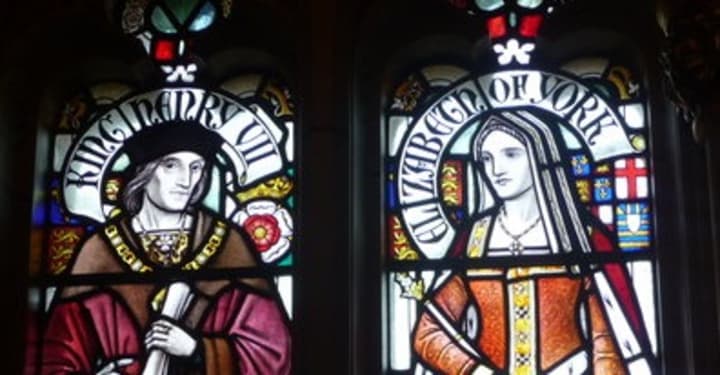
Elizabeth was “a very handsome woman of great ability, and in conduct very able.” She was intelligent, beautiful and loved for her charity and humanity. The humanist scholar Erasmus described Elizabeth of York as “brilliant.” Elizabeth’s marriage to Henry VII was immensely popular, “for the union of the white rose of York and the red rose of Lancaster was seen as bringing peace after years of dynastic war.”
The couple shared a happy marriage and had great affection for each other. Henry came to trust, love and respect his ‘Yorkist’ bride. The couple had seven children and when the heir died, Henry and Elizabeth grew even closer. Now, Elizabeth made sure that her second son, Harry, was prepared for the throne. Her mother-in-law, Margaret, took over her son’s education and, in many ways, ‘controlled’ the Court. How Elizabeth felt about this we do not know, but she showed a very submissive attitude considering it was Elizabeth, the Queen, who should have been in charge of the Court. This may have been to keep the peace with her husband because he loved his mother very much.
Elizabeth proved to be the perfect Medieval Queen! She was beautiful, devout, fertile, kind and decorous, symbolic and dynastic. A perfect Queen to start the Tudor Dynasty. This Queen never got involved in politics, nor did she want to promote a horde of ambitious relatives. Elizabeth displayed the perfect qualities of a Medieval Queen --- she put all her efforts into her household, her Court and her children. She always placed her husband, the King, first.
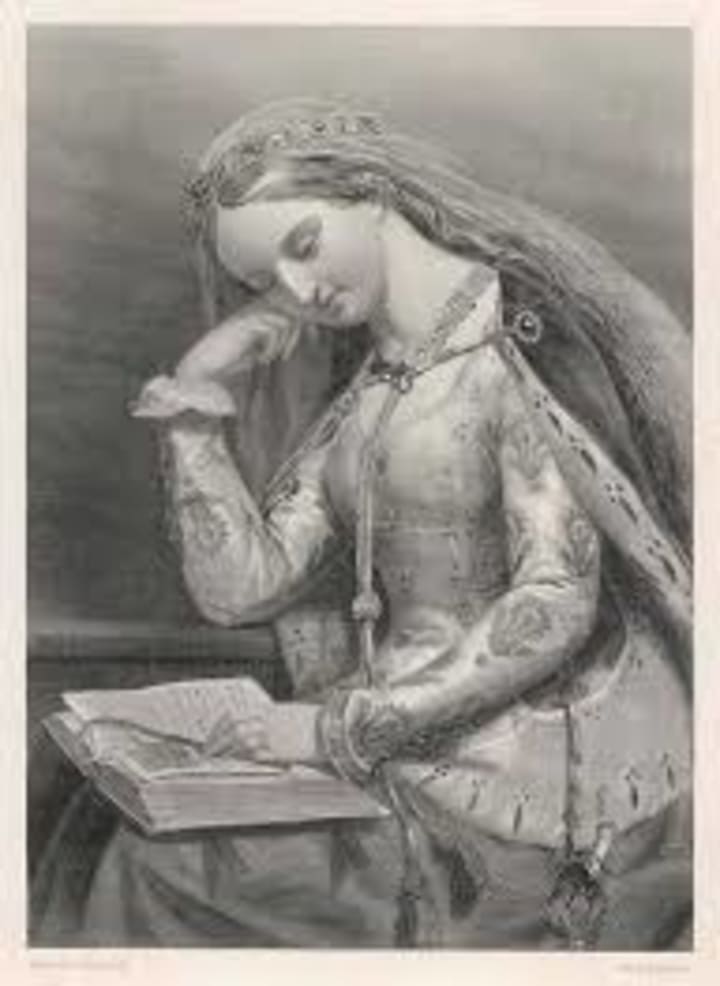
Elizabeth of York was quite well educated for a woman of the Century. She learned history and alchemy from her father, and was taught by ladies-in-waiting, learning the skills needed to be a Queen of England. These skills included reading, writing, mathematics, needlework, horsemanship, music, dancing and household management. Elizabeth did speak French but not fluently.
When Elizabeth became pregnant, not long after her eldest son had died, she was hoping for another boy. However, after six children, her body was weakened, and Elizabeth died soon after giving birth to a little Princess, from ‘complications.’ Learning about Medieval midwifery, it is quite amazing that Elizabeth survived giving birth to all of her children --- and that several of them lived past infancy!
Elizabeth of York died on 11th February, 1503, at the age of 37. After his wife’s death, Henry VII was “withdrawn in sorrow” and gave his Queen a good funeral, spending lavishly on the occasion. Elizabeth left her quiet but firm mark as an English Queen on English history.
About the Creator
Ruth Elizabeth Stiff
I love all things Earthy and Self-Help
History is one of my favourite subjects and I love to write short fiction
Research is so interesting for me too
Keep reading
More stories from Ruth Elizabeth Stiff and writers in FYI and other communities.
Henry VII
Being of the Lancastrian branch of the House of Plantagenet, his mother was Margaret Beaufort and his father was Edmund Tudor, the half-brother of Henry VI. He descended from the Welsh Tudors of Penmynydd and was the last King to win the throne on the field of battle. He ‘cemented’ his claim to the throne by marrying Elizabeth of York, who was the daughter of King Edward. His reign restored power and stability to the English throne and he reigned for nearly 24 years. He was Henry VII.
By Ruth Elizabeth Stiff4 years ago in FYI
A Failed Artist, A Disillusioned Poet, An Underpaid Game Show Host
I took my son and niece to Gori, a small town in Georgia where Joseph Stalin was born. They talked me into visiting the Stalin's Museum, the largest in the post-Soviet space. I had resisted going there because I just can't stand the monster and know enough about him, or so I thought.
By Lana V Lynx9 days ago in FYI
The Timeless Title: “Olu of Warri” – A Pre-Colonial Legacy Rooted in History, Affirmed by Colonial Recognition Before 1952
The title “Olu of Warri” stands as an enduring symbol of sovereignty, predating colonial rule by centuries and embodying the unbroken monarchy of the Warri Kingdom. Far from being a modern invention, this title traces its origins to the late 15th century, when Prince Ginuwa, son of the Oba of Benin, founded the kingdom in 1480 as “Iwere” – the ancestral homeland of the Itsekiri people. Historical records, maps, and accounts from European explorers unequivocally demonstrate that the monarch was consistently referred to as the Olu or King of Warri long before British colonial interference. The temporary shift to “Olu of Itsekiri” in the 1930s was a colonial administrative concession tied to the creation of Warri Province, but compelling evidence from colonial documents reveals that the British authorities had already recognized and supported the historical validity of “Olu of Warri” as early as 1936 – well before the formal restoration in 1952. Through persuasive evidence from Portuguese decrees, ancient maps, literary accounts, royal narratives, and declassified colonial dispatches, this article affirms that the “Olu of Warri” has always been the rightful designation, reflecting a kingdom’s sovereignty and its king’s dominion, with pre-1952 colonial endorsements underscoring its legitimacy.
By Omasanjuwa Ogharandukun3 days ago in FYI



Comments
There are no comments for this story
Be the first to respond and start the conversation.