

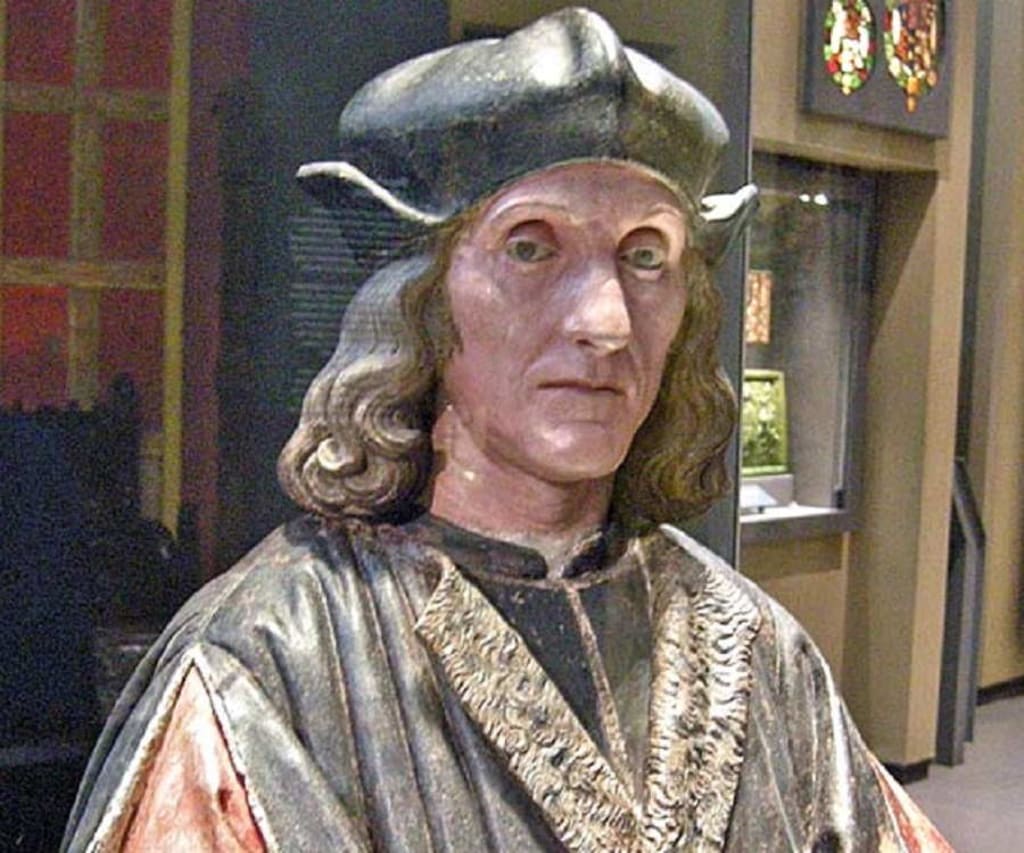
Being of the Lancastrian branch of the House of Plantagenet, his mother was Margaret Beaufort and his father was Edmund Tudor, the half-brother of Henry VI. He descended from the Welsh Tudors of Penmynydd and was the last King to win the throne on the field of battle. He ‘cemented’ his claim to the throne by marrying Elizabeth of York, who was the daughter of King Edward. His reign restored power and stability to the English throne and he reigned for nearly 24 years. He was Henry VII.
Born on 28th January, 1457, at Pembroke castle, Henry’s claim to the throne was ‘tenuous’ at best, as it was through a woman and by illegitimate descent. Little did anyone know that when this little Prince was born, he would end the Wars of the Roses and found the Tudor Dynasty.
When Henry’s father was captured while fighting for Henry VI against the Yorkists, and died in Carmarthen Castle, Henry's mother was cared for by her brother-in-law, Jasper Tudor, and she gave birth to Henry. Margaret was 13 years old! Henry had to flee to Brittany with other Lancastrians whilst he was still young, and he stayed ‘under the protection’ of Francis II, Duke of Brittany, for 14 years.
Henry’s mother actively promoted her son to be King instead of Richard III. She had remarried to lord Stanley who was a Yorkist. In 1483, Henry pledged to Marry Elizabeth of York (eldest daughter of Edward IV). Gaining support from the French and the Woodvilles, Henry marched to England accompanied by his uncle Jasper and John de Vere and an army of about 5,000 soldiers. Henry’s Lancastrian forces defeated Richard III’s Yorkist army at the Battle of Bosworth Field (22nd August, 1485). This ended the Wars of the Roses.
Henry was now King of England, France and Lord of Ireland and was entitled to bear the Royal Arms of England. Henry’s Coronation took place in Westminster Abbey on 30th October, 1485. Henry and Elizabeth had already married in December, 1483, thus uniting the Yorkist and Lancastrian sides of the Plantagenet dynasties. For most of Henry VII’s reign, he did his best to increase the finances of the Crown, sometimes extracting money from the people on different pretexts (for example, war with France and Scotland). Henry improved tax collection by introducing efficient mechanisms of taxation, for example, taxes were increased towards the noble-men. Also, the government was reformed with the introduction of the King’s Council to keep the nobility in check. An interesting fact is that Henry VII established the ‘pound avoirdupois’ as a standard of weight, which later became part of the ‘Imperial’ and ‘Customary’ systems of units.
Henry VII wanted to maintain peace and to create economic prosperity, and, up to a point, he succeeded. He signed the Treaty of Redon which redefined Anglo-Breton relations and it marked a shift from neutrality over French invasion of Brittany to active intervention against it. Henry signed many other Treaties and trade Agreements during his reign, thus securing his hold on the throne, and enriching his kingdom. He also ‘strengthened’ the Justices of Peace in order to avoid another “Wars of the Roses”. Henry and ELizabeth had seven children; Arthur, Margaret, Henry (later Henry VIII), Elizabeth, Mary, Edmund and Katherine. When his eldest son, Arthur, died, his second son, Harry, became heir apparent. Henry was devastated by Arthur’s death, showing his grief by sobbing, and when his wife, Elizabeth, died a year later, Henry shut himself away for several days, refusing to speak to anyone. Their marriage had been a happy one. Unusually for the time, Henry VII never took a mistress and never remarried. He seemed to genuinely love his wife.
On 21st April, 1509, Henry VII died of tuberculosis at Richmond Palace. He was buried next to his wife Elizabeth, in the chapel he had commissioned in Westminster Abbey. His son, Henry VIII succeeded to the throne and his mother, Margaret, died just two months after her son.
Henry VII was an intelligent man who was tall, slender and high-spirited. Henry had blue eyes but bad teeth, which sat in a long, sallow face beneath fair hair. Maybe because he never had a family as a child, Henry lavished attention and money on his wife and children, buying a lion for Elizabeth’s menagerie and a golden lute for his daughter among many other ‘gifts’.

The courage of this King ended the Wars of the Roses, stabilizing the Tudor dynasty and giving ‘birth’ to one of the most famous Kings of England, Henry VIII.
About the Creator
Ruth Elizabeth Stiff
I love all things Earthy and Self-Help
History is one of my favourite subjects and I love to write short fiction
Research is so interesting for me too
Keep reading
More stories from Ruth Elizabeth Stiff and writers in FYI and other communities.
Samuel Pepys
He was an administrator of the Navy of England and a Member of Parliament and he lived during Charles II and James II reigns. His diary gives us a deep insight into what life was like in the 17 Century and during the Great Fire of London and the Plague. Samuel Pepys' private diary goes into detail about the years from 1660 to 1669.
By Ruth Elizabeth Stiff5 years ago in FYI
A Failed Artist, A Disillusioned Poet, An Underpaid Game Show Host
I took my son and niece to Gori, a small town in Georgia where Joseph Stalin was born. They talked me into visiting the Stalin's Museum, the largest in the post-Soviet space. I had resisted going there because I just can't stand the monster and know enough about him, or so I thought.
By Lana V Lynx7 days ago in FYI
The Deepest Hole on Earth: Why We Stopped Digging Toward Hell
You know that colorful diagram of the Earth’s layers you’ve been staring at since third grade? The one with the crust, mantle, and core that looks like a giant jawbreaker? Well, here’s a reality check: we aren’t actually 100% sure that’s how it works.
By Areeba Umaira day ago in FYI
Day 4 of Quitting
If this is how sobriety feels, maybe it’s better to go through life a little buzzed… this, along with other hits like, I want to kill myself, I wish I was dead, and I’m going to throw myself off a bridge have been the only thoughts on rotation these past few days. I promise myself that if, in a month, I still feel like this (‘this’ meaning despondent, full of rage, and simultaneously numb) I can go back to smoking. Until mid-February though? Nicotine is off the table.
By sleepy drafts6 days ago in Longevity




Comments
There are no comments for this story
Be the first to respond and start the conversation.