
Allahu Akbar & Other Common Phrases
Islam Basics (No. 2) debunking misconceptions about Islam and answering your questions!
Welcome to the second content post for my series, Islam Basics! (If you want to learn more about what the series is, you can find the introduction post here.)
DISCLAIMER: This series is for educational purposes only. By no means is this series meant to convince others to join Islam, nor is it meant to be coercive. Its sole purpose is to spread awareness and debunk common misconceptions about the religion at a time in which Islamophobia is ever-increasing.
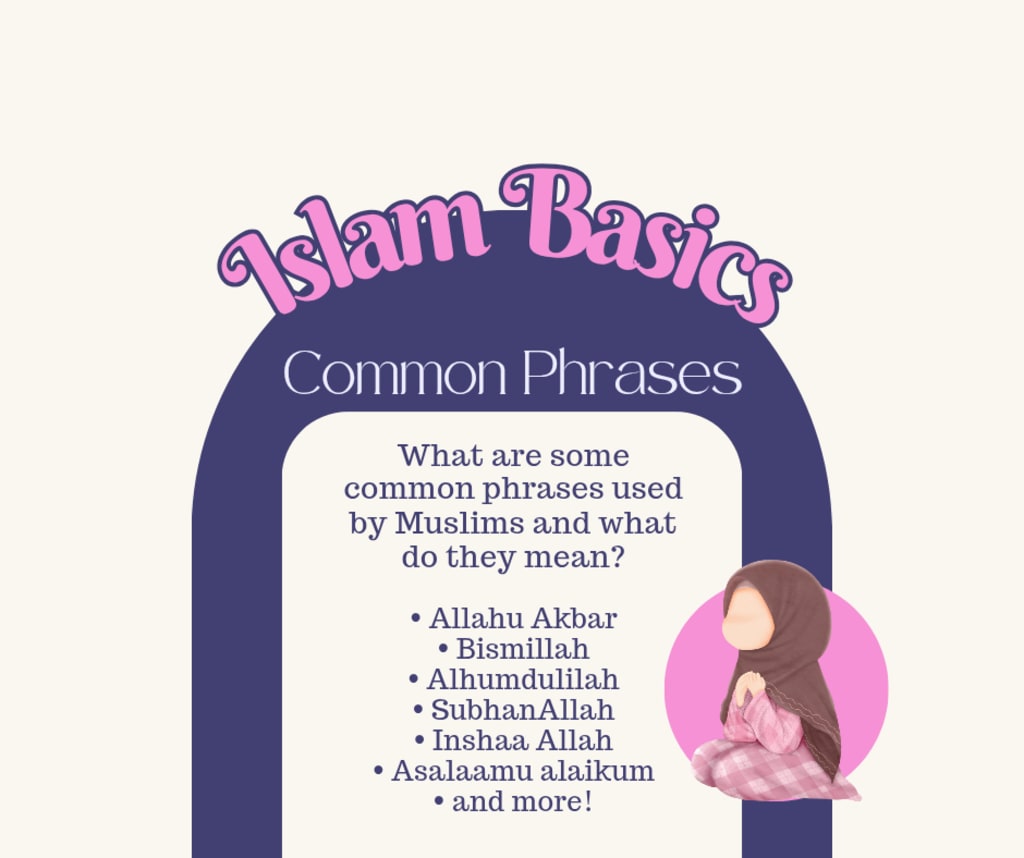
This session will be all about ISLAMIC PHRASES (or, I should say, phrases used in Islam) and what they mean!
I have created a post on this once before, but I wanted to create it again because of the amount of attention it got the first time.
This is the post that I made a year ago:
Although it only has three comments and two likes on Vocal, it is my most read work with almost 500 reads, and the read count goes up still every single day.
This just tells me that there is a wide audience outside of Vocal that has been interested in this specific topic and has been seeking it out. So I wanted to make an updated version in this new series that I have launched.
Without further ado, let's get into it!
ISLAMIC vs. ARABIC
I'd like to first establish the relationship between an Islamic phrase and an Arabic phrase. Most of the phrases you'll see below are not exclusively Islamic, they're just Arabic.
All Muslims will use them, but not everyone who uses them is Muslim.
Let's break that down.
Arabic is a language used by Muslims everywhere, regardless of whether or not they are Arab. Arabic is used by Muslims for religious phrases because the Qur'an was written in Arabic, and it was the language of the Prophet Muhammad ﷺ. Muslims are very concerned about the proper understanding of the Qur'an, and in order to avoid misunderstandings through mistranslation, it is the duty of every Muslim to learn Arabic to understand the Qur'an in its original form.

According to the Sebil Center, the Arabic language has 12.3 million words, whereas the English language only has 600,000. The difference in the number of words just shows how many more meanings/connotations can be expressed in Arabic, whereas an Arabic word might not have an English word that it directly translates to. This is why understanding the Qur'an in Arabic is so important.
Therefore, every Muslim continues to use words and phrases in Arabic because of what Arabic represents and because it maintains the most accurate meaning of the phrase.
Having said that, Muslims do not have a claim on Arabic. There are many many Arabic-speaking Christians and followers of other religions who may also use these same terms.
The main reason for this is because, while many of the phrases have the word "Allah" in them, "Allah" directly translates to "God" in Arabic. So, anyone who believes in God who is Arab or speaks the Arabic language will likely also use these phrases.
ARABIC
Also! Since you cannot read the phrase by the Arabic spelling, the English transliteration (translation into Latin letters) is provided. There are slight variations in how different people transliterate Arabic into Latin letters.
Another important note: where English is read/written from left to right, Arabic is from right to left.
Culture vs. Religion
It's important to note that depending on where a person is from, they may use these phrases slightly differently or in slightly different contexts; however, the direct meaning will remain the same.
PHRASES
Now that we've got that outta the way, these are the phrases I would like to talk about today:
- Allahu Akbar (الله أكبر)
- Bismillah (بِسْمِ ٱللّٰهِ)
- Alhumdulillah (ٱلْحَمْدُ لِلَّٰهِ)
- Subhan Allah (سُبْحَانَ ٱللَّهِ)
- Inshaa Allah (إِنْ شَاءَ اللَّهُ)
- Assalaamu alaikum (ٱلسَّلَامُ عَلَيْكُمْ)
- Mashaa Allah (ما شاء الله)
- Astaghfirullah (أسْتَغْفِرُ الله)
- La ilaha illAllah (لَا إِلَٰهَ إِلَّا اللهُ)
- Subhanahu wa ta'ala (سبحانه وتعالى or ﷻ)
- Sallallahu alaihi wasallam (صَلَّى اللهُ عَلَيْهِ وَسَلَّمَ or ﷺ)
- If there is anything else you have heard that you have questions about, please mention it!
Allahu Akbar (الله أكبر)
This phrase is actually the reason I created my first post a year ago. It is without a doubt the most misunderstood phrase spoken by Muslims and associated with Islam (even though Muslims are not the only ones who say it).
Islamophobic representations of this phrase claim it to be some sort of terrorist slogan, particularly within Western media/movies.
But what does the phrase actually mean? It directly translates to: God is the Greatest.
That's it. It doesn't have anything to do with terrorism or extremism in any way. The weaponizing of this phrase is really disappointing, and I hope that we can reclaim it in the media as something good rather than something associated with terror efforts.
A Muslim might say "Allahu Akbar" to praise God after something good has happened, or on the contrary, they might say it to express faith in God after something bad has happened.
For example, I have seen videos of refugees being reunited after years of not seeing each other, and saying Allahu Akbar (God is the Greatest) to praise God for allowing them to see each other again. I have also seen videos of Palestinians saying Allahu Akbar with the sounds of bombs in the background, fearing for their lives, using the phrase as a reminder that God is the most powerful and to express their faith that God will keep them safe.
It is important to note that the speakers in both of these videos may not have been Muslims at all. They could have been Arabic-speaking Christians.
Bismillah (بِسْمِ ٱللّٰهِ)
Bismillah means "In the name of God." Muslims are encouraged to say this before doing any action, for example: praying, eating, taking a drink, upon entering/exiting the house, etc.
Alhumdulillah (ٱلْحَمْدُ لِلَّٰهِ)
Alhumdulillah directly translates to "All praise be to God" or "Thanks be to God." Similarly to Allahu Akbar, this might be said after something good happens, but is also used to show gratitude during hard times.
Muslims often use it as a response to the question "How are you doing?" It can be used as a response in addition to an answer, or as the answer itself. For example, "Good, alhumdulillah" or "Not too great, but alhumdulillah" or just "Alhumdulillah."
Subhan Allah (سُبْحَانَ ٱللَّهِ)
Subhan Allah directly translates to "Glory be to God." It is most often used in situations where you have encountered something surprising, or want to praise God for his creation. For example, upon seeing a new animal for the first time, a Muslim might say "SubhanAllah." It can also be in response to an unpleasant surprise, such as a natural disaster.
The bottom line is that it is used to show praise about or awe for the vast power of God.
Inshaa Allah (إِنْ شَاءَ اللَّهُ)
This phrase directly translates to "If God wills" or "God willing." This is used to express hope of something happening in the future. For example, if your friend is sick, instead of saying "I hope you feel better soon," you might say "Inshaa Allah you'll feel better soon." If someone asks if you are going to attend an event, instead of saying yes, you might say "Inshaa Allah." It is typically used in an affirmative/positive manner to indicate that you plan to do something or that you hope something happens.
Assalaamu alaikum (ٱلسَّلَامُ عَلَيْكُمْ)
Assalaamu alaikum translates to "Peace be upon you." It is the standard greeting that Muslims will use with one another, in which the appropriate response is walaikum assalam (وَعَلَيْكُمُ السَّلَامُ) meaning "And unto you be peace."
Depending on where a person is from, they may use this phrase as just a form of greeting, or as a greeting as well as a good-bye. You could then use this to say "Hello" as well as "Goodbye."
Mashaa Allah (ما شاء الله)
Mashaa Allah is typically seen as a means of complimenting someone, but the deeper meaning is that you are wishing only good things upon that person, in a means of protecting them from jealousy/envy.
The phrase directly translates to "God has willed it" meaning that you are acknowledging appreciation for something good that God has created. It is often used to display appreciation for someone's accomplishments, and can also be used as a means of complimenting.
Beyond that, it also serves as a means of protecting someone against the "evil eye" or from jealousy. Evil eye, in brief description, is the concept that someone else's jealous feelings towards you can cause you harm, even if it wasn't intended.
Astaghfirullah (أسْتَغْفِرُ الله)
The phrase "Astaghfirullah" means "I seek forgiveness from God." In an equivalence to English phrases, it is similar to saying "God, forgive me." It is also an acknowledgment that God is the only one that can forgive your wrongdoings, and can be seen as an affirmation of faith in that way.
La ilaha illAllah (لَا إِلَٰهَ إِلَّا اللهُ)
This is part of the Islamic declaration of faith (shahadda). "La ilaha illAllah" translates to "There is no deity worthy of worship except God." This is used in prayer to affirm that God is the only one that should be worshipped (a rejection of polytheism) and to affirm faith in God.
Subhanahu wa ta'ala (سبحانه وتعالى or ﷻ)
This phrase is used after mentioning the name "Allah" to show respect and affirm God's glory. It directly translates to "the most glorified, the most high." It is seen as a sign of respect to say this after speaking Allah's name.
Sallallahu alaihi wasallam (صَلَّى اللهُ عَلَيْهِ وَسَلَّمَ or ﷺ)
Similarly to the last example, this phrase is used to show respect to the Prophet Muhammad ﷺ after saying his name. You might notice that in this series I use the symbol version of it after Muhammad's name.
It directly translates to "Peace and blessings of Allah be upon him." It is used to show respect towards the prophet as he is the integral figure in Islam and was the one that the Qur'an was relayed to.
There are also other phrases for when you say the name of other prophets (which is a little bit different) as well as words for the companions of the Prophet Muhammad ﷺ, which are used to show respect to them as well.
⟡ ⟡ ⟡
Those are all the phrases I had today to give you! These are all from my own common knowledge and understanding (as someone who has used these phrases for the past three years). If there are any other phrases you think should be added, or any questions you have about any of them, please feel free to comment below! Also, if you would like sources to support the meanings behind the phrases, I can send you some links!
If there is anything about Islam you would like to know more about or questions that you might have, please feel free to comment! (I encourage it)
Also -- do not be afraid of commenting a "rude" question. If your comment is directly coming from a place of hate, then that is a different story, but if you are honestly curious or seeking an answer for something that you think might be a misconception, don't hesitate to comment! I am open to discussion about these things.
Thank you so much for reading.
Till next time!
⟡ Belle ⟡
About the Creator
Belle
I host unofficial challenges and enjoy writing microfiction and poetry.
Top Story Count: 16
Reader insights
Outstanding
Excellent work. Looking forward to reading more!
Top insights
On-point and relevant
Writing reflected the title & theme
Heartfelt and relatable
The story invoked strong personal emotions
Expert insights and opinions
Arguments were carefully researched and presented
Eye opening
Niche topic & fresh perspectives
Excellent storytelling
Original narrative & well developed characters
Compelling and original writing
Creative use of language & vocab
Masterful proofreading
Zero grammar & spelling mistakes
Easy to read and follow
Well-structured & engaging content
A Failed Artist, A Disillusioned Poet, An Underpaid Game Show Host
I took my son and niece to Gori, a small town in Georgia where Joseph Stalin was born. They talked me into visiting the Stalin's Museum, the largest in the post-Soviet space. I had resisted going there because I just can't stand the monster and know enough about him, or so I thought.
By Lana V Lynx8 days ago in FYI
We Shall Never Surrender: The Speech That Turned Britain’s Darkest Hour Into Defiance
There are speeches that explain history, and then there are speeches that intervene in it. On June 4, 1940, Winston Churchill delivered one of the most consequential addresses ever spoken inside the House of Commons. Britain had just pulled off the miracle of Dunkirk—an evacuation that saved more than 330,000 Allied troops from annihilation. But make no mistake: this was not a victory. France was collapsing. Nazi Germany looked unstoppable. Invasion felt inevitable.
By Lawrence Lease2 days ago in FYI



Comments (2)
Firstly, let’s appreciate the fact that you’ve spent a great time crafting this piece ❤️❤️ Exceptional! I loved how you initially made a difference between Islamic and Arabic… “Allah ho Akbar” is my top fav phrase.. 🤝🏼❤️ it gives me strength when I say it
I also wanted to add something beautiful I’ve learned: We say "Allahumma Barik" when we see something lovely or admirable in someone else’s life—like their kids, talent, house, vibes; basically anything that makes us go wow. It literally means “O Allah, bless it”, so we don’t (even unintentionally) bring negative energy or envy to what we love in others. And when it comes to our own blessings, we say "MashaAllah", which means “What Allah has willed”.💖