
What is Islam?
Islam Basics (No. 1) debunking misconceptions about Islam and answering your questions!
Welcome to the first content post for my new series, Islam Basics! [If you want to learn more about what the series is, you can find the introduction post here.]
DISCLAIMER: This series is for educational purposes only. By no means is this series meant to convince others to join Islam, nor is it meant to be coercive. Its sole purpose is to spread awareness and debunk common misconceptions about the religion at a time in which Islamophobia is ever-increasing.
So what is this first session about?
WHAT IS ISLAM?
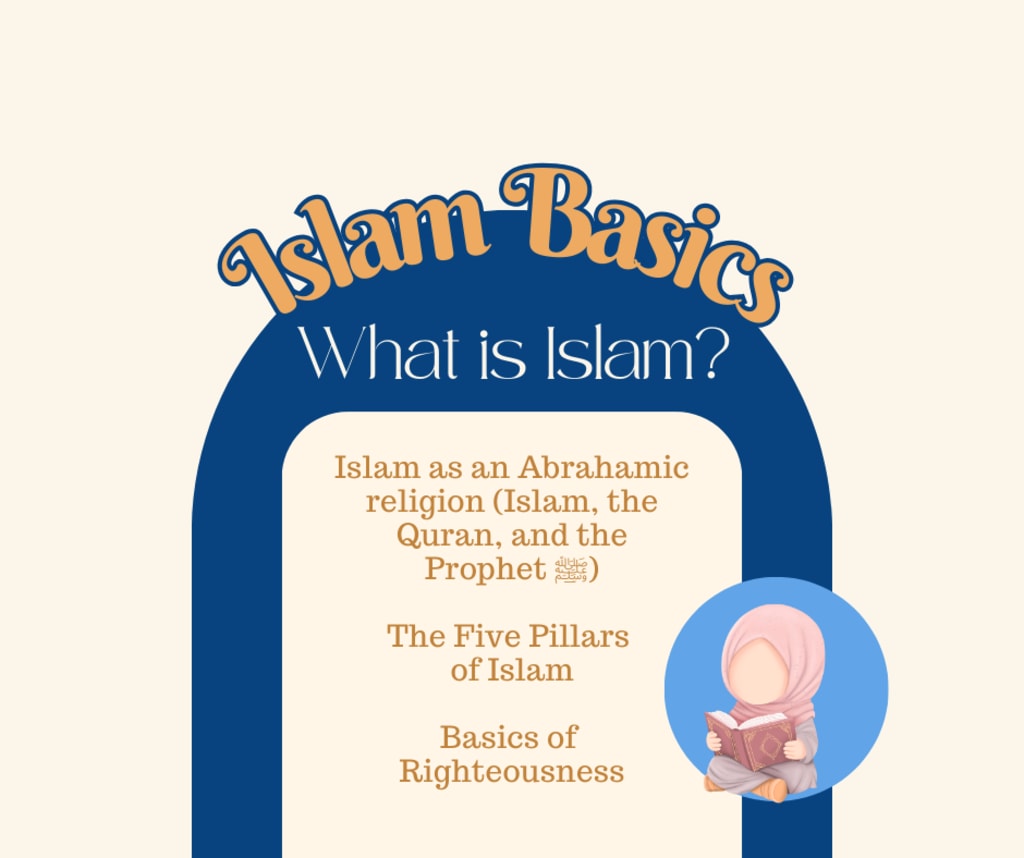
For this session, we will learn some surface-level information about what Islam is. What are its foundations? What are its basics? What kind of fundamentals are there? We will talk about:
- Islam as an Abrahamic religion: Islam, the Quran, and the Prophet ﷺ
- The five pillars of Islam
- Basic teachings about righteousness
This session will be a bit longer than the sessions that will come hereafter, just to briefly describe a large variety of things, and then each thing will later be explored further in depth in later sessions (as well as many other things that are not mentioned in this article).
① Islam as an Abrahamic religion: Islam, the Quran, and the Prophet ﷺ
One of the most common misunderstandings about Islam is the foreignization of it as a religion. I think a lot of people don't realize that it actually has a LOT in common with Christianity, in that it follows in a sequence with Judaism and Christian beliefs, rooting from Abraham.
What is an Abrahamic religion?
This term refers to monotheistic religions (worshipping one God) that are connected (/root back) to Abraham.¹ The three Abrahamic religions are Judaism, Christianity, and Islam, sequentially. What does this mean?
Islam recognizes the Torah (the Hebrew Bible) and the Gospel (the Christian Bible) as previous revelations. While the Torah was revealed to Moses and the Gospel was revealed to Jesus, the Quran was revealed to Muhammad ﷺ (approximately 1,400 years ago). Islam recognizes Moses and Jesus (along with all the other prophets recognized in Christianity) as prophets of God.
Oftentimes, Islam is foreignized as a completely different form of religion, because of Muslims' use of the word "Allah" instead of "God." The term "Allah" is just the Arabic word for "God." Since the Quran was revealed in Arabic, all Muslims have prioritized understanding the text in its original language (to avoid problems in mistranslation), which has led to a strong connection and use of the Arabic language when using everyday religious terms/phrases.
[Future post on Islam's use of Arabic/common Islamic phrases]
Although Islam has been alienated from Judaism and Christianity due to the misconceptions about its foundations, it actually follows many similar teachings, and follows the same history of prophets/messengers, all the way back to Adam (but with the addition of Muhammad ﷺ).
[Future posts on the Prophets in Islam]
The Islamic Calendar
One of Islam's unique qualities, in comparison to the other Abrahamic religions, is its use of a lunar calendar. While most Christians follow the Gregorian calendar, distinguished through Christ (BC and AD, being 2025 years since Jesus's birth), Muslims follow the Hijri calendar, distinguished through Muhammad's ﷺ migration from Mecca to Medina (the Hijrah).²
The Hijri calendar is 12 months long, like the Gregorian calendar, but it follows the lunar cycle, so each new month begins when the lunar cycle restarts (the birth of a "new moon").³ This means that each month in the Islamic calendar is 29-30 days, making the year a bit shorter than the Gregorian calendar, so Islamic dates (and holidays) fall on slightly different Gregorian dates every year.
For example, one of the major holidays in Islam, Eid al Fitr, takes place on 1 Shawwal (of the Hijri calendar). In 2025, Eid al Fitr was on March 30th (for the majority), while in 2024, Eid al Fitr was on April 10th.
Today's Gregorian date: 31 March 2025.
Today's Hijri date: 2 Shawwal 1446.
[Future post on the Hijri calendar]
② The Five Pillars of Islam
I could go on forever talking about these, but to keep it brief (to allow for another session dedicated entirely to this topic), I will just touch the surface of each pillar. I wanted to touch on these in this post as they give some insight into the values that Islam holds and what kind of beliefs/foundations it lies on.
[Future post on the Five Pillars of Islam]
The five pillars of Islam are five key practices and core beliefs/foundations that shape a Muslim. They are referred to as pillars often in the analogy that they are five pillars that hold up your faith, and without one, the structure will fall. You need all five in order to have a solid foundation.
So what are they?
The five pillars of Islam are: faith (shahada), prayer (salah), charity (zakat), fasting (sawm), and pilgrimage (hajj).⁴
- Faith (Shahada): Each Muslim must believe in Islam's core basis in order to be a Muslim. They must believe that there is only one God and that Muhammad ﷺ is His Messenger.⁵
- Prayer (Salah): Muslims have five obligatory prayers to make each day at prescribed times (following the position of the sun in the sky). These prayers consist of a specific sequence of phrases and actions. This is an essential part of a Muslim's daily life.⁶ [Future post on Islamic prayer]
- Charity (Zakat): Giving charity (almsgiving) is mandatory for adult Muslims, given that they are financially able. What you donate must be given to those who are in need of it.⁷
- Fasting (Sawm): During the Hijri month of Ramadan, able Muslims are to fast from sunrise to sunset, abstaining from food and drink, as well as sexual relations. This is a time to strengthen connections with God, remind us of our control over our base desires, and promote humility, reminding us of our privilege. Although Ramadan is the mandatory time for fasting, there are other times throughout the year that a Muslim may fast.⁸ [Future post on Ramadan]
- Pilgrimage (Hajj): Each able-bodied Muslim is obligated to at some point in their lifetime go on pilgrimage to Mecca to visit the Kabbah (Masjid al-Haram) in Saudi Arabia. This occurs during the Hijri month Dhul Hijjah. It is a duty for every Muslim, as long as they are financially, physically, and emotionally capable of completing the journey.⁹
③ Basic teachings about righteousness
Righteousness in Islam is based off of one's belief in God, His Messenger, and the Quran, but also refers to goodness of character. In order to be a righteous follower, a Muslim must not harm others intentionally, must maintain modesty (in behaviour), perform good deeds, act according to what is halal (permissible and lawful), act with kindness and sympathy, and fulfill their obligations (prayer, fasting, charity, etc.).
[Future post on "Halal"]
There are many, many, many different values and virtues recognized in Islam, including (but definitely not limited to): generosity, contentment, courtesy, courage, discipline, forgiveness, gratitude, honesty and fairness, humility, kindness, loyalty, justice, patience, perseverance, repentance, responsibility/reliability, respect, and sincerity.¹⁰
These values/virtues are supported by verses of the Quran as well as the sunnah (hadith).
What is sunnah? What does it mean? And what is hadith?
[Future post on sunnah/hadith]
"Sunnah" refers to anything that the Prophet Muhammad ﷺ did or said during his life. These are recorded as hadith, large collections of the sayings/traditions of the Prophet ﷺ, each with its own chain of recollection to validate its authenticity. There is a lot of emphasis put on Muhammad ﷺ and his actions as being righteous because Muslims consider him to be the most righteous human to have lived, being the closest to God.
Virtuous and righteous characteristics in Islam are considered to be so because of verses in the Quran that directly identify them as such, AND because of hadith that tell us that the Prophet ﷺ used to act in that way, as he is a Muslim's greatest role model.
FINI
I hope this helps to identify some of the key elements of Islam, as a religion and a belief system! As you can see, I've noted a variety of future posts throughout this session that will appear later on (or that I hope to create in the future). If you have any questions about anything Islam related (whether mentioned in this session or not), please feel free to ask your questions in the comments!
(In the future, I might create a Google Form for you to ask questions anonymously if you would like. However, I am a little hesitant just because I feel it might open me up to receiving anonymously posted hate mail... So we'll see!)
Thank you so much for reading this session, and I can't wait to read your comments and questions!
Footnotes
- "Abraham Religions | Definition, Timeline & Origin." Study.com, 10 January 2024. Accessed 31 March 2025.
- The Editors of Encyclopedia Britannica. "Islamic calendar." Encyclopedia Britannica, 13 February 2025. Accessed 31 March 2025.
- Osman, Nadda. "The Islamic calendar: How does it work and why is it lunar?" Middle East Eye, 28 February 2025. Accessed 31 March 2025.
- "Five pillars of Islam." Islamic Relief UK. Accessed 31 March 2025.
- "Shahada - A profession of faith." Islamic Relief UK. Accessed 31 March 2025.
- "Salah." Islamic Relief UK. Accessed 31 March 2025.
- "Zakat 2025." Islamic Relief UK. Accessed 31 March 2025.
- "Sawm (fasting)." Islamic Relief UK. Accessed 31 March 2025.
- "When is Hajj 2025?" Islamic Relief UK. Accessed 31 March 2025.
- Baig, Mirza. "36 Islamic Everyday Virtues." Islam.ru, 11 March 2023. Accessed 31 March 2025.
About the Creator
Belle
I host unofficial challenges and enjoy writing microfiction and poetry.
Top Story Count: 16
A Failed Artist, A Disillusioned Poet, An Underpaid Game Show Host
I took my son and niece to Gori, a small town in Georgia where Joseph Stalin was born. They talked me into visiting the Stalin's Museum, the largest in the post-Soviet space. I had resisted going there because I just can't stand the monster and know enough about him, or so I thought.
By Lana V Lynx6 days ago in FYI
Standing While Falling
Quotation from Friedrich Nietzsche "He who wrestles long with monsters should beware lest he himself become a monster. And if you gaze long into an abyss, the abyss also gazes into you. Man is not destroyed by suffering, but by the meaning he makes of it."
By LUCCIAN LAYTH5 days ago in Critique


Comments (4)
Here in Malaysia, 1 Shawwal is on 31st March. I don't know how to wish you but I'll go with this because this is how we wish Muslims here: "Selamat Hari Raya"! ✨️❤️
Islam is fascinating! Great to learn about!
This is awesome! Here for this series, thank you so much 💙
I’d like to sincerely congratulate you on publishing such a wonderful piece of writing. 👏