
A Night of Spells and Omens
Candles and preprations

The first day of Christmas for many is just another day for a partridge in a pear tree. To others, the first day of Christmas marks something older and unsettling.
Saint Lucy's Day (Lucia), also known as the Festival of Light and Candles, is a perfect blend of Norse pagan and Christian influences. Before the adoption of the Gregorian calendar, Lucia fell close to the winter solstice on the Julian calendar, a time long associated with darkness, thresholds, and the thinning of boundaries between worlds.
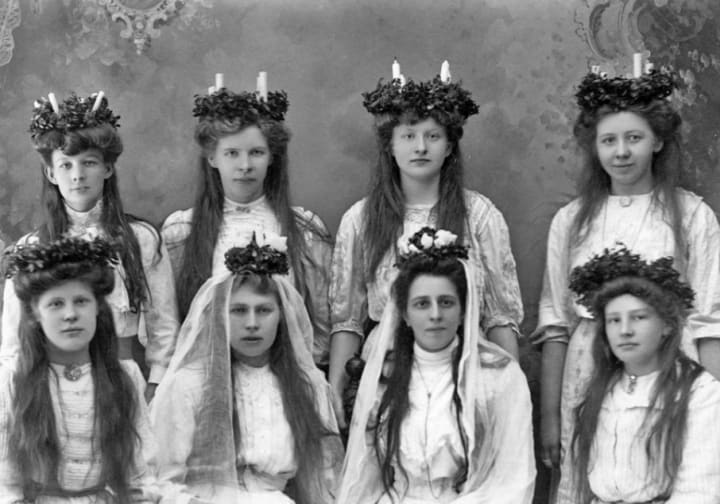
To celebrate Lucia, children in Sweden will dress up in white robes with a red sash, and their crowns will be covered with candles (LEDs, not real candles) and sing songs. Lucia, the candlelight maiden, helps guide the spirits and anyone lost in the darkness on the darkest of all nights.
This is a much kinder, more Disney version of the original and far more terrifying Lussi Night.
It is because of this that the belief is that this night (and in all this time of the year) is liminal or transitional, similar to Samhain, and is considered the darkest day of the year; darkest, not shortest, where malicious spirits and demons can roam freely among the living.

Lussi, unlike her contemporary counterpart, is said to be an evil witch or demon, and is described as a corpse-looking woman. At the stroke of midnight, she is said to fly over houses, and if the chores weren't done or the homeowner was not prepared for the winter, she would break the door open and terrorise the home.
Across the border in Norway, they believed candlelight and prayer helped ward off evil spirits/witches and protected the most vulnerable - children and livestock. Spinning a wheel was said to invoke demons and invite them into your home, rendering your candles utterly useless.
Further south in Italy, Lucia is a tale of two sides. By day, she is the light bringer, yet the night before her feast is most feared. Her witch-like alternative roams homes in search of misbehaving children. Having garlic and blessed bread is a part of the protection rituals.
In Northern Europe, Icelandic giantess Grýla is most active during this winter period and is said to feast on naughty children. She is also accompanied by the Yule cat, who, as you may have guessed, also feasts on naughty children and devours anyone who doesn't have new clothes. As such, it is a time when children and livestock were to be protected, heavily guarded and, well, probably best to stay at home.
The Yule Lads, on the other hand, are the thirteen trolls that leave gifts, like potatoes. Which I'd say is an excellent gift for a time of feasting.

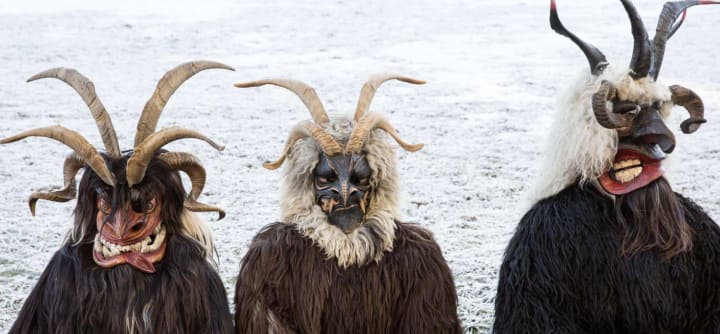
Over in Germany, the 12 harsh nights, known as the Rauhnächte, begin on the 13th or 24th, depending on the region. The belief is that wild hunters and winter spirits (Perchten) might carry you off. As such, it's believed nighttime during this season is bad for travel, urging home cleansing and purification. Also, smoking herbs wards off spirits.
Staying at home is a theme that is shared in Poland's Night of the Unquiet Dead and Finland's Night of Omens, too. In Poland, the spirits of the dead rise, and it's believed that speaking names aloud could invoke the spirits. In an act of protection, windows and doors are sealed until dawn.
Across the Baltic, Finland urges silence and stillness so as not to invite unwanted guests, as spirits of the dead may appear in shadows or reflections. Although it is believed to be a perfect night for divination, scrying and candlelight rituals. Whatever vision the practitioner sees, it will be one of two things: either 1. love, or 2. death.
In Denmark, the night is known for wandering spirits and, like Finland, it is a perfect night for divination. Believing mirror rituals can show you your future lover.
In Britain, this ritual is performed by placing apple peels in water. Also in the UK, animals that speak are considered an omen of death, and rituals at crossroads are intensified during this liminal period.
Whether staying indoors across the Baltic, sealing doors in Poland, or avoiding travel altogether in Germany, these traditions echo through the ages. When the world grows dark and uncertain, we retreat, protect, and watch for signs.
Over centuries, these beliefs have been reshaped, softened, and repackaged. Some into gentle festivals of light, others into half-remembered warnings we tell children. Yet they persist.
I wonder are these stories are merely folklore? And if they are only stories, why do we keep telling them? If so, what's yours?
__________________________________________________
Thank you for taking the time out of your day to read my work. If you like what I do, don't forget to leave a like and subscribe. A tip would be greatly appreciated, never expected.
Stay safe out there, be kind, and I hope to see you around.
I also have a YouTube channel I've not long started, where I try to figure out why things are the way they are - messed up - by looking into myths, mysteries, folklore and legends, separating the fact from the fiction.
Stories have the power to give us life lessons without us having to take a step, and can reveal a lot about ourselves and the world we live in, so if you want to be a storywalker, join me by subscribing:
About the Creator
Keep reading
More stories from Rosie J. Sargent and writers in FYI and other communities.
I'd Rather Have a Kiss than an Arrow
If you've been following me for a while, you know it's my niche to ask questions about why things are the way they are—whether it's what the ancients thought of the Aurora Borealis or why we knock on wood when we say uncertain things.
By Rosie J. Sargentabout a month ago in FYI
Indonesia Data Center Market: Digital Infrastructure Expansion, Cloud Adoption, and Capacity Growth
According to IMARC Group’s latest research publication, the Indonesia data center market size reached USD 3.1 Billion in 2025. Looking forward, the market is expected to reach USD 8.4 Billion by 2034, exhibiting a compound annual growth rate (CAGR) of 11.66% during 2026–2034.
By Abhishek Rastogi4 days ago in FYI




Comments
There are no comments for this story
Be the first to respond and start the conversation.