
I'd Rather Have a Kiss than an Arrow
A dive into mistletoe mythology


If you've been following me for a while, you know it's my niche to ask questions about why things are the way they are—whether it's what the ancients thought of the Aurora Borealis or why we knock on wood when we say uncertain things.
With the festive season rolling in, I found myself wondering why we kiss under the mistletoe and what the act actually means.
Most people attribute the role of the mistletoe to Frigg, mother of Baldur, Odin's son. According to the Poetic Edda, Baldur dreamed of his own death (Baldur's Draumar).
To prevent this, Frigg travelled across the nine realms of Yggdrasil, extracting oaths from every being and object not to harm him, except for the mistletoe.
As Frigg’s magic took hold, the gods in Asgard began throwing weapons at Baldur for sport. Even Thor hurled Mjolnir at him, and it bounced harmlessly away.
Yet in Snorri Sturluson’s Prose Edda, Loki discovers that Frigg overlooked the mistletoe. He fashions an arrow from the plant, places it into the hand of Höd (the blind brother who had been left out of the fun) and guides his aim. The mistletoe strikes Baldur, killing him and setting into motion the events that lead toward Ragnarök.

In Druidism, mistletoe was a sacred symbol of fertility and health, being one of the few plants that thrives in winter, a season traditionally associated with death.
A Roman account by Pliny the Elder in the 1st century AD describes a ritual in which Druids used a golden sickle to cut mistletoe from an oak tree. This oak and mistletoe ceremony produced a potion believed to cure infertility or neutralise poison.
Mistletoe’s associations with health continued through the medieval period, when practitioners used it to treat epilepsy, menstrual problems, and headaches.
Even today, modern medicine continues to explore its potential medicinal properties. Some studies suggest mistletoe extracts may reduce inflammation or ease the side effects of chemotherapy.

However, the evidence remains inconclusive, as research is ongoing, and crucially, mistletoe berries are toxic and potentially dangerous.
Still, none of this explains how we journeyed from mistletoe arrows to mistletoe kisses.
According to historical records, the first reference to kissing under the mistletoe appears in an English song from 1784, though the tradition did not flourish until the Victorian period.
The idea was to hang mistletoe over a threshold (a door - symbolically the boundary between life and death). Kissing beneath it represented the belief that love prevails even in the presence of mortality. Refusing a kiss beneath the mistletoe was considered a bad omen, as Victorians thought it was tempting fate.
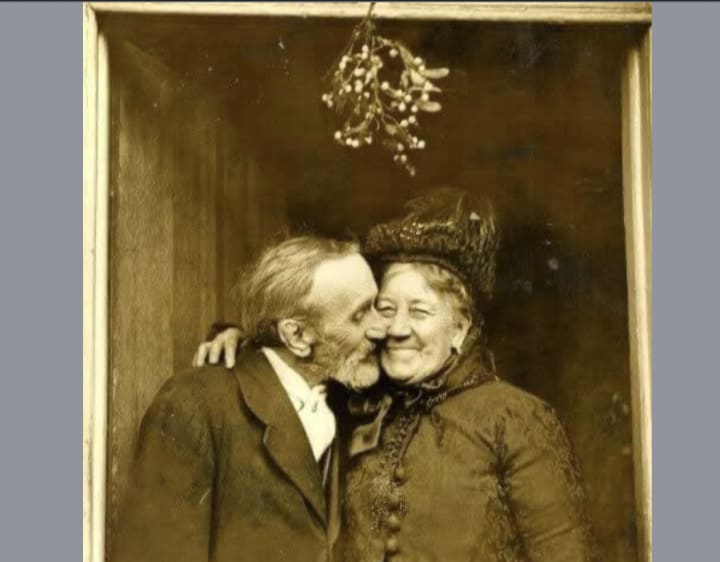
In the Victorian custom, one berry was plucked for each kiss. As the berries are poisonous, the kiss was thought to offer symbolic protection. But once all the berries were gone, so was the luck and therefore, no further kisses were allowed.
This tradition, which survives today, was especially popular in the Victorian era because it broke social norms and allowed romantically charged interactions that were otherwise discouraged.
Some people link this practice back to Frigga, interpreting the mistletoe kiss as an echo of a mother’s love. But no historian can verify that kissing played any part in the death of Baldur, and without concrete evidence, unlike the 1784 song or later accounts, we can only speculate.
But one thing is certain: the story of mistletoe begins with a mother on a mission to protect her child. And for all the mothers out there, it’s a reminder that no matter how fiercely we try to shield those we love, we cannot protect them from everything.
Above all, love and life are important—embrace them and enjoy.
Merry Christmas, God Jul, and a Happy New Year!
_____________________________________________
Thank you for taking the time out of your day to read my work. If you like what I do, don't forget to leave a like and subscribe. A tip would be greatly appreciated, never expected.
Stay safe out there, be kind, and I hope to see you around.
I also have a YouTube channel I've not long started, where I try to figure out why things are the way they are - messed up - by looking into myths, mysteries, folklore and legends, separating the fact from the fiction.
Stories have the power to give us life lessons on paths we never have to walk and can reveal a lot about ourselves and the world we live in, so if you want to be a storywalker, join me by subscribing:
I am also over on Skool, so feel free to join the Storywalker club!
About the Creator
Keep reading
More stories from Rosie J. Sargent and writers in FYI and other communities.
A Failed Artist, A Disillusioned Poet, An Underpaid Game Show Host
I took my son and niece to Gori, a small town in Georgia where Joseph Stalin was born. They talked me into visiting the Stalin's Museum, the largest in the post-Soviet space. I had resisted going there because I just can't stand the monster and know enough about him, or so I thought.
By Lana V Lynx6 days ago in FYI
Why real-time QA dashboards outperform periodic quality reports
For decades, quality teams have relied on periodic quality reports—monthly summaries, quarterly reviews, and audit-ready binders—to understand performance and demonstrate compliance. While these reports still have value, they are increasingly inadequate in today’s fast-paced, highly regulated, and data-rich manufacturing environments. Quality risks evolve daily, not quarterly, and delayed visibility can lead to costly issues, compliance gaps, and lost trust.
By Compliance Quest5 days ago in FYI
Let's Don't Do This
"I just can't do this anymore..." "Do what?" What can't you do? Put gas in your own car? I swear to God you make me take care of everything, don't you? You know I'm on my way to work right now but that never stops you from bothering me, does it?"
By Shirley Belk7 days ago in Fiction



Comments
There are no comments for this story
Be the first to respond and start the conversation.