
Worlds With Three Suns: The Strange and Stunning Reality of Triple-Star Planets
Space

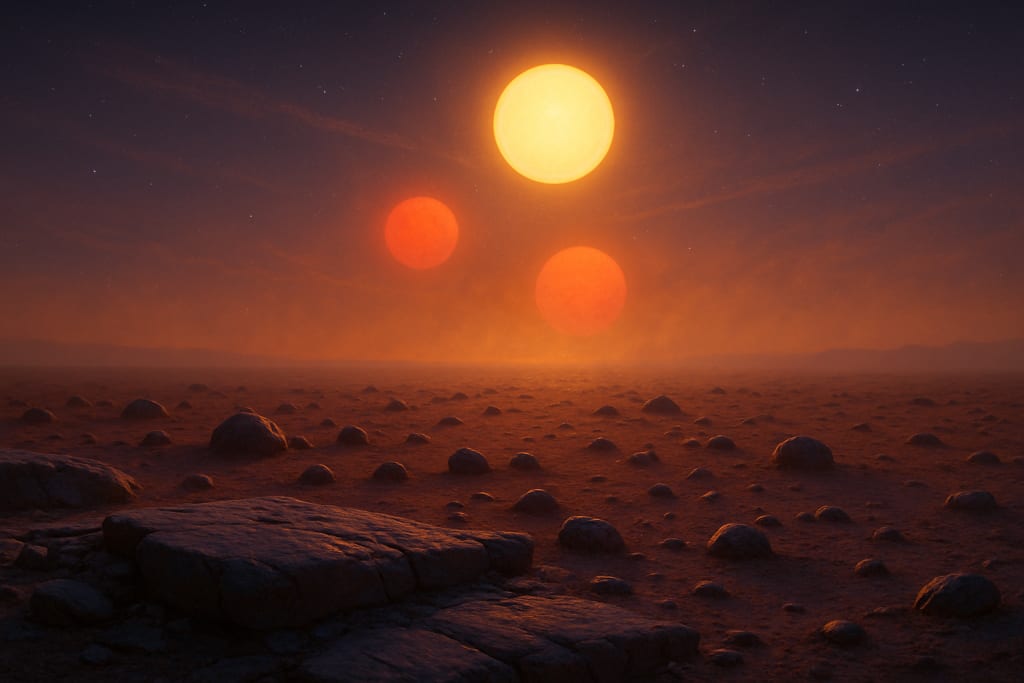
Most of us grow up imagining a solar system as something simple and orderly: a single star with a neat family of planets circling around it. Our own Sun reinforces that picture. But the universe rarely sticks to simple patterns. Among the billions of stars in the Milky Way, there exist far more complex arrangements — including triple-star systems. And what’s even more astonishing is that some of these systems are home to planets that orbit all three stars at once.
This idea sounds like pure science fiction — like something straight out of Star Wars, where the desert planet Tatooine has twin sunsets. But reality goes even further. Instead of two suns, some planets may light their skies with three blazing stars at the same time.
How Triple-Star Systems Work
A triple-star system is exactly what it sounds like: three stars bound together by gravity. But they are not arranged randomly. Astronomers have discovered that most of these systems follow a surprisingly elegant structure:
- Two stars form a tight binary pair, orbiting one another closely.
- The third star circles this pair from farther away, like a distant companion.
You can think of it as a dance: two partners waltzing in the center while a third performer moves in a wide loop around them.
Despite this complexity, many triple-star systems are stable for billions of years. And where stability exists, planets can form and survive.
Can Planets Really Orbit Three Stars?
Yes — and evidence is growing.
NASA’s Kepler Space Telescope has already identified several candidates, such as the system KOI-2626, which appears to include a planet orbiting a trio of stars. Some of these signals still need confirmation, but sophisticated computer models show that stable triple-star planets are absolutely possible.
Two main orbital patterns allow such worlds to exist:
1. Close-in Orbit Around One Star
A planet may orbit just one of the stars in the system, staying close enough that the other two suns are distant background lights. In this case, the planet’s “local” star acts as its primary sun, while the others behave like bright, slow-moving companions that rise and set on unusual schedules.
Imagine standing on the surface of such a world:
At noon, your main sun blazes overhead — but near the horizon you could see a second sun dipping low and turning orange, while a third begins to lift into the sky. The daily light cycle would feel like living under a cosmic light show.
2. A Wide Orbit Encompassing All Three Stars
This is the true mind-bender — a planet so far from the center that it orbits the entire triple-star system as a single unit. In other words, all three stars appear relatively close together in the sky, rising and setting as one glowing cluster.
If you lived on such a planet, you might see three suns arcing overhead at once. Their colors could differ — perhaps one white, one orange, one red — creating strange blended shadows and landscapes bathed in shifting hues.
Although this sounds chaotic, wide orbits can remain stable for billions of years, long enough for complex geology — and potentially even life — to evolve.
What Would the Sky Look Like on a Triple-Sun Planet?
The short answer: unforgettable.
Depending on the distances and types of stars, you might see:
- Three distinct suns of different sizes and colors.
- Regular or occasional triple sunsets — one star disappearing behind the horizon after the next.
- Spectacular multiple-star alignments, which could cause brief bursts of brilliant light.
- Rare, dramatic eclipses, where one star passes in front of another.
Nighttime might be rare. Even if one star sets, the others might still light the landscape with warm twilight. The planet could spend long periods illuminated by at least one sun, producing ecosystems that evolve in almost perpetual daylight.
Could Life Survive There?
At first glance, triple suns might sound too extreme for life. Constantly changing temperatures, multiple light sources, and complex seasons could pose real challenges. Yet under the right conditions, these worlds might be surprisingly comfortable.
If the planet occupies the habitable zone — the region where liquid water can exist — around the entire triple system, it could experience a relatively steady climate. In fact, the combined energy from three stars might help keep it warm and stable even if individual stars vary in brightness.
Life doesn’t require a perfect Earth clone. It only needs a persistent environment. And triple-star systems could provide one — just in an unfamiliar form.
Why These Worlds Matter
Studying planets in triple-star systems offers far more than scientific curiosity. It helps astronomers:
- Understand how planets form in complex gravitational environments.
- Expand the definition of what a “habitable world” might look like.
- Improve models of orbital dynamics useful for everything from exoplanets to galactic structure.
Most importantly, triple-star planets remind us that the universe isn’t limited by our imagination. It builds solar systems stranger and more beautiful than anything we’ve drawn in fiction.
About the Creator
Keep reading
More stories from Holianyk Ihor and writers in Futurism and other communities.
NASA’s Psyche Mission Is Headed Toward a Metal World Worth $10,000 Quadrillion
In October 2023, NASA launched one of its most intriguing deep-space missions yet — Psyche, a robotic explorer on a years-long journey to a mysterious metallic asteroid unlike anything humanity has ever visited. This strange object, named 16 Psyche, isn’t valuable because it hides alien technology or secret energy sources, but because it appears to be made largely of metal. Not just any metal — we’re talking about iron, nickel, and potentially precious metals that, on Earth, form the backbone of modern industry.
By Holianyk Ihor2 months ago in Futurism
About Binding Prometheus
I want to start actively advocating on behalf of my own work, and the most valuable part of my canon is, without a doubt, Binding Prometheus, the play I have been working on since 2019 and only finished in 2023 as part of my MA. The play itself is an amalgamation of a million different inspirations. On one end, it evokes the Ancient Greek myth-play, deriving its own title from the earliest extant work of Western drama we have, Aeschylus’s Prometheus Bound. On the other end, it borrows significantly from the sci-fi bulwarks from over the years, namely Mary Shelley’s Frankenstein and Karel Capek’s Rossum’s Universal Robots. The play could be an episode of Black Mirror, I fear. I don’t know. I’ve only ever seen one episode of Black Mirror.
By Steven Christopher McKnight11 days ago in Futurism
GCC LED Display Market: Digital Advertising Expansion, Smart Infrastructure & Growth Outlook
According to IMARC Group's latest research publication, GCC LED Display Market size reached USD 373.1 Million in 2024. Looking forward, IMARC Group expects the market to reach USD 797.0 Million by 2033, exhibiting a growth rate (CAGR) of 8.2% during 2025-2033.
By Abhay Rajputabout 2 hours ago in Futurism
Violence Begets
"Any last words, cowboy?" "None you'd understand, sodbuster." "Funny. That's Marshall Sodbuster to you. But I meant some last nugget that would help us in the adjudication of the myriad offenses counted against you and your gang. I wasn't asking for penitence."
By Adam Diehl5 days ago in Fiction



Comments
There are no comments for this story
Be the first to respond and start the conversation.