
NASA’s Psyche Mission Is Headed Toward a Metal World Worth $10,000 Quadrillion
Space


In October 2023, NASA launched one of its most intriguing deep-space missions yet — Psyche, a robotic explorer on a years-long journey to a mysterious metallic asteroid unlike anything humanity has ever visited. This strange object, named 16 Psyche, isn’t valuable because it hides alien technology or secret energy sources, but because it appears to be made largely of metal. Not just any metal — we’re talking about iron, nickel, and potentially precious metals that, on Earth, form the backbone of modern industry.
Scientists have tossed out a jaw-dropping estimate of its hypothetical worth: about $10,000 quadrillion. That’s a one followed by nineteen zeros. For perspective, the entire global economy sits around $100 trillion — meaning Psyche’s theoretical value is about 100 million times the Earth’s annual output.
Of course, no one is planning to tow the asteroid home and crash the global metals market. The Psyche mission isn’t about mining. It’s about answering one of the oldest questions we have: How do planets like ours form? And to find out, NASA is sending a probe on a journey of more than 3.6 billion kilometers toward what may be the exposed core of a failed planet.
What Makes Psyche So Special?
Most asteroids fall into one of two categories: rocky or icy. Psyche, however, seems to break this rule. Early observations from Earth-based telescopes and radar suggest that the asteroid is unusually dense and highly reflective — clues that it may be primarily metallic. This makes Psyche an outlier and a priceless scientific opportunity.
Think of it as a planetary time capsule. Billions of years ago, when the solar system was a swirling, chaotic disk of dust and gas, countless protoplanets began to form. Many collided, split apart, or never developed fully. If Psyche is the exposed core of one of these early worlds, then studying it is like looking directly at the heart of a planet — something we could never do with Earth’s own buried iron core.
Imagine trying to learn how cars work if every engine were sealed under layers of metal and you could never open the hood. Psyche, in that analogy, is an engine sitting uncovered on the shop floor.
The $10,000 Quadrillion Question
So why the mind-blowing price tag? Using current market prices for iron and nickel, scientists made a playful, hypothetical calculation: If the metals on Psyche could be extracted and if they could be brought to Earth (two things far beyond modern engineering), they’d be worth around $10 quintillion — enough to make every person on Earth a billionaire many times over.
But this is purely theoretical economics. Bringing that much metal to Earth would cause prices to collapse instantly. Gold wouldn’t be rare. Platinum wouldn’t be precious. Even iron — the backbone of global manufacturing — would suddenly be as cheap as sand. The only real marketplace where Psyche holds infinite value is science.
NASA’s interest is not in space mining, but in space knowledge.
What Psyche Hopes to Discover
The mission aims to reveal:
1. The composition of Psyche’s metal
Is it mostly iron and nickel, like Earth’s inner core? Could it contain exotic alloys? Are there trace amounts of rare metals? Instruments aboard the spacecraft — including a gamma-ray and neutron spectrometer — will scan Psyche’s “skin” to tell us precisely what it’s made of.
2. Whether Psyche has a magnetic field
Earth’s core generates our protective magnetic field. If Psyche retains traces of magnetism, it would be powerful evidence that it once behaved like a mini-planet with a molten, active interior.
3. How proto-planets evolve
By orbiting Psyche at progressively lower altitudes, the spacecraft will map its gravity, density, and geology. These clues could reshape our models of planetary birth.
A Testbed for Future Space Travel
Beyond the science, Psyche is a technological milestone. The spacecraft uses solar electric propulsion, a highly efficient form of ion propulsion that may power future missions to Mars and beyond. Instead of burning through chemical fuel, Psyche accelerates charged particles — slowly, but steadily — like a cosmic Prius that trades horsepower for extreme mileage.
NASA is also flying an experimental deep-space laser communication system, capable of transmitting data faster than traditional radio waves. Think of it as upgrading from dial-up to fiber-optic Internet — but in deep space.
When Will Psyche Arrive?
The spacecraft will reach its asteroid destination in 2030, where it will spend roughly 26 months orbiting and studying the metallic world. Over time, Psyche will descend through a series of orbital phases, each designed to reveal finer details.
Why Psyche Truly Matters
Even if humans never mine a single asteroid, Psyche represents something bigger: curiosity on a cosmic scale. We’re venturing to a world no one has seen before, one that could unlock secrets about our own origins. It’s a reminder that exploration isn’t always about profit — sometimes it’s about understanding where we came from and imagining where we might go.
About the Creator
Keep reading
More stories from Holianyk Ihor and writers in Futurism and other communities.
When the Universe was one second Old: The Birth of the First Hydrogen Atoms
Imagine a cosmic stopwatch starting at the very instant the Universe burst into existence. It clicks once—one second has passed. Just a single heartbeat. That moment is so short that most of us wouldn’t even notice it. But on the scale of the cosmos, one second after the Big Bang marks a profound turning point. It’s the moment when the foundations of all future matter—including stars, planets, and eventually us—began to solidify.
By Holianyk Ihor2 months ago in Futurism
About Binding Prometheus
I want to start actively advocating on behalf of my own work, and the most valuable part of my canon is, without a doubt, Binding Prometheus, the play I have been working on since 2019 and only finished in 2023 as part of my MA. The play itself is an amalgamation of a million different inspirations. On one end, it evokes the Ancient Greek myth-play, deriving its own title from the earliest extant work of Western drama we have, Aeschylus’s Prometheus Bound. On the other end, it borrows significantly from the sci-fi bulwarks from over the years, namely Mary Shelley’s Frankenstein and Karel Capek’s Rossum’s Universal Robots. The play could be an episode of Black Mirror, I fear. I don’t know. I’ve only ever seen one episode of Black Mirror.
By Steven Christopher McKnight11 days ago in Futurism
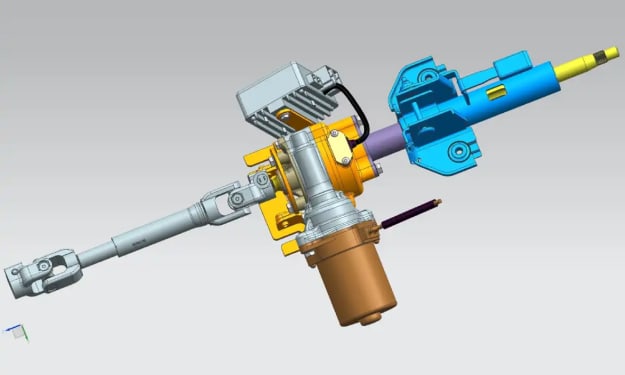
Electric Power Steering Market: Lightweight Designs, Fuel Efficiency Benefits & Automotive Innovation
According to IMARC Group's latest research publication, global Electric Power Steering Market size reached USD 29.62 Billion in 2024. Looking forward, IMARC Group expects the market to reach USD 45.30 Billion by 2033, exhibiting a growth rate (CAGR) of 4.59% during 2025-2033.
By sujeet. imarcgroup4 days ago in Futurism



Comments
There are no comments for this story
Be the first to respond and start the conversation.