
Wood and Timber Products Market Size and Forecast 2025
Renewable Materials Powering Global Construction, Furniture, and Sustainable Development

Wood and Timber Products Market Outlook (2025–2033)
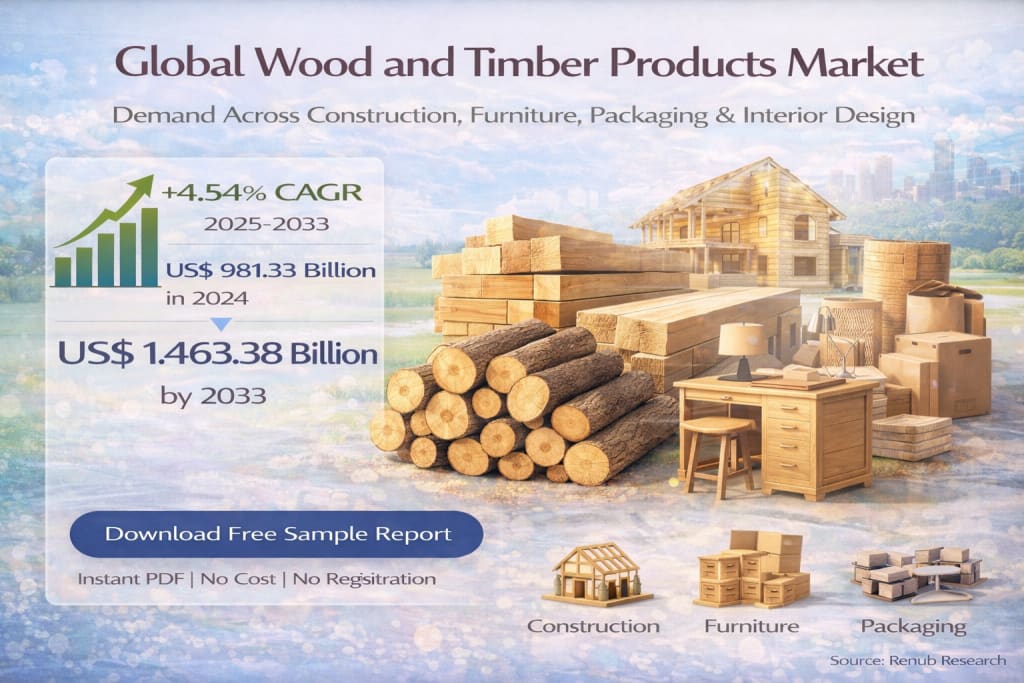
According to Renub Research, the global Wood and Timber Products Market is projected to grow from US$ 981.33 billion in 2024 to US$ 1,463.38 billion by 2033, expanding at a CAGR of 4.54% during 2025–2033. This steady growth trajectory reflects increasing demand from the construction, furniture, packaging, and interior design industries, along with rising global awareness around renewable and sustainable building materials.
Wood and timber products remain essential materials across both traditional and modern economies. From residential housing and commercial infrastructure to modular furniture and eco-friendly packaging, wood-based products continue to evolve in functionality, performance, and environmental value.
Global Wood and Timber Products Market Overview
The global wood and timber products industry encompasses a broad portfolio of processed and semi-processed materials, including lumber, plywood, veneer, particleboard, MDF, HDF, and engineered wood products such as cross-laminated timber (CLT) and laminated veneer lumber (LVL). These materials play a critical role in construction, furniture manufacturing, interior décor, packaging, and industrial applications.
Wood’s renewable nature, adaptability, strength-to-weight ratio, and aesthetic appeal make it a preferred choice across multiple end-use sectors. As housing demand rises globally—particularly in emerging economies—wood continues to be viewed as both a functional and environmentally responsible alternative to carbon-intensive materials such as steel and concrete.
Technological advancements in wood processing, treatment, and preservation have significantly enhanced product durability, fire resistance, moisture control, and load-bearing capacity. These innovations are expanding the applicability of timber in mid-rise and high-rise construction, further strengthening its market relevance.
At the same time, regulatory focus on sustainable forestry, responsible sourcing, and supply chain transparency is reshaping industry practices. Certification programs and eco-labels are now integral to market competitiveness, particularly in developed regions.
Key Factors Driving Wood and Timber Products Market Growth
1. Rising Demand from the Construction Industry
The construction sector remains the largest consumer of wood and timber products worldwide. Rapid urbanization, population growth, and infrastructure development are driving demand for structural timber, plywood, and engineered wood across residential, commercial, and industrial projects.
Modern construction techniques—such as modular construction and mass timber buildings—are accelerating the use of wood in applications traditionally dominated by steel and concrete. Builders increasingly favor timber due to its ease of installation, thermal insulation properties, seismic performance, and design flexibility.
With sustainability becoming central to architectural planning, timber is widely adopted as a low-carbon construction material, particularly in regions facing housing shortages and green building mandates.
2. Technological Advancements in Wood Processing
Innovation has transformed the wood industry from a traditional sector into a highly engineered materials market. Products like CLT, OSB, and LVL offer enhanced strength, dimensional stability, and moisture resistance, enabling their use in complex structural applications.
Automation, digital sawmilling, precision cutting, and advanced drying technologies are improving yield efficiency and product consistency, while reducing material waste. Additionally, new chemical and thermal treatments are extending product lifespan by improving fire resistance, pest control, and weather durability.
These advancements are making wood products more competitive, cost-efficient, and versatile across construction, furniture, and industrial segments.
3. Growing Preference for Sustainable and Eco-Friendly Materials
Global emphasis on climate change mitigation and environmental responsibility is accelerating the shift toward renewable materials. Wood, when sourced responsibly, is biodegradable, recyclable, and carbon-storing, making it a preferred alternative to plastics and metals.
Governments, corporations, and consumers are increasingly adopting green building standards, many of which encourage or mandate the use of certified timber products. Eco-labels and forest stewardship certifications enhance credibility and help manufacturers access premium markets.
Beyond construction, industries such as furniture, packaging, and interior design are replacing synthetic materials with wood to align with sustainability goals—further fueling market expansion.
Challenges in the Wood and Timber Products Market
Environmental Regulations and Deforestation Concerns
One of the most significant challenges facing the industry is deforestation and environmental compliance. Unsustainable logging practices can lead to biodiversity loss, soil degradation, and increased carbon emissions, prompting stricter regulations worldwide.
Compliance with forestry laws and certification requirements often involves costly audits, traceability systems, and documentation, increasing operational complexity. Illegal logging and grey-market imports also distort pricing and undermine sustainable practices.
Failure to meet regulatory standards can restrict market access—especially in Europe and North America—making sustainability investments essential rather than optional.
Raw Material Supply and Price Volatility
The availability and pricing of raw timber are influenced by climate conditions, forest policies, labor availability, and geopolitical factors. Natural disasters such as wildfires, floods, and pest infestations can disrupt supply chains and cause sudden price spikes.
This volatility complicates long-term planning, procurement contracts, and capital investments. To mitigate risks, companies are diversifying sourcing strategies, maintaining buffer inventories, and adopting flexible procurement models—though challenges persist across the value chain.
Wood and Timber Products Market Overview by Region
United States
The U.S. wood and timber products market is supported by a strong construction, housing, and furniture manufacturing base. With extensive managed forest resources, the country is both a major producer and consumer of lumber and engineered wood.
Innovations in mass timber construction and widespread adoption of green building certifications such as LEED are driving demand for certified wood products. Despite challenges related to labor shortages and regulatory compliance, the U.S. market remains technologically advanced and innovation-driven.
United Kingdom
The UK market relies heavily on imports due to limited domestic forestry resources. Demand is driven by construction, packaging, and interior applications, with sustainability playing a central role in purchasing decisions.
Engineered wood panels are increasingly used in modern architecture, aligned with the UK’s carbon reduction and green building objectives. Despite post-Brexit trade adjustments, the market benefits from consistent demand for low-impact construction materials.
India
India represents one of the fastest-growing wood and timber markets, fueled by urbanization, infrastructure expansion, and rising demand for furniture and interior décor. While domestic production exists, imports are critical—especially for premium timber and engineered panels.
The rapid growth of modular furniture and real estate is boosting demand for plywood, MDF, and particleboard. Government initiatives supporting housing and local manufacturing further enhance market prospects, despite challenges related to raw material availability and environmental regulations.
United Arab Emirates
The UAE’s demand for wood and timber products is driven by construction, hospitality, and interior fit-out projects. With limited forest resources, the country depends almost entirely on imports from Asia, Europe, and North America.
Engineered wood products dominate usage, particularly in high-end commercial and residential developments. Sustainability certifications are gaining importance, while Dubai and Abu Dhabi serve as key regional distribution hubs.
Recent Developments in the Wood and Timber Products Industry
In July 2024, Georgia-Pacific commenced production at its state-of-the-art Dixie facility, focused on high-end paper plate manufacturing. The facility emphasizes energy efficiency, waste reduction, and sustainable production, reflecting the industry’s broader shift toward environmentally responsible operations.
Market Segmentation
By Application
Furniture
Paper
Lumber
Textiles
Bio Chemicals
Others
Regional Outlook
North America: United States, Canada
Europe: France, Germany, Italy, Spain, United Kingdom, Belgium, Netherlands, Turkey
Asia Pacific: China, Japan, India, South Korea, Thailand, Malaysia, Indonesia, Australia, New Zealand
Latin America: Brazil, Mexico, Argentina
Middle East & Africa: Saudi Arabia, United Arab Emirates, South Africa
Key Companies Covered
Ogonek Custom Hardwoods, Inc.
PotlatchDeltic Corporation
Resolute Forest Products
RSG Forest Products, Inc.
Sierra Forest Products, Inc.
Southern Pine Timber Products, Inc.
Stora Enso Oyj
Timbeck Architecture
Timber Products Co. Limited Partnership
West Fraser Timber Co. Ltd.
Each company analysis includes overview, key personnel, recent developments, SWOT analysis, and revenue insights.
Final Thoughts
The global Wood and Timber Products Market stands at the intersection of economic growth and environmental responsibility. With rising construction activity, continuous technological innovation, and strong momentum toward sustainable materials, the industry is well-positioned for long-term expansion.
While challenges such as regulatory compliance and raw material volatility persist, the shift toward engineered wood, certified sourcing, and green construction offers substantial opportunities. As governments and industries worldwide prioritize renewable resources, wood and timber products will remain fundamental to building a sustainable, low-carbon future.
About the Creator
Diya Dey
Market Analyst
About Binding Prometheus
I want to start actively advocating on behalf of my own work, and the most valuable part of my canon is, without a doubt, Binding Prometheus, the play I have been working on since 2019 and only finished in 2023 as part of my MA. The play itself is an amalgamation of a million different inspirations. On one end, it evokes the Ancient Greek myth-play, deriving its own title from the earliest extant work of Western drama we have, Aeschylus’s Prometheus Bound. On the other end, it borrows significantly from the sci-fi bulwarks from over the years, namely Mary Shelley’s Frankenstein and Karel Capek’s Rossum’s Universal Robots. The play could be an episode of Black Mirror, I fear. I don’t know. I’ve only ever seen one episode of Black Mirror.
By Steven Christopher McKnight10 days ago in Futurism
United Kingdom Software Development Market Size and Forecast 2026–2034
United Kingdom Software Development Market: Outlook The United Kingdom software development market is entering a period of strong and sustained growth, supported by widespread digital transformation across industries, rapid adoption of cloud platforms, and accelerating use of artificial intelligence and automation technologies. According to Renub Research, the market is expected to expand from US$ 19.55 billion in 2025 to US$ 45.57 billion by 2034, registering a robust compound annual growth rate (CAGR) of 9.86% from 2026 to 2034.
By Marthan Sir2 days ago in Futurism


Comments
There are no comments for this story
Be the first to respond and start the conversation.