
Why the Universe Doesn’t Fall Apart: The Forces Holding the Cosmos Together
Space

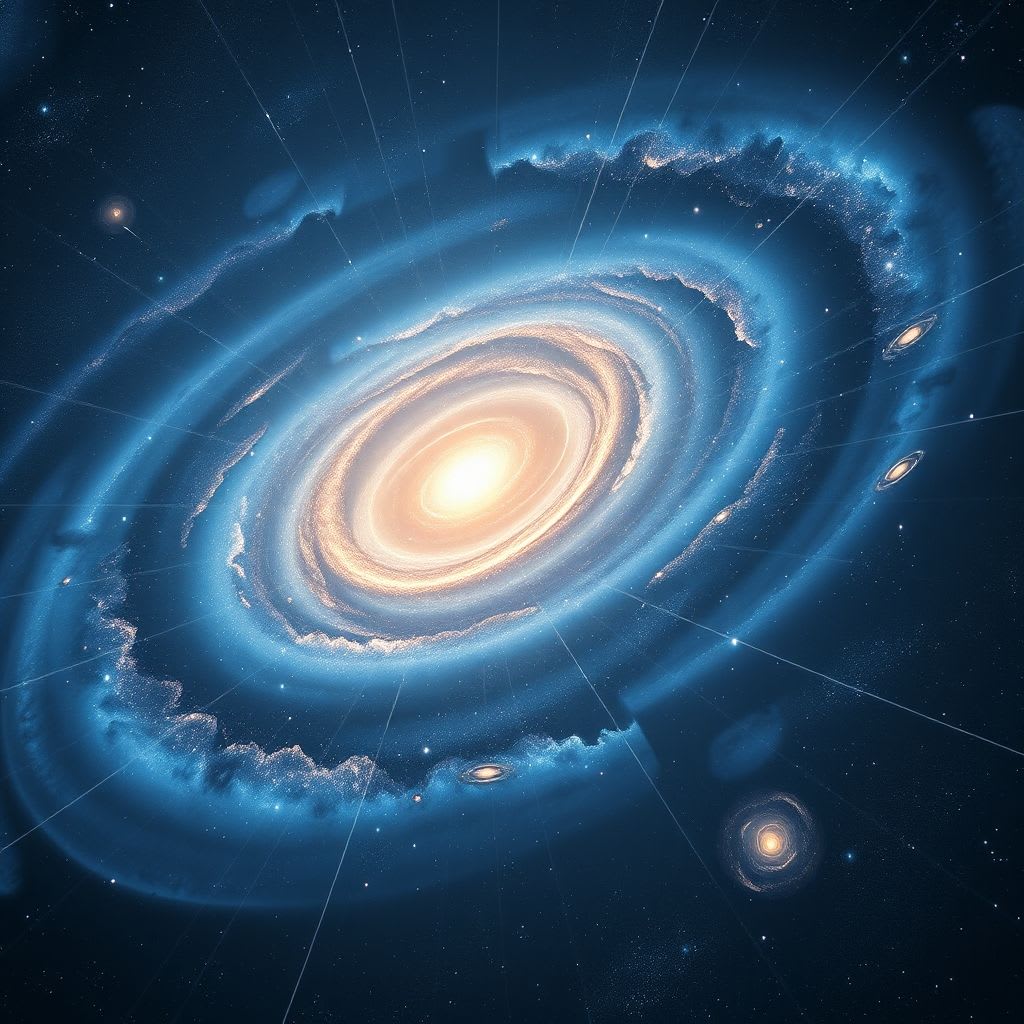
The universe is vast, dynamic, and constantly expanding. It contains incomprehensible forces, staggering distances, and matter unevenly scattered across the cosmic landscape. So why doesn’t it all simply collapse or drift apart into chaos? The answer lies in the intricate balance of physical laws, the invisible forces of gravity, and the surprising roles played by dark matter and dark energy. These elements work together in a delicate harmony, holding the universe in a complex but stable structure.
Gravity: The Cosmic Glue
At the heart of the universe’s cohesion is gravity—the invisible force that pulls all objects with mass toward one another. Gravity is what keeps the Moon orbiting Earth, the planets circling the Sun, and stars bound within galaxies. On even larger scales, it holds entire galaxies within galaxy clusters.
After the Big Bang, matter was flung outward in all directions. But tiny fluctuations in density caused some regions to attract more matter than others. These pockets of attraction eventually formed galaxies, stars, and planets. Gravity acted like a cosmic sculptor, shaping the universe into the structured tapestry we observe today.
Without gravity’s unifying pull, space would be a scattered collection of particles drifting aimlessly. Instead, it binds matter into beautifully organized systems that persist for billions of years.
Expanding, But Not Exploding
We often hear that the universe is expanding—and it is. But this expansion isn't like a traditional explosion where matter flies away from a central point. Instead, it’s the expansion of space itself. The fabric of the universe stretches, carrying galaxies along for the ride.
However, this expansion does not mean the universe is falling apart. Local systems like galaxies, solar systems, and even galaxy clusters remain gravitationally bound. Within these structures, gravity is strong enough to overcome the stretching of space.
Think of it like raisins in a loaf of rising bread. The dough (space) expands, but the raisins (galaxies) stay intact. They may move apart from one another over time, but they don’t fall apart individually.
The Invisible Support of Dark Matter
In the 20th century, astronomers observed something puzzling: galaxies were rotating much faster than expected. According to the known laws of physics, they should have flung themselves apart. But they didn’t. The reason? Dark matter.
Dark matter is a mysterious, invisible substance that doesn’t emit or absorb light, but its gravitational effects are undeniable. It forms massive halos around galaxies and clusters, providing extra "glue" to hold these structures together.
Without dark matter, the gravitational pull of visible matter alone wouldn’t be enough to maintain the integrity of galaxies. They would be too fragile to survive for billions of years. Dark matter acts like an unseen skeleton, providing the strength that visible matter lacks.
Though we still don’t know exactly what dark matter is, its presence is essential for the universe’s stability. It silently anchors cosmic structures, keeping them from drifting apart.
The Strange Role of Dark Energy
If gravity and dark matter are the universe’s binding forces, dark energy is the opposite. Discovered in the late 1990s, dark energy is responsible for the accelerating expansion of the universe. It’s like a cosmic repellent, pushing galaxies away from each other faster and faster.
At first glance, this seems like the force that would cause the universe to unravel. But here’s where things get interesting: on smaller cosmic scales, like within galaxy clusters, gravity still dominates. It's only on enormous scales—between superclusters—that dark energy takes control.
We happen to live in a cosmic moment where gravity and dark energy are in a kind of cosmic tug-of-war. This balance allows galaxies to remain intact and the universe to expand at an accelerating pace—without tearing itself apart.
A Fine-Tuned Universe
Why does this balance exist at all? It's a question that has fascinated physicists and cosmologists for decades. If gravity were just slightly weaker, stars and galaxies might never have formed. If it were stronger, the universe might have collapsed in on itself long ago. And if dark energy had been just a bit more powerful, matter could have been stretched too thin to form anything meaningful.
The universe we live in is extraordinarily finely tuned. The conditions that allow us to exist—and to study the universe at all—depend on an almost perfect harmony between opposing cosmic forces.
Conclusion: A Universe in Harmony
Despite the chaotic appearance of exploding stars, colliding galaxies, and endless expansion, the universe is a deeply balanced system. Gravity binds matter into coherent structures. Dark matter strengthens and stabilizes them. Dark energy stretches the cosmic fabric without tearing apart its contents—at least not yet.
This grand balance is what keeps the universe from falling apart. It’s why galaxies can exist, why stars can shine, and why life on Earth is possible. As we continue to explore the cosmos, we uncover not only its complexity but also its remarkable resilience—a testament to the invisible forces that hold everything together.
And as long as this cosmic equilibrium endures, we’ll keep watching the stars, wondering what else the universe has hidden in its vast and silent design.
About the Creator
Keep reading
More stories from Holianyk Ihor and writers in Futurism and other communities.
How Time Works in Space: From Relativity to the Rhythm of the Universe
Time may seem like one of the most straightforward aspects of life—constantly ticking forward, evenly and reliably. On Earth, we mark it with clocks and calendars, confident that a second here is a second anywhere. But when we look beyond our planet into the vastness of space, time transforms into something far more mysterious. In the cosmos, time is flexible, curved, and deeply dependent on gravity, speed, and the very shape of space itself. Understanding how time works in the universe requires us to go beyond our everyday experience and dive into the strange and beautiful laws that govern reality.
By Holianyk Ihor7 months ago in Futurism
About Binding Prometheus
I want to start actively advocating on behalf of my own work, and the most valuable part of my canon is, without a doubt, Binding Prometheus, the play I have been working on since 2019 and only finished in 2023 as part of my MA. The play itself is an amalgamation of a million different inspirations. On one end, it evokes the Ancient Greek myth-play, deriving its own title from the earliest extant work of Western drama we have, Aeschylus’s Prometheus Bound. On the other end, it borrows significantly from the sci-fi bulwarks from over the years, namely Mary Shelley’s Frankenstein and Karel Capek’s Rossum’s Universal Robots. The play could be an episode of Black Mirror, I fear. I don’t know. I’ve only ever seen one episode of Black Mirror.
By Steven Christopher McKnight17 days ago in Futurism
DIY Furniture Market Size and Forecast 2025–2033
Introduction: The Rise of Hands-On Home Design Furniture is no longer just something we buy—it is increasingly something we build, customize, and take pride in creating. Across the world, consumers are embracing a hands-on approach to home décor, driven by a desire for personalization, affordability, and sustainable living. This shift has given rise to the fast-growing DIY (Do-It-Yourself) furniture market, where flat-pack kits, modular designs, and ready-to-assemble products empower individuals to become co-creators of their living spaces.
By Janine Root 3 days ago in Futurism


Comments
There are no comments for this story
Be the first to respond and start the conversation.