
Why Scientists Are Rethinking What Makes a Planet “Habitable”
Space

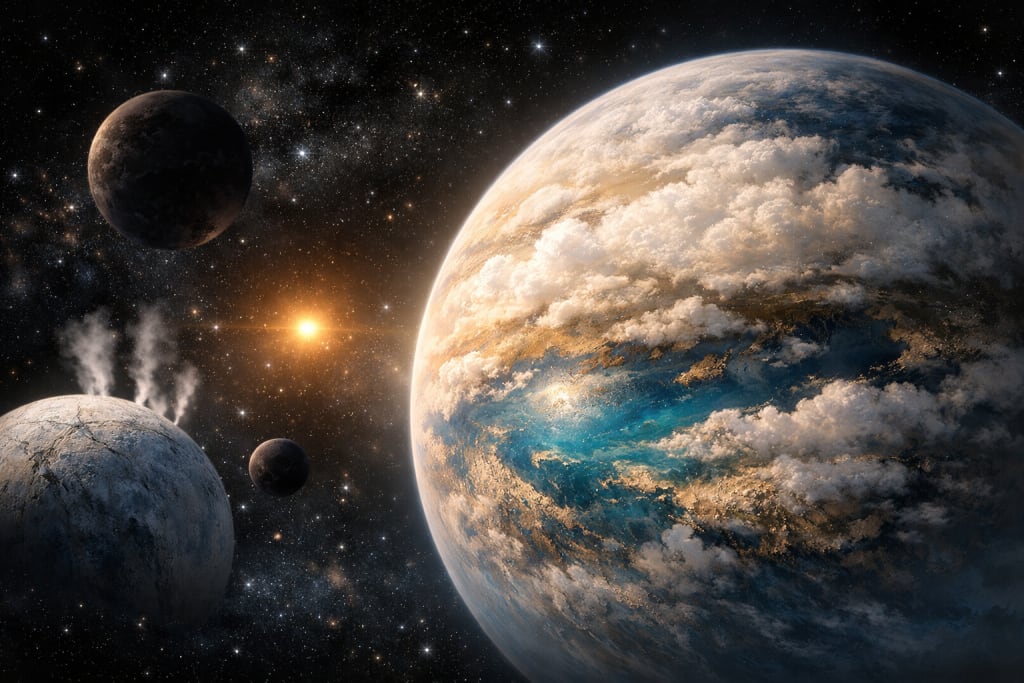
For much of modern scientific history, the idea of a “habitable planet” seemed relatively straightforward. If astronomers wanted to find life beyond Earth, they needed to look for worlds that closely resembled our own: rocky planets, orbiting at just the right distance from their stars, with mild temperatures and liquid water on the surface. This concept shaped decades of research, telescope design, and space missions.
But in recent years, scientists have begun to challenge this once-comfortable definition. As new discoveries pour in from space telescopes, planetary missions, and laboratory experiments, it has become clear that life-friendly conditions may be far more diverse—and far more surprising—than previously imagined.
The Limits of the Traditional “Habitable Zone”
At the heart of the classic definition lies the so-called habitable zone: the region around a star where temperatures allow water to remain liquid on a planet’s surface. Too close, and water evaporates; too far, and it freezes solid. Earth sits neatly within this zone, which made it a useful starting point for planetary science.
However, this model has a major flaw. It assumes that all life must resemble life on Earth. In other words, it treats Earth not as one example, but as the universal standard. As researchers now recognize, this Earth-centered perspective may be overly restrictive—and potentially misleading.
Exoplanets Changed Everything
The discovery of thousands of exoplanets over the past two decades has fundamentally altered our understanding of planetary systems. Astronomers have identified worlds unlike anything in our solar system: planets covered entirely by oceans, massive “super-Earths” with crushing gravity, worlds locked in eternal day and night, and planets orbiting dangerously close to their stars.
Many of these planets fall far outside the classical habitable zone, yet they display complex atmospheres, internal heat, and active chemistry. These findings forced scientists to reconsider a basic assumption: that distance from a star alone determines a planet’s potential for life.
Life Without Sunlight: Lessons from Earth
One of the strongest arguments for redefining habitability comes from life on our own planet. Deep beneath Earth’s oceans, near hydrothermal vents, entire ecosystems thrive without sunlight. These organisms rely on chemical energy released from Earth’s interior, not photosynthesis.
This discovery revolutionized biology—and had profound implications for astronomy. If life on Earth can exist without sunlight, then similar ecosystems might exist elsewhere. Icy moons such as Europa and Enceladus, which harbor subsurface oceans heated by tidal forces, are now considered promising candidates for life, despite being far from the Sun.
The same logic applies to exoplanets and moons orbiting distant stars. Internal heat, not stellar warmth, could be the key factor.
Atmospheres Matter More Than Location
Modern research increasingly shows that a planet’s atmosphere can dramatically alter its surface conditions. Thick atmospheres rich in greenhouse gases can trap heat and maintain warm temperatures even on planets that receive little stellar energy. Conversely, reflective cloud layers can shield planets from intense radiation.
Venus provides a striking example. Long dismissed as a hostile, lifeless world, Venus has recently regained scientific interest. While its surface is unimaginably hot, conditions within its cloud layers—where temperatures and pressures are far more moderate—could theoretically support microbial life. This possibility challenges the idea that surface conditions alone define habitability.
Beyond Water and Carbon
Perhaps the most radical shift in thinking concerns the very nature of life itself. Earth-based life depends on carbon chemistry and liquid water, but scientists now explore the possibility of alternative biochemistries. Some theoretical models suggest that life could exist using ammonia, methane, or other solvents under conditions lethal to terrestrial organisms.
Saturn’s moon Titan, with its methane lakes and complex organic chemistry, has become a testing ground for these ideas. While such life would look nothing like plants or animals, it could still meet fundamental criteria: energy use, metabolism, and reproduction.
This broader perspective dramatically expands the number of worlds that could be considered “habitable.”
Habitability as a Spectrum, Not a Switch
Another important shift is the recognition that habitability is not a simple yes-or-no condition. Instead, it exists along a spectrum. Some planets may be suitable only for microbial life. Others may be habitable only in specific regions or during certain periods of their history.
Mars illustrates this idea well. Today it is cold, dry, and hostile. But evidence suggests that billions of years ago, it had rivers, lakes, and a thicker atmosphere—conditions that may have supported life. Habitability, scientists now argue, can be temporary and evolving.
A New Cosmic Perspective
Reconsidering what makes a planet habitable is more than an academic exercise. It reshapes the search for life in the universe and challenges humanity’s perception of its own uniqueness. If life can arise in environments vastly different from Earth, then the universe may be far more biologically active than once believed.
Today, scientists are no longer asking, “Is this planet Earth-like?” Instead, they are asking a deeper and more open-ended question: “In how many different ways can life exist?”
The answer to that question may redefine our place in the cosmos—and bring us closer than ever to discovering that we are not alone.
About the Creator
Keep reading
More stories from Holianyk Ihor and writers in Futurism and other communities.
Venus Returns: Why the “Hell Planet” Is Back in the Spotlight of Science
For much of the space age, Venus was treated as a cautionary tale rather than a destination of hope. Nearly identical to Earth in size and composition, it once seemed like our planet’s twin. Instead, it turned out to be one of the most hostile worlds in the Solar System. Surface temperatures hot enough to melt lead, crushing atmospheric pressure, clouds of sulfuric acid, and a landscape shaped by catastrophic forces earned Venus its grim nickname: the hell planet.
By Holianyk Ihor4 days ago in Futurism
About Binding Prometheus
I want to start actively advocating on behalf of my own work, and the most valuable part of my canon is, without a doubt, Binding Prometheus, the play I have been working on since 2019 and only finished in 2023 as part of my MA. The play itself is an amalgamation of a million different inspirations. On one end, it evokes the Ancient Greek myth-play, deriving its own title from the earliest extant work of Western drama we have, Aeschylus’s Prometheus Bound. On the other end, it borrows significantly from the sci-fi bulwarks from over the years, namely Mary Shelley’s Frankenstein and Karel Capek’s Rossum’s Universal Robots. The play could be an episode of Black Mirror, I fear. I don’t know. I’ve only ever seen one episode of Black Mirror.
By Steven Christopher McKnight27 days ago in Futurism
Fiber Laser Market: Industrial IoT Integration, Smart Factories & Growth Prospects
Driven by rising demand for precision manufacturing, automotive and electronics production, energy-efficient laser systems, and increasing adoption in cutting, welding, and additive manufacturing applications worldwide. According to IMARC Group's latest research publication, the global fiber laser market size reached USD 3.0 Billion in 2024. Looking forward, IMARC Group expects the market to reach USD 6.1 Billion by 2033, exhibiting a growth rate (CAGR) of 7.8% during 2025-2033.
By Andrew Sullivan7 days ago in Futurism



Comments
There are no comments for this story
Be the first to respond and start the conversation.