
Venus Returns: Why the “Hell Planet” Is Back in the Spotlight of Science
Space

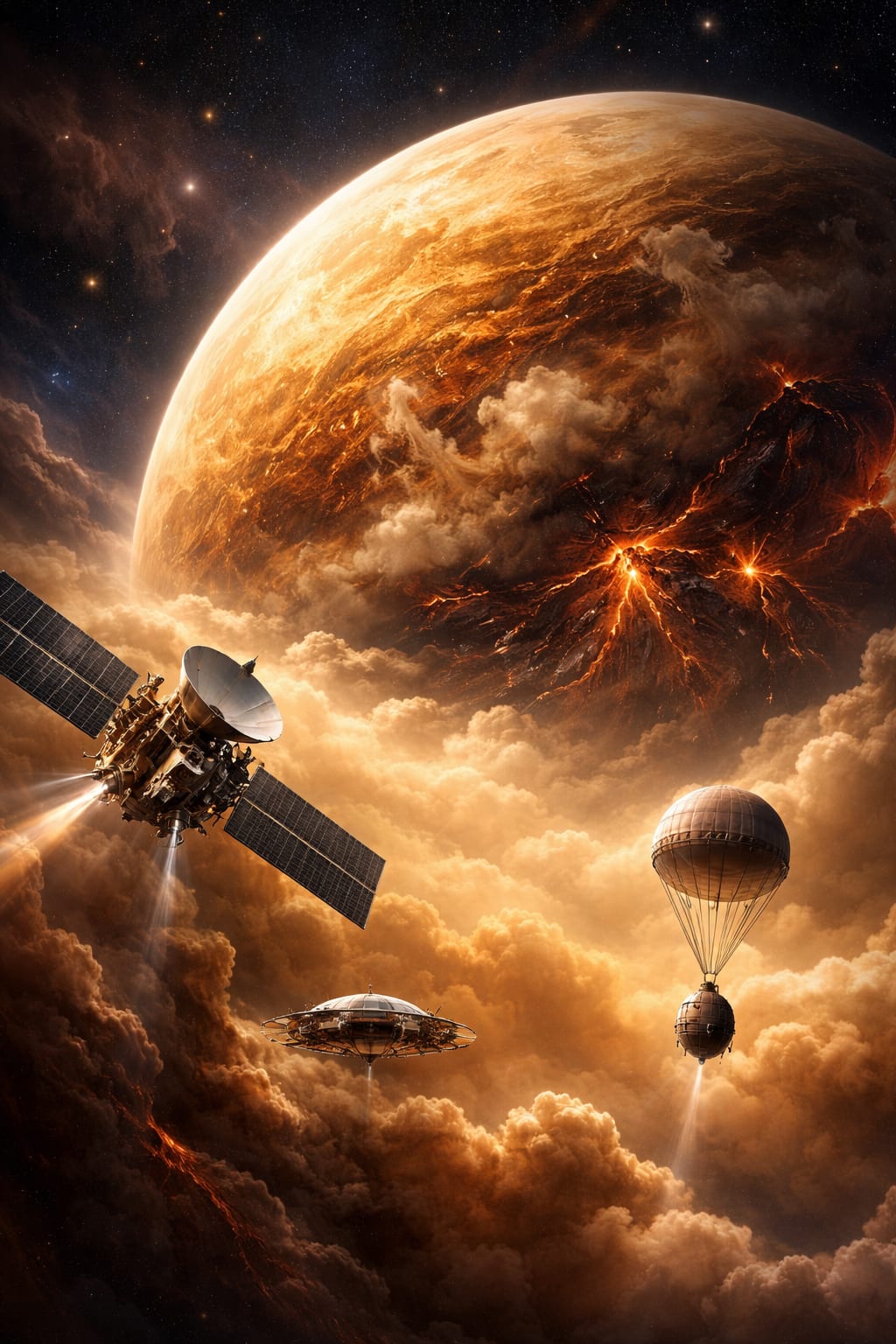
For much of the space age, Venus was treated as a cautionary tale rather than a destination of hope. Nearly identical to Earth in size and composition, it once seemed like our planet’s twin. Instead, it turned out to be one of the most hostile worlds in the Solar System. Surface temperatures hot enough to melt lead, crushing atmospheric pressure, clouds of sulfuric acid, and a landscape shaped by catastrophic forces earned Venus its grim nickname: the hell planet.
For decades, scientists largely turned away from Venus, focusing instead on Mars and the outer moons. But in recent years, something remarkable has happened. Venus is back. New data, fresh interpretations, and bold hypotheses have transformed it from a scientific dead end into one of the most intriguing planets we can study today.
Why Venus Was Considered a Lost Cause
The fall of Venus in scientific priority began in the late 20th century. Soviet missions from the Venera program successfully landed probes on the planet’s surface, but their findings were brutal. The probes survived only minutes before being destroyed by extreme heat and pressure. The data confirmed that the surface environment was utterly inhospitable to life as we know it.
At the same time, Mars offered a more optimistic narrative. Ancient riverbeds, polar ice caps, and the possibility of future human exploration made it far more appealing to both scientists and the public. Venus, by contrast, seemed static, deadly, and technologically frustrating. Electronics struggled to function, landers failed quickly, and the thick atmosphere made imaging difficult.
As a result, Venus was sidelined. For nearly three decades, no major new flagship missions were sent to study it in detail. The planet became known mainly as an example of what happens when climate evolution goes horribly wrong.
What Changed in the Data
The revival of Venus began quietly, with scientists re-examining old data using modern tools. Improved computer models and advanced radar analysis revealed that Venus might not be as geologically dead as once believed. In fact, large portions of its surface appear surprisingly young, suggesting massive resurfacing events in the planet’s recent past.
Further evidence came from the European Space Agency’s Venus Express mission. It detected unusual variations in atmospheric gases such as sulfur dioxide. On Earth, such fluctuations are often linked to volcanic activity. This raised the possibility that Venus is still volcanically active today.
Even more importantly, Venus began to be seen as a critical case study in planetary climate evolution. Many models suggest that Venus may once have had oceans and a temperate climate billions of years ago. At some point, however, it crossed a tipping point, triggering a runaway greenhouse effect that transformed it into the inferno we see today.
Understanding how and why this happened is no longer just about Venus. It has direct implications for Earth’s future and for the study of Earth-like exoplanets orbiting distant stars.
The Controversial Idea of Life in the Clouds
In 2020, Venus shocked the scientific world. Researchers announced the possible detection of phosphine in its atmosphere — a gas that, on Earth, is strongly associated with biological processes. While later studies questioned whether phosphine was truly present, the announcement had a lasting impact.
It forced scientists to reconsider a long-ignored possibility: life not on the surface, but in the clouds.
At altitudes of around 50 to 60 kilometers above Venus’s surface, conditions are surprisingly mild. Temperatures and pressures are comparable to those on Earth. Some researchers now speculate that microbial life could exist within microscopic droplets in the planet’s clouds, protected from extreme heat below and intense radiation above.
This idea of an “aerial biosphere” challenges traditional assumptions about habitability. Even if Venus’s clouds are lifeless, the concept has expanded how scientists think about where life might exist — not just on planetary surfaces, but in atmospheres as well.
New Missions and a New Era of Exploration
Recognizing Venus’s renewed scientific value, space agencies have launched a new wave of missions. NASA approved two major projects: DAVINCI+ and VERITAS. DAVINCI+ will send a probe deep into Venus’s atmosphere, directly measuring its chemical composition and searching for clues about the planet’s ancient climate. VERITAS will use high-resolution radar to map the surface in unprecedented detail, revealing tectonic features and possible signs of active volcanism.
The European Space Agency is preparing EnVision, a mission designed to bridge atmospheric and geological studies. Meanwhile, Russia has proposed the Venera-D project, which could include long-lived landers and balloon-based platforms capable of floating through the atmosphere.
Together, these missions mark the first coordinated return to Venus in generations.
More Than a Hell Planet
Venus is no longer viewed simply as Earth’s failed twin. It is now recognized as a key to answering some of the most profound questions in planetary science: How do planets evolve? What causes worlds to become uninhabitable? And how fragile is Earth’s own climate balance?
The renewed exploration of Venus reminds us that even the most hostile worlds can teach us something vital. The planet once dismissed as a scientific nightmare is now one of the most valuable laboratories in the Solar System.
Venus is speaking again — and this time, we are finally listening.
About the Creator
Keep reading
More stories from Holianyk Ihor and writers in Futurism and other communities.
Children in Space: Science Fiction or an Inevitable Reality?
For decades, the idea of children being born in space belonged firmly to the realm of science fiction. From futuristic novels to blockbuster movies, space-born humans were portrayed as exotic symbols of humanity’s cosmic future. Yet today, this question is slowly moving from imagination into serious scientific and ethical discussion. As plans for long-term missions to the Moon, Mars, and even permanent space settlements gain momentum, one unavoidable issue emerges: if humans are going to live in space for years or generations, what happens to reproduction and childhood beyond Earth?
By Holianyk Ihorabout 18 hours ago in Futurism
About Binding Prometheus
I want to start actively advocating on behalf of my own work, and the most valuable part of my canon is, without a doubt, Binding Prometheus, the play I have been working on since 2019 and only finished in 2023 as part of my MA. The play itself is an amalgamation of a million different inspirations. On one end, it evokes the Ancient Greek myth-play, deriving its own title from the earliest extant work of Western drama we have, Aeschylus’s Prometheus Bound. On the other end, it borrows significantly from the sci-fi bulwarks from over the years, namely Mary Shelley’s Frankenstein and Karel Capek’s Rossum’s Universal Robots. The play could be an episode of Black Mirror, I fear. I don’t know. I’ve only ever seen one episode of Black Mirror.
By Steven Christopher McKnight23 days ago in Futurism
Autonomy Is The Real Privilege
Good morning, freedom-seekers! Today we’re gonna be looking at autonomy. A strange word, I know; one many would probably look at blankly and run away from on sight. We’re gonna figure out what it actually means, consider how it’s achieved, and decipher just how deeply most of us are tangled up in dependence without realising it.
By That ‘Freedom’ Guy4 days ago in Humans



Comments
There are no comments for this story
Be the first to respond and start the conversation.