
Why Don’t Spaceships Use Solar Panels for Propulsion?
Space

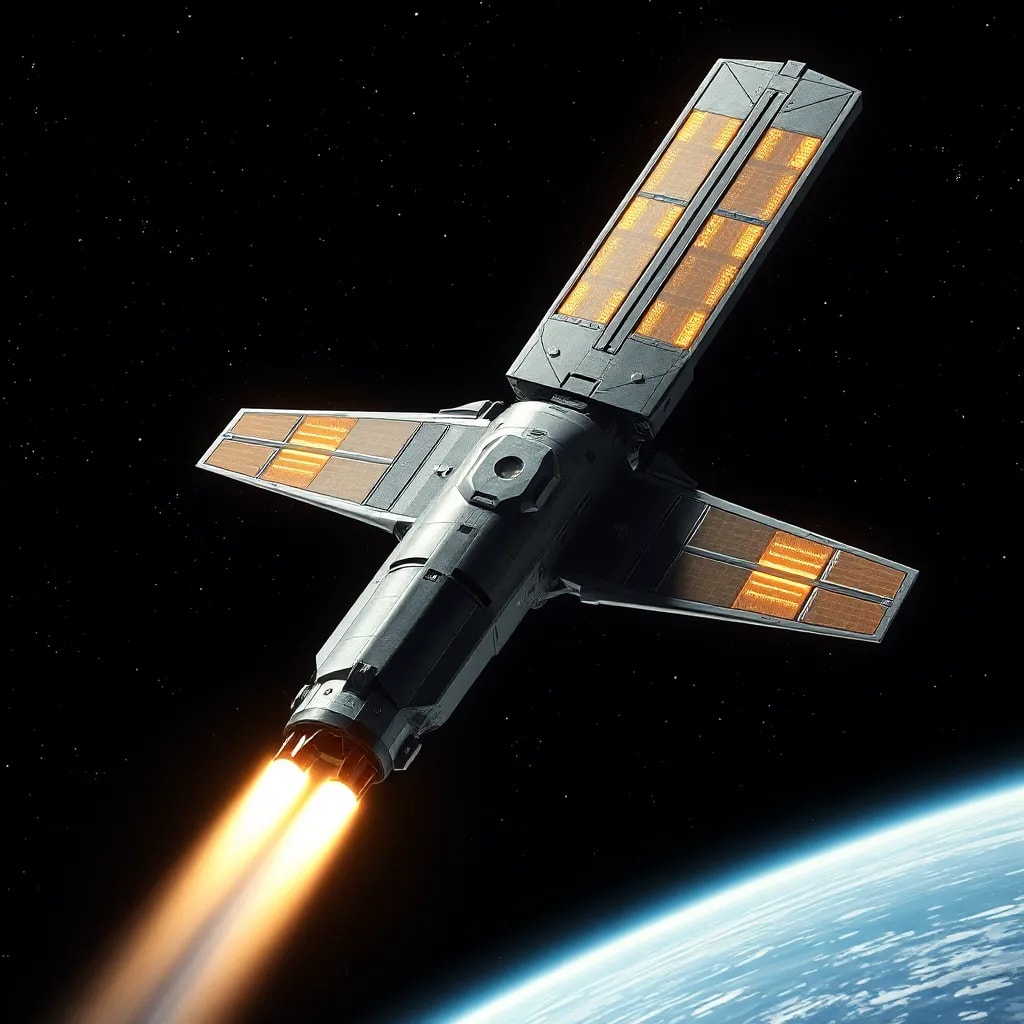
At first glance, it sounds like the perfect idea: space is flooded with sunlight, so why not use solar panels not just to power onboard systems, but also to propel the spacecraft itself? It seems clean, endless, and efficient. But in reality, the situation is far more complicated. Solar panels are excellent for generating electricity but they’re a poor choice for producing thrust. Here’s why.
What Do Solar Panels Actually Do?
Solar panels, or photovoltaic cells, convert sunlight into electricity. This electricity powers communication systems, onboard computers, environmental controls, scientific instruments, and other essential functions. The International Space Station (ISS), for instance, relies entirely on solar energy and performs exceptionally well.
But propulsion is a different beast. Moving a spacecraft especially changing speed or direction requires massive amounts of energy in short bursts. Solar panels simply can’t provide that kind of power.
Why Thrust Requires More Than Just Light
Imagine trying to light a room versus trying to launch a rocket. Lighting a room is easy with a few watts. Launching a rocket? That demands millions of watts, delivered instantly.
Chemical rockets, the ones used to launch spacecraft from Earth or maneuver in space, burn fuel at extremely high rates. This releases gas under immense pressure, which is expelled through nozzles to generate high-thrust propulsion. That’s what gets things moving quickly in the vacuum of space.
Solar panels, on the other hand, produce a low, steady stream of electricity. This is perfect for powering electronics, but not for generating fast, forceful movement. If a spaceship relied solely on solar panels for propulsion, its acceleration would be painfully slow millions of times weaker than Earth’s gravity. Theoretically, it would move... but so slowly that even reaching basic orbital speeds could take years. And course corrections? They’d take months.
What About Ion Engines?
There is a notable exception: ion propulsion. Ion engines do use electricity from solar panels to generate thrust. They work by accelerating ions (charged particles) to high speeds and ejecting them from the spacecraft, creating a gentle but continuous push.
These engines are extremely efficient and ideal for long-term missions. NASA’s Dawn spacecraft used ion propulsion powered by solar energy to explore the asteroids Vesta and Ceres. Over time, that weak but persistent thrust built up enough speed to cross vast distances.
However, ion engines have major limitations:
- They provide very low thrust and can't lift off from Earth.
- They work only in the vacuum of space.
- It takes a lot of time to build up speed.
So while they’re useful, they’re far from a catch-all solution for propulsion.
The Physics Problem
To make solar-based propulsion truly viable, we’d need one of the following:
- Gigantic solar arrays: Increasing the area of solar panels could provide more energy, but it would also add weight and make the spacecraft fragile.
- Super-efficient energy storage: In theory, a ship could collect solar energy over time and release it all at once. But current battery technology can’t store nearly enough to match the energy needed for propulsion.
- Alternative concepts: Such as solar sails, which don’t use electricity at all. Instead, they rely on the pressure of photons (particles of light) to push the spacecraft forward. It’s a fascinating technology and it’s real but it’s suited only for specific types of missions. Speed builds slowly, and it doesn’t work well close to planets or in shadowed regions.
Where Solar Panels Shine
Despite their limitations in propulsion, solar panels are indispensable in space. Here’s where they work best:
- Orbital Satellites: Satellites around Earth use solar panels to power sensors, cameras, and communication systems. They don’t need engines once in orbit.
- Planetary Rovers: NASA’s Opportunity rover on Mars thrived for years on solar power, until a massive dust storm blocked its panels.
- Deep Space Missions: Probes like Juno, currently orbiting Jupiter, use solar energy even that far from the Sun though efficiency drops significantly at that distance.
Conclusion: Reliable, But Not for Thrust
Solar panels are a fantastic energy source for running systems in space. They’re clean, quiet, and long-lasting. But when it comes to propulsion, they fall short. Producing thrust means releasing huge amounts of energy quickly something solar panels simply can’t do. Think of them as a candle: steady and dependable, but not powerful enough to light a rocket engine.
In the future, we might see breakthroughs hybrid systems that combine ion engines, solar sails, nuclear power, or advanced batteries. But for now, traditional chemical propulsion remains the workhorse of space travel, with solar energy playing a supporting (but vital) role.
About the Creator
Keep reading
More stories from Holianyk Ihor and writers in Futurism and other communities.
How Religions Explained the Cosmos Before Telescopes: Myths, Dogmas, and Celestial Mysteries
Long before telescopes, satellites, and astrophysics offered us a glimpse into the true nature of the universe, humanity gazed at the night sky with a mixture of awe and fear. Stars, planets, comets, and the Moon weren’t just distant objects they were divine symbols, messages from the heavens, and pieces of a grand spiritual puzzle. In nearly every culture, the cosmos was explained through the lens of religion and mythology. So how exactly did people understand the universe before science took its first real look through a lens?
By Holianyk Ihor6 months ago in Futurism
About Binding Prometheus
I want to start actively advocating on behalf of my own work, and the most valuable part of my canon is, without a doubt, Binding Prometheus, the play I have been working on since 2019 and only finished in 2023 as part of my MA. The play itself is an amalgamation of a million different inspirations. On one end, it evokes the Ancient Greek myth-play, deriving its own title from the earliest extant work of Western drama we have, Aeschylus’s Prometheus Bound. On the other end, it borrows significantly from the sci-fi bulwarks from over the years, namely Mary Shelley’s Frankenstein and Karel Capek’s Rossum’s Universal Robots. The play could be an episode of Black Mirror, I fear. I don’t know. I’ve only ever seen one episode of Black Mirror.
By Steven Christopher McKnight14 days ago in Futurism
Saudi Arabia Pharmaceuticals Market: Rising Healthcare Demand, Drug Innovation & Growth
According to IMARC Group's latest research publication, the Saudi Arabia pharmaceuticals market size reached USD 9.4 Billion in 2024. The market is projected to reach USD 11.7 Billion by 2033, exhibiting a growth rate of 2.27% during 2025-2033.
By Suhaira Yusuf6 days ago in Futurism
"Hear Me Out"
"Hear me out, what if we ran away together?" "Where do you want to go?" "Anywhere but here. We could move to a new city or to Canada, or we could disappear from society to live in the middle of the woods. Maybe a combination of two of those things would be good. What do you say?"
By Kay Husnick7 days ago in Fiction




Comments
There are no comments for this story
Be the first to respond and start the conversation.